
As product managers navigating the complex landscape of modern software development, we often find ourselves caught between two powerful yet seemingly competing approaches: Use Case 2.0 and User Stories. With over seven years of experience in product management across diverse organizations—from startups to enterprise cloud platforms—I've witnessed teams struggle with this choice, sometimes treating it as an either/or decision when the real opportunity lies in strategic integration.
The debate isn't new, but it's more relevant than ever. On one hand, Use Case 2.0 offers structured thinking about user goals, business workflows, and system interactions—essential for complex domains like the cloud infrastructure products I've worked on at Acme Cloud. On the other hand, User Stories bring agility, customer-centricity, and iterative delivery that align perfectly with Scrum practices (which I've been certified in since 2020).
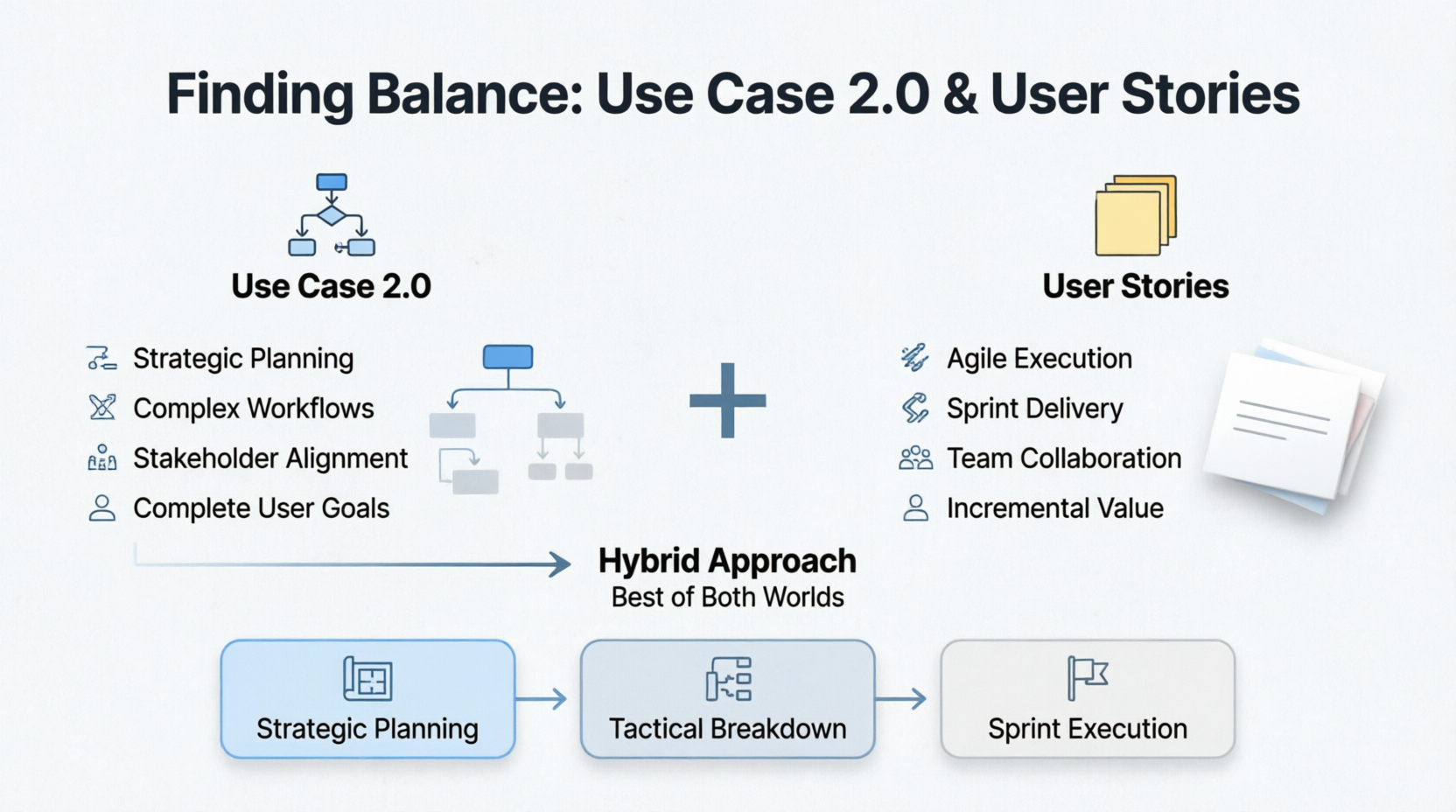
This article explores not just the differences between these approaches, but how they complement each other. We'll examine when each method shines, provide practical examples, and demonstrate through visual models how combining them creates a more robust product development framework. Whether you're roadmapping a new feature, conducting user research, or aligning cross-functional teams, understanding both tools will make you a more versatile and effective product leader.
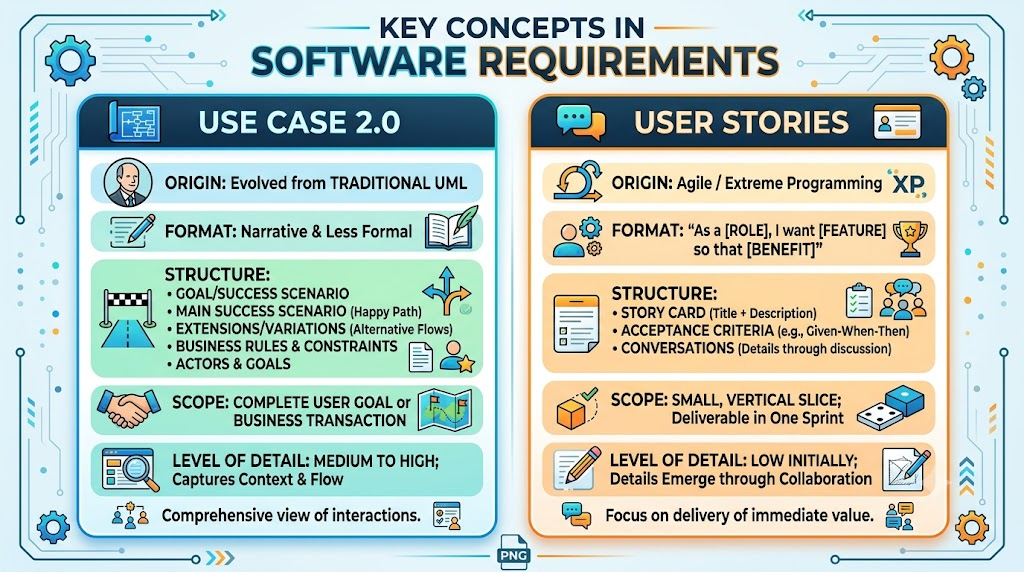
Origin: Evolved from traditional UML use cases (Ivar Jacobson)
Format: More narrative and less formal than traditional use cases
Structure: Includes:
Goal/Success scenario
Main success scenario (happy path)
Extensions/variations (alternative flows)
Business rules and constraints
Actors and their goals
Scope: Typically covers a complete user goal or business transaction
Level of detail: Medium to high; captures context and flow
Origin: Agile/Extreme Programming methodology
Format: Simple, conversational template: "As a [role], I want [feature] so that [benefit]"
Structure:
Story card (title + description)
Acceptance criteria (often in Given-When-Then format)
Conversations (details emerge through discussion)
Scope: Small, vertical slice of functionality deliverable in one sprint
Level of detail: Low initially; details emerge through collaboration
Complex workflows with multiple paths and decision points
Regulatory/compliance requirements need detailed documentation
Cross-team alignment on end-to-end processes
Onboarding new team members who need system context
Stakeholder communication requiring clear business logic
System integration scenarios with multiple actors
Legacy system migration where understanding current flows is critical
Agile development with iterative delivery
Small, well-understood features that fit in a sprint
Team collaboration and conversation-driven development
Rapid prototyping and MVP development
Customer-facing features where value is clear
Experienced teams who can fill in gaps through discussion
Fast-paced environments prioritizing speed over documentation
Absolutely! In fact, combining them often yields the best results:
Use Cases at Epic/Feature Level: Map out major user goals and workflows
User Stories for Implementation: Break use case scenarios into sprint-sized stories
Traceability: Link stories back to use case scenarios for context
Documentation Strategy: Use cases provide "why" and "what"; stories capture "how" incrementally
Use Case: "Process Customer Order"
├── Main Success Scenario
│   ├── Story 1: Add items to cart
│   ├── Story 2: Enter shipping info
│   ├── Story 3: Select payment method
│   └── Story 4: Confirm order
├── Extension: Payment fails
│   └── Story 5: Handle payment retry
└── Extension: Out of stock
    └── Story 6: Notify customer & suggest alternatives
To better illustrate how these concepts work together, here are three PlantUML diagrams showing the relationship between Use Cases and User Stories.
This diagram shows the high-level interactions between actors and the system.
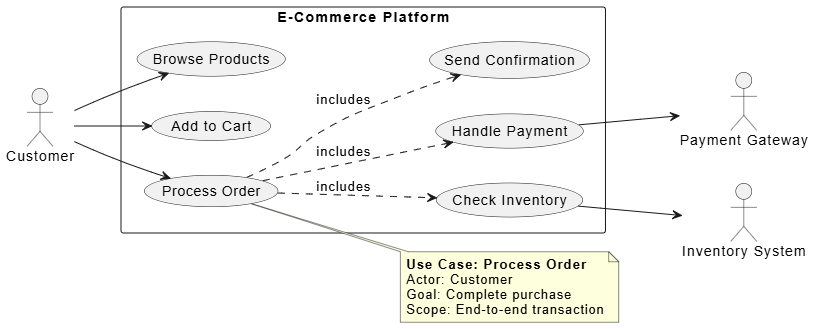
@startuml
left to right direction
skinparam packageStyle rectangle

actor "Customer" as Customer
actor "Payment Gateway" as PaymentGW
actor "Inventory System" as Inventory

rectangle "E-Commerce Platform" {

  usecase "Browse Products" as UC1
  usecase "Add to Cart" as UC2
  usecase "Process Order" as UC3
  usecase "Handle Payment" as UC4
  usecase "Check Inventory" as UC5
  usecase "Send Confirmation" as UC6

  Customer --> UC1
  Customer --> UC2
  Customer --> UC3

  UC3 ..> UC4 : includes
  UC3 ..> UC5 : includes
  UC3 ..> UC6 : includes

  UC4 --> PaymentGW
  UC5 --> Inventory
}

note right of UC3
  <b>Use Case: Process Order</b>
  Actor: Customer
  Goal: Complete purchase
  Scope: End-to-end transaction
end note

@enduml
This diagram illustrates how a single Use Case decomposes into multiple User Stories.
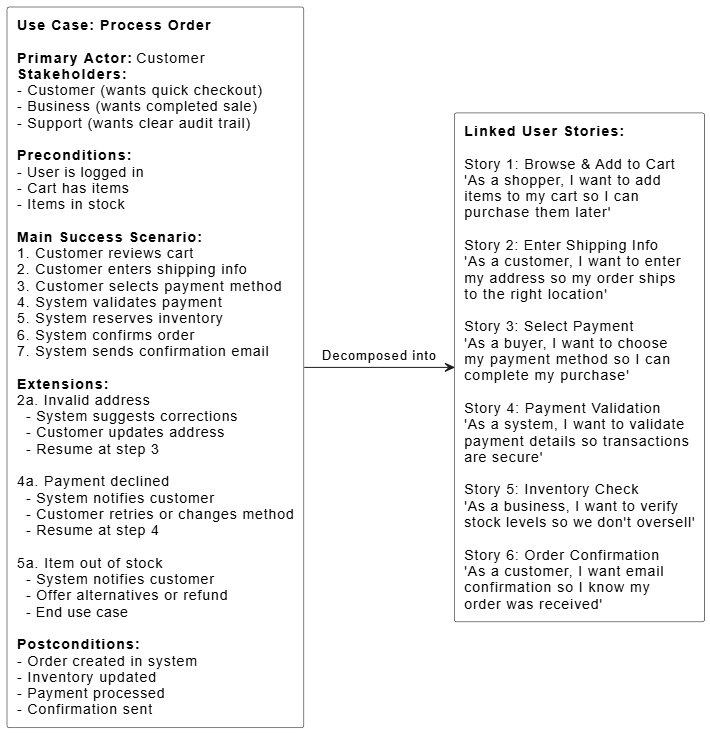
@startuml
skinparam rectangle {
  BackgroundColor White
  BorderColor Black
}

rectangle "<b>Use Case: Process Order</b>\n\n<b>Primary Actor:</b> Customer\n<b>Stakeholders:</b> \n- Customer (wants quick checkout)\n- Business (wants completed sale)\n- Support (wants clear audit trail)\n\n<b>Preconditions:</b>\n- User is logged in\n- Cart has items\n- Items in stock\n\n<b>Main Success Scenario:</b>\n1. Customer reviews cart\n2. Customer enters shipping info\n3. Customer selects payment method\n4. System validates payment\n5. System reserves inventory\n6. System confirms order\n7. System sends confirmation email\n\n<b>Extensions:</b>\n2a. Invalid address\n  - System suggests corrections\n  - Customer updates address\n  - Resume at step 3\n\n4a. Payment declined\n  - System notifies customer\n  - Customer retries or changes method\n  - Resume at step 4\n\n5a. Item out of stock\n  - System notifies customer\n  - Offer alternatives or refund\n  - End use case\n\n<b>Postconditions:</b>\n- Order created in system\n- Inventory updated\n- Payment processed\n- Confirmation sent" as UseCase

rectangle "<b>Linked User Stories:</b>\n\nStory 1: Browse & Add to Cart\n'As a shopper, I want to add\nitems to my cart so I can\npurchase them later'\n\nStory 2: Enter Shipping Info\n'As a customer, I want to enter\nmy address so my order ships\nto the right location'\n\nStory 3: Select Payment\n'As a buyer, I want to choose\nmy payment method so I can\ncomplete my purchase'\n\nStory 4: Payment Validation\n'As a system, I want to validate\npayment details so transactions\nare secure'\n\nStory 5: Inventory Check\n'As a business, I want to verify\nstock levels so we don't oversell'\n\nStory 6: Order Confirmation\n'As a customer, I want email\nconfirmation so I know my\norder was received'" as Stories

UseCase -right-> Stories : Decomposed into

@enduml
This diagram shows the flow from strategic planning through tactical breakdown to sprint execution.
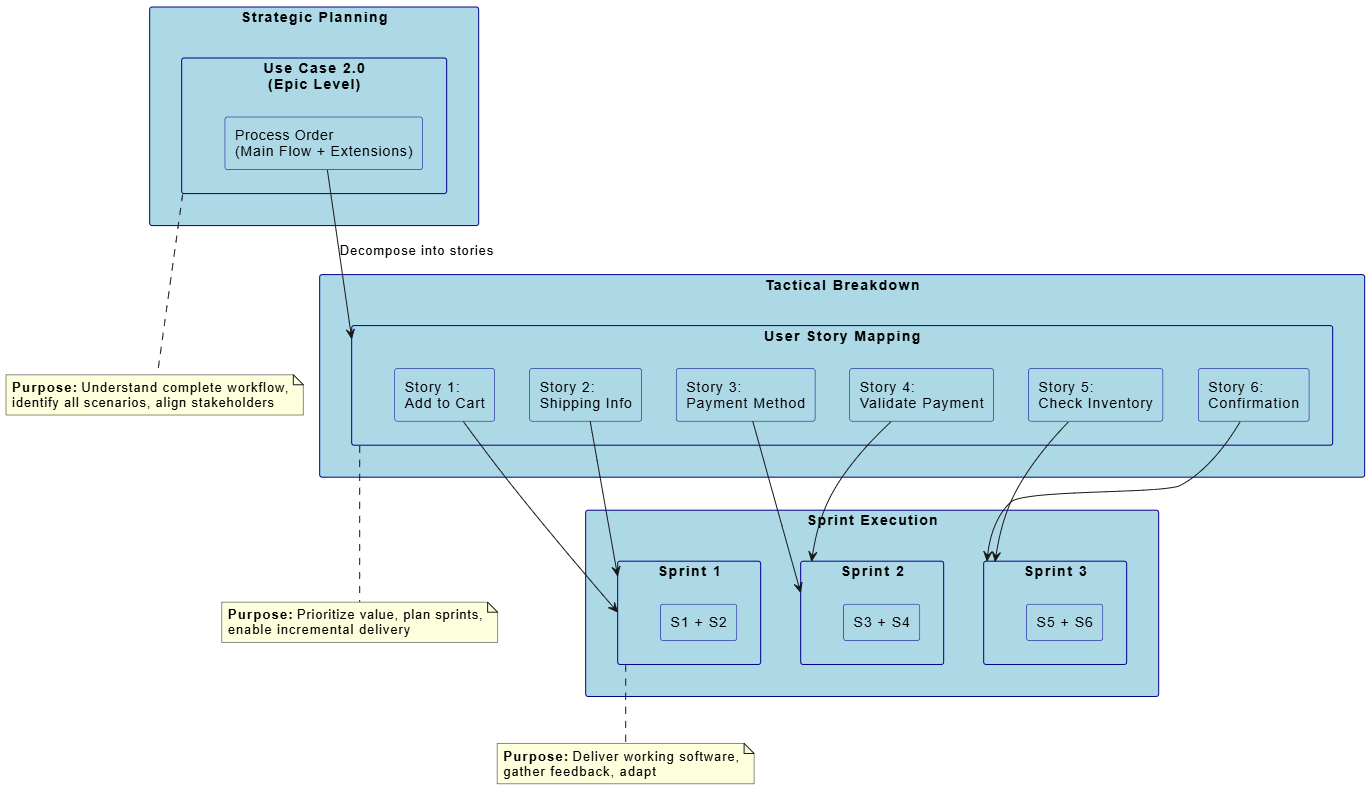
@startuml
skinparam packageStyle rectangle
skinparam rectangle {
  BackgroundColor LightBlue
  BorderColor DarkBlue
}

package "Strategic Planning" {
  rectangle "Use Case 2.0\n(Epic Level)" as UC {
    rectangle "Process Order\n(Main Flow + Extensions)" as MainUC
  }
}

package "Tactical Breakdown" {
  rectangle "User Story Mapping" as USM {
    rectangle "Story 1:\nAdd to Cart" as S1
    rectangle "Story 2:\nShipping Info" as S2
    rectangle "Story 3:\nPayment Method" as S3
    rectangle "Story 4:\nValidate Payment" as S4
    rectangle "Story 5:\nCheck Inventory" as S5
    rectangle "Story 6:\nConfirmation" as S6
  }
}

package "Sprint Execution" {
  rectangle "Sprint 1" as Sprint1 {
    rectangle "S1 + S2" as SP1
  }
  rectangle "Sprint 2" as Sprint2 {
    rectangle "S3 + S4" as SP2
  }
  rectangle "Sprint 3" as Sprint3 {
    rectangle "S5 + S6" as SP3
  }
}

MainUC --> USM : Decompose into stories
S1 --> Sprint1
S2 --> Sprint1
S3 --> Sprint2
S4 --> Sprint2
S5 --> Sprint3
S6 --> Sprint3

note bottom of UC
  <b>Purpose:</b> Understand complete workflow,
  identify all scenarios, align stakeholders
end note

note bottom of USM
  <b>Purpose:</b> Prioritize value, plan sprints,
  enable incremental delivery
end note

note bottom of Sprint1
  <b>Purpose:</b> Deliver working software,
  gather feedback, adapt
end note

@enduml
There's no universal "best"—it depends on context:
| Factor | Favors Use Case 2.0 | Favors User Stories |
|---|---|---|
| Team experience | Mixed/new teams | Experienced agile teams |
| Project complexity | High | Low to medium |
| Regulatory needs | Yes | No |
| Delivery speed | Less critical | Critical |
| Documentation needs | High | Minimal |
| Stakeholder involvement | Formal reviews needed | Collaborative workshops |
| System type | Enterprise/B2B | Consumer/SaaS |
Given your experience as a Senior Product Manager with expertise in roadmapping and product design, I'd recommend:
For strategic planning: Use Use Case 2.0 to map customer journeys and identify opportunities
For execution: Use User Stories for sprint planning and backlog management
For complex domains (like your cloud platform work at Acme Cloud): Start with use cases to understand workflows, then decompose into stories
For stakeholder communication: Use cases help non-technical stakeholders understand the big picture
For team velocity: Stories keep development moving forward iteratively
Tiered Documentation Approach:
Tier 1 (Strategic): Use Case diagrams for major capabilities
Tier 2 (Tactical): Use Case 2.0 narratives for epics/features
Tier 3 (Operational): User stories for sprint execution
Tier 4 (Technical): Acceptance criteria and technical specs
This gives you the rigor of use cases where needed and the agility of stories where appropriate.
The choice between Use Case 2.0 and User Stories isn't about picking a winner—it's about recognizing that each tool serves different purposes in the product development lifecycle. Through my journey from Associate Product Manager at Northstar Tech to Senior Product Manager at Acme Cloud, I've learned that the most successful products emerge from teams that leverage both approaches strategically.
Use Case 2.0 excels at providing the architectural blueprint: it helps us understand complex workflows, identify edge cases, ensure regulatory compliance, and communicate vision to stakeholders who need the big picture. It's particularly valuable in enterprise environments like cloud platforms where multiple systems interact and business rules are intricate.
User Stories, meanwhile, bring the human element and agility: they keep us focused on customer value, enable rapid iteration, foster team collaboration, and allow us to adapt quickly based on feedback. They're essential for maintaining momentum in agile environments and ensuring we deliver value incrementally.
The hybrid approach—using Use Cases for strategic planning and epics, then decomposing them into User Stories for sprint execution—gives us the best of both worlds. This tiered documentation strategy provides rigor where needed without sacrificing agility. As product managers with backgrounds in both technical fields (like my Computer Science degree from UC Berkeley) and human-centered design (my HCI Master's from Carnegie Mellon), we're uniquely positioned to bridge these methodologies.
Remember: tools serve outcomes. Whether you're roadmapping features, conducting user research, or designing product experiences, choose the approach—or combination—that best serves your users, your team, and your business goals. The mark of a mature product organization isn't rigid adherence to one methodology, but the wisdom to apply the right tool at the right time.

