
In the modern healthcare landscape, seamless digital interaction between patients and healthcare providers is no longer a luxury but a necessity. This comprehensive case study explores the end-to-end development of Project HealthConnect, a unified patient portal system designed for a mid-sized regional hospital network. By leveraging Agile methodologies, User Stories, and Unified Modeling Language (UML) diagrams, this project demonstrates how to deliver a secure, user-centric, and scalable IT solution within a strict 6-month timeframe and a defined budget.
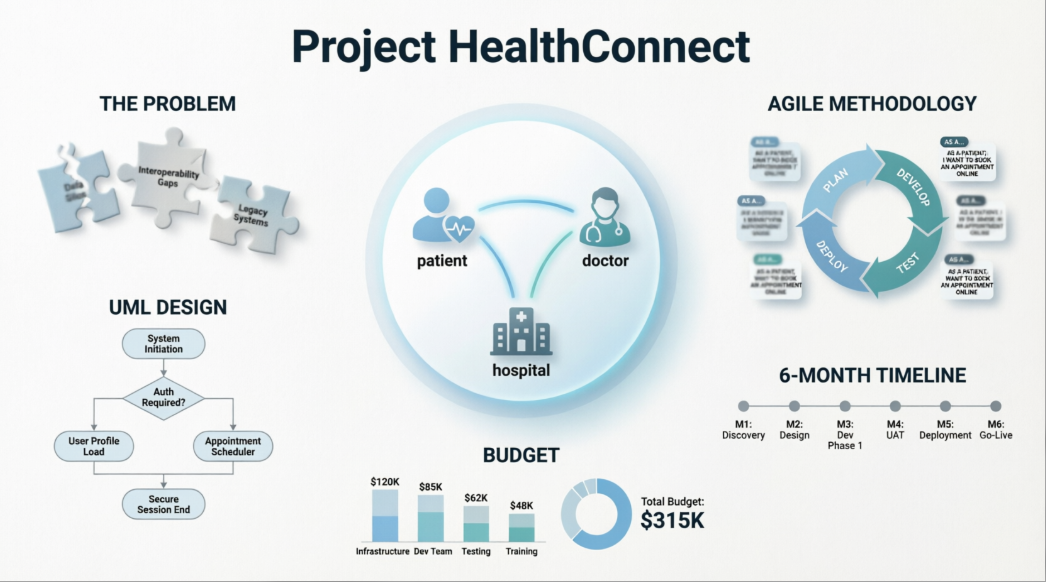
The hospital network currently relies on three disjointed legacy systems: one for appointment scheduling, another for electronic health records (EHR), and a third for patient billing.
Fragmented User Experience: Patients must navigate multiple portals with different credentials to book appointments, view lab results, and pay bills, leading to frustration and low adoption rates.
Operational Inefficiency: The call center is overwhelmed with routine inquiries (e.g., "What are my lab results?"), leading to long wait times, staff burnout, and high operational costs.
Data Silos: Clinicians lack a unified dashboard to view a patient’s upcoming appointments alongside their latest lab results, slowing down clinical decision-making.
Security Risks: Outdated legacy systems lack modern encryption and multi-factor authentication (MFA), posing significant compliance risks with healthcare data regulations (e.g., HIPAA).
Develop "HealthConnect," a centralized, cloud-native patient and provider portal that unifies scheduling, secure messaging, and lab result viewing into a single, secure, and intuitive interface.
To ensure the project's success, the development team will utilize the following core concepts:
Agile Scrum Framework: Iterative development in 4-week sprints, allowing for continuous feedback, rapid adaptation to changing requirements, and incremental delivery of value.
MVP (Minimum Viable Product): Delivering core functionalities (Authentication, Appointments, Messaging) first, with advanced features (Billing, Telehealth) phased for later releases.
CI/CD (Continuous Integration/Continuous Deployment): Automated testing and deployment pipelines to ensure rapid, reliable, and secure software delivery.
UML (Unified Modeling Language): Visual modeling to define system architecture, actor interactions, and data flow before coding begins, ensuring alignment between technical and non-technical stakeholders.
Requirements in this project are captured using a dual approach: User Stories for granular, value-driven backlog items, and Use Case Diagrams for high-level system scoping.
User stories form the actionable backbone of the Agile development process, focusing on the end-user's perspective.
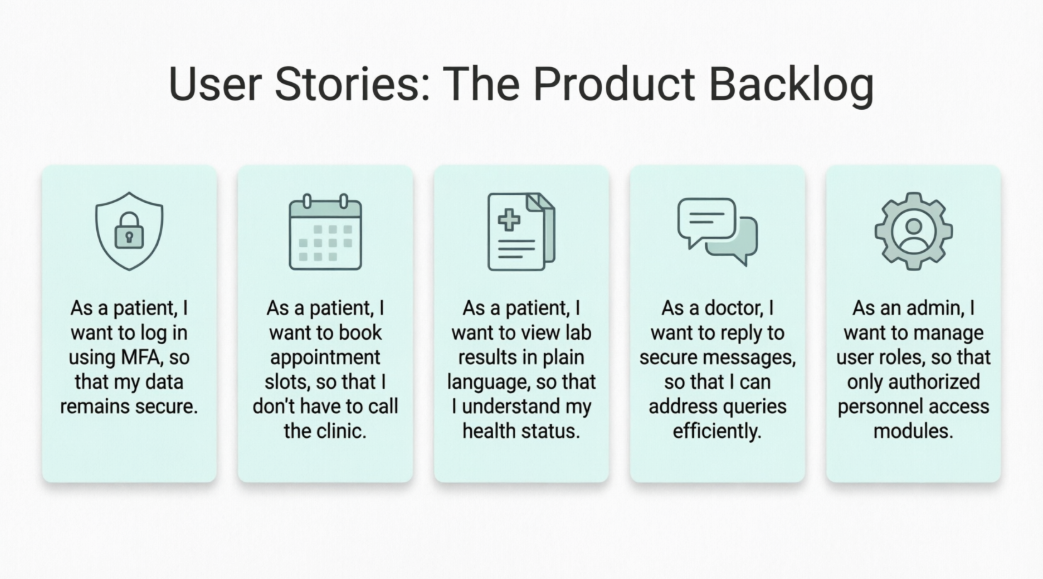
Authentication: As a patient, I want to log in using Multi-Factor Authentication (MFA), so that my sensitive health data remains secure.
Appointments: As a patient, I want to view and book available appointment slots with my primary care physician, so that I do not have to call the clinic.
Lab Results: As a patient, I want to view my recent lab results in plain language, so that I can understand my health status before my follow-up visit.
Messaging: As a doctor, I want to receive and reply to secure messages from my patients, so that I can address non-urgent queries efficiently.
Administration: As a system admin, I want to manage user roles and permissions, so that only authorized personnel can access specific modules.
The Use Case Diagram provides a visual representation of the system's boundaries, actors, and major functionalities.
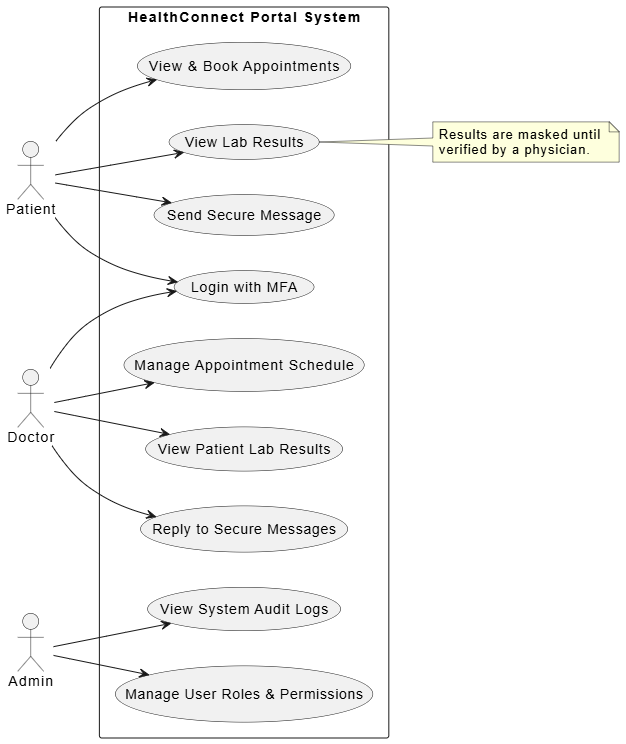
@startuml
left to right direction
skinparam packageStyle rectangle

actor Patient
actor Doctor
actor Admin

rectangle "HealthConnect Portal System" {
  Patient --> (Login with MFA)
  Patient --> (View & Book Appointments)
  Patient --> (View Lab Results)
  Patient --> (Send Secure Message)

  Doctor --> (Login with MFA)
  Doctor --> (Manage Appointment Schedule)
  Doctor --> (View Patient Lab Results)
  Doctor --> (Reply to Secure Messages)

  Admin --> (Manage User Roles & Permissions)
  Admin --> (View System Audit Logs)
}

note right of (View Lab Results)
  Results are masked until
  verified by a physician.
end note
@enduml
In Agile development, User Stories and Use Case Diagrams are highly complementary. They exist at different levels of abstraction but work together to ensure the system is both well-scoped and deeply aligned with user needs.
Mapping (One-to-Many Relationship): A single "Use Case" (e.g., View & Book Appointments) represents a broader feature or epic. This is broken down into multiple, granular User Stories in the backlog (e.g., Story 1: View available slots, Story 2: Receive email confirmation, Story 3: Doctor blocks out time off).
Scope vs. Detail: Use Case Diagrams define the boundary (answering "Who interacts with the system and what are the major functions?"). User Stories define the value and acceptance criteria (answering "Why are we building this, and how do we test it?").
Validation and Gap Analysis: They act as a quality check for each other. If a User Story cannot be mapped to a Use Case, it may be out of scope. Conversely, if a Use Case exists in the diagram but has no corresponding User Stories, that feature is at risk of being forgotten during development.
Example from HealthConnect: The Use Case Diagram visually establishes that Patients interact with "View Lab Results" and notes a business rule (masked until verified). The corresponding User Story gives the developer the exact "who, what, and why," plus testable conditions (e.g., "Results show 'Pending' if unverified").
Beyond scoping, UML is used to define the static structure and dynamic behavior of the system.
Defines the system's entities, attributes, and relationships, forming the basis for the database schema and object-oriented design.
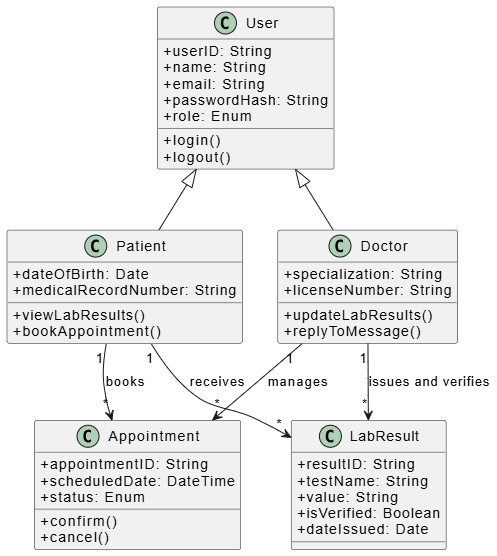
@startuml
skinparam classAttributeIconSize 0

class User {
  +userID: String
  +name: String
  +email: String
  +passwordHash: String
  +role: Enum
  +login()
  +logout()
}

class Patient {
  +dateOfBirth: Date
  +medicalRecordNumber: String
  +viewLabResults()
  +bookAppointment()
}

class Doctor {
  +specialization: String
  +licenseNumber: String
  +updateLabResults()
  +replyToMessage()
}

class Appointment {
  +appointmentID: String
  +scheduledDate: DateTime
  +status: Enum
  +confirm()
  +cancel()
}

class LabResult {
  +resultID: String
  +testName: String
  +value: String
  +isVerified: Boolean
  +dateIssued: Date
}

User <|-- Patient
User <|-- Doctor
Patient "1" --> "*" Appointment : books
Doctor "1" --> "*" Appointment : manages
Patient "1" --> "*" LabResult : receives
Doctor "1" --> "*" LabResult : issues and verifies
@enduml
Details the step-by-step flow of a specific use case, ensuring all system components interact correctly. Below is the flow for a patient booking an appointment.
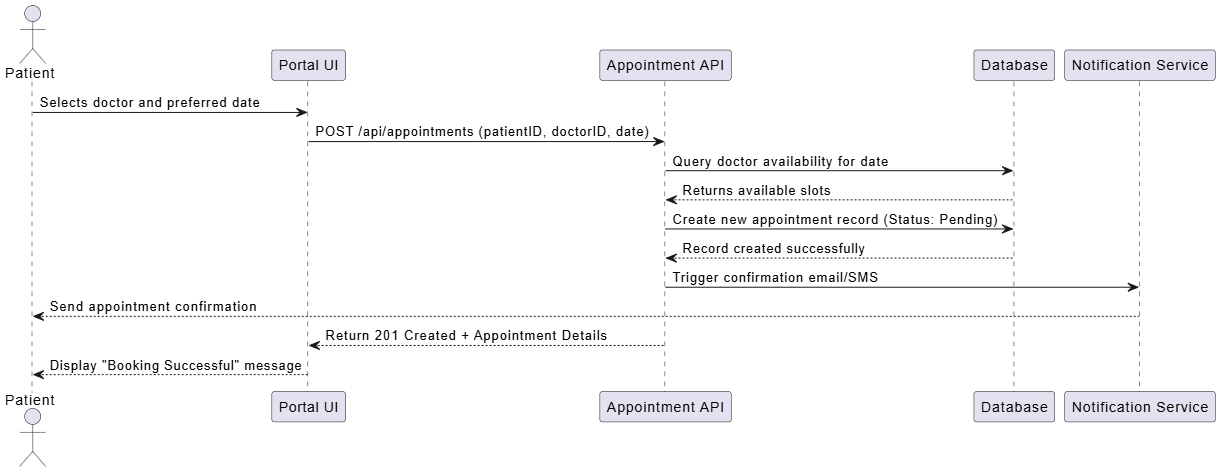
@startuml
actor Patient
participant "Portal UI" as UI
participant "Appointment API" as API
participant "Database" as DB
participant "Notification Service" as NS

Patient -> UI : Selects doctor and preferred date
UI -> API : POST /api/appointments (patientID, doctorID, date)
API -> DB : Query doctor availability for date
DB --> API : Returns available slots
API -> DB : Create new appointment record (Status: Pending)
DB --> API : Record created successfully
API -> NS : Trigger confirmation email/SMS
NS --> Patient : Send appointment confirmation
API --> UI : Return 201 Created + Appointment Details
UI --> Patient : Display "Booking Successful" message
@enduml
The project will be executed over 6 months (July 2026 – December 2026), divided into six 4-week sprints to ensure steady progress and regular stakeholder review.
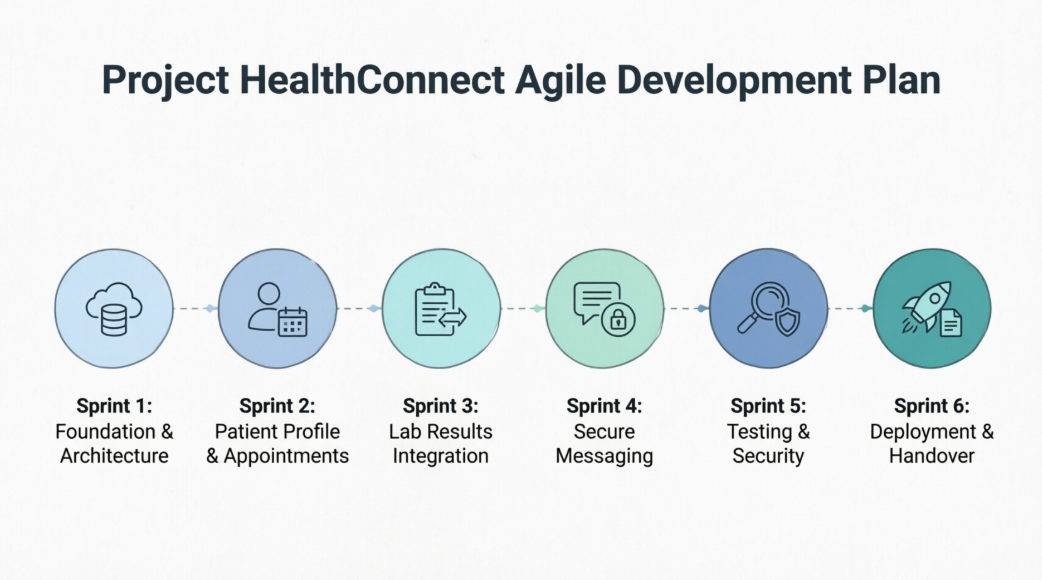
Sprint 1 (July 2026): Foundation & Architecture
Setup cloud infrastructure (AWS/Azure), CI/CD pipelines, and database schema.
Implement core User Authentication (with MFA) and Role-Based Access Control (RBAC).
Sprint 2 (August 2026): Patient Profile & Appointments
Develop patient profile management.
Build appointment viewing and booking APIs and UI components.
Sprint 3 (September 2026): Lab Results Integration
Integrate with the existing legacy EHR via secure HL7/FHIR APIs.
Build the lab results dashboard with plain-language explanations.
Sprint 4 (October 2026): Secure Messaging
Develop the internal messaging system between patients and doctors.
Implement read receipts and notification triggers.
Sprint 5 (November 2026): Testing, Security & UAT
Comprehensive QA testing, penetration testing, and HIPAA compliance audit.
User Acceptance Testing (UAT) with a pilot group of 50 patients and 10 doctors.
Sprint 6 (December 2026): Deployment & Handover
Phased production rollout.
Staff training, documentation finalization, and transition to the maintenance team.
The estimated budget for the 6-month development cycle is structured to cover personnel, infrastructure, compliance, and operational overhead.
| Category | Description | Estimated Cost (USD) |
|---|---|---|
| Personnel | 1 Scrum Master, 2 Backend Devs, 2 Frontend Devs, 1 QA Engineer, 1 UX/UI Designer (6 months) | $120,000 |
| Infrastructure | Cloud hosting, database instances, load balancers, and automated backup storage | $12,000 |
| Security & Compliance | Third-party penetration testing, HIPAA compliance audit, MFA licensing | $8,000 |
| Tools & Licensing | Jira, Confluence, GitHub Enterprise, Figma, monitoring tools (e.g., Datadog) | $5,000 |
| Training & Change Mgmt | Creation of user manuals, video tutorials, and clinical staff training sessions | $5,000 |
| Contingency Fund | 15% buffer for unforeseen scope changes, technical debt resolution, or delays | $22,500 |
| Total Estimated Budget | $172,500 |
Project HealthConnect serves as a prime example of how combining Agile methodologies with rigorous UML modeling and user-centric User Stories can effectively solve complex, real-world IT system problems.
By utilizing Use Case Diagrams to establish clear system boundaries and User Stories to drive granular, value-based development, the team ensures that no requirement is lost in translation. Breaking the development into manageable 4-week sprints guarantees continuous delivery of value, early detection of flaws, and the flexibility to adapt to stakeholder feedback.
The resulting unified portal will drastically reduce call center volume, empower patients with easy, secure access to their health data, and provide doctors with a streamlined clinical workflow. Ultimately, this structured, Agile-driven approach guarantees a secure, scalable, and compliant system delivered on time and within the projected $172,500 budget, setting a new standard for digital healthcare engagement in the network.

