
Hello! If you're new to Enterprise Architecture (EA) or have heard about TOGAF but found it intimidating, you've come to the right place. This tutorial is designed specifically for absolute beginners. We'll walk through what's new in TOGAF 10, why it matters, and how you can start using it—without getting lost in jargon.
Think of this as your friendly roadmap to understanding one of the world’s most popular frameworks for organizing and improving business IT systems.
TOGAF (The Open Group Architecture Framework) is like a playbook for building and managing an organization’s technology and business structure. Version 10 is the latest update, designed to be easier to use, more flexible, and better suited for today’s fast-paced digital world.
In the past (TOGAF 9.2), the framework was one massive document. It was comprehensive but hard to navigate and slow to update. TOGAF 10 changes that by splitting the content into two parts: a stable core and flexible guides. This means you get reliable fundamentals plus up-to-date advice on modern topics like Agile, Cloud, and Security.
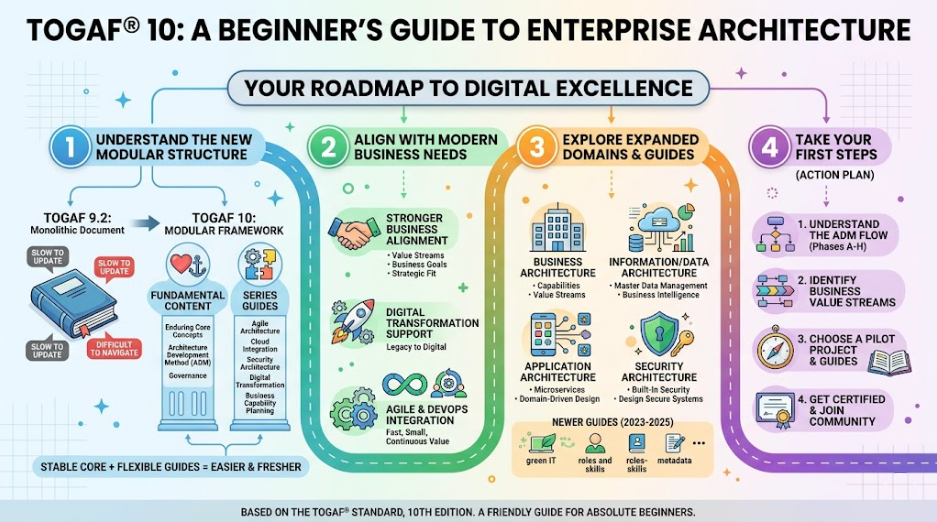
Imagine if every time your phone got a small software update, you had to buy a whole new phone. That was the old way. TOGAF 10 uses modularity. The core rules stay the same, but additional guidance comes in separate "Series Guides." This makes it easier to find what you need and keeps the framework fresh.
No more hunting through hundreds of pages. Content is now organized logically:
Fundamental Content: The essential rules and methods.
Series Guides: Practical advice on specific topics (like Agile or Security).
Old versions had repeated information. TOGAF 10 cleans this up, so you spend less time reading the same thing twice and more time applying it.
TOGAF 10 rests on two main components. Think of them as the foundation and the customizable rooms of a house.
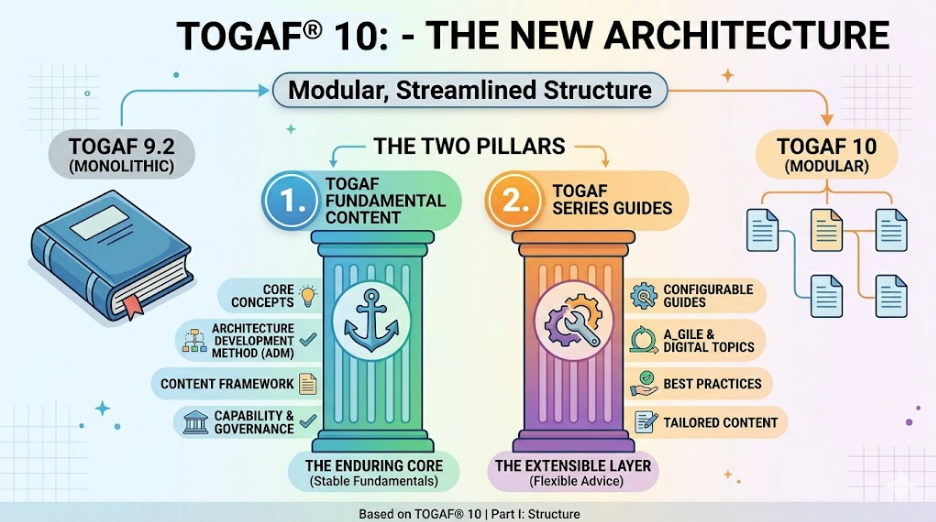
This is the heart of TOGAF. It includes:
Core Concepts: Basic terms and ideas (e.g., what is an "architecture"?).
Architecture Development Method (ADM): A step-by-step process for creating architecture. We’ll dive deeper into this later.
Architecture Content Framework: What documents and models you should create.
Enterprise Architecture Capability & Governance: How to set up your EA team and manage decisions.
Key Takeaway: This part doesn’t change often. It’s your reliable anchor.
These are optional but highly recommended guides that provide best practices for specific situations. Examples include:
Agile Architecture
Digital Transformation
Security Architecture
Cloud Integration
Key Takeaway: Pick and choose the guides that match your company’s needs. You don’t need to read them all at once.
TOGAF 10 isn’t just about IT—it’s about business value.
Learn how to use EA to support moving from legacy systems to digital-first operations.
Old EA was seen as slow and rigid. TOGAF 10 shows how to work with Agile teams, delivering value in small increments rather than waiting years for a big bang release.
It starts with why. TOGAF 10 helps you map out Value Streams (the steps a business takes to deliver value to customers) and align technology to support them.
EA is divided into four domains. TOGAF 10 gives each one more attention:
Focuses on Business Capabilities (what the business does) and Value Streams (how it delivers value). This ensures IT supports real business goals.
Covers Master Data Management, Metadata, and Business Intelligence. In short: how to manage data as a valuable asset.
Includes modern approaches like Microservices and Domain-Driven Design. This helps break down large, clunky applications into smaller, manageable pieces.
Security is no longer an afterthought. There’s dedicated guidance for designing secure systems from the start.
Focuses on Cloud Integration and Platform Thinking. Learn how to leverage cloud services and build reusable technology platforms.
Here are some of the newest guides you might find useful:
Information Architecture: Business Intelligence & Analytics: How to turn data into insights.
Information Architecture: Metadata Management: Understanding your data’s context.
Business Capability Planning: Mapping what your business can do.
Environmentally Sustainable Information Systems: Green IT practices.
Architecture Roles and Skills: What jobs exist in EA and what skills they need.
An Approach to Selecting Building Blocks: How to choose reusable components.
Because the Series Guides are separate, The Open Group can update them quickly as technology changes. No more waiting years for a new version.
TOGAF 10 works well with other standards from The Open Group, creating a cohesive ecosystem.
Even after release, small fixes and clarifications are made. The 2025 update ensures everything is clear and correct.
Read the Fundamental Content: Start with the ADM (Architecture Development Method).
Pick One Series Guide: Choose a topic relevant to your current project (e.g., Agile or Security).
Get Certified: Consider taking the TOGAF 10 Foundation exam to validate your knowledge.
| Aspect | TOGAF 9.2 | TOGAF 10 |
|---|---|---|
| Core Focus | A single, comprehensive specification | A modular core with extensible guides |
| Flexibility | One-size-fits-all approach | Configurable to specific needs |
| Documentation | Monolithic, difficult to update | Modular "Fundamental Content" + "Series Guides" |
| Agility | Limited guidance on Agile | Full Series Guides on Agile and Digital Transformation |
| Evolution | Slow to release updates | Series Guides allow for continuous updates |
Understand the ADM: The Architecture Development Method is the core process. It has phases (A-H) that guide you from vision to implementation. Don’t memorize them all at once—just understand the flow.
Identify Your Business Value Streams: Talk to business stakeholders. What are the key steps they take to serve customers? Map these out.
Choose a Pilot Project: Apply TOGAF 10 concepts to a small, manageable project. Use the Series Guides that fit your needs.
Join the Community: Connect with other EA practitioners online or through The Open Group.
TOGAF 10 is designed to be practical, flexible, and relevant. You don’t need to implement everything at once. Start small, focus on business value, and use the modular guides to adapt the framework to your situation.

