
Welcome to the world of Enterprise Architecture. If you’ve never worked with business strategy, IT planning, or systems design, don’t worry. This guide is written from the ground up for absolute beginners. We’ll walk through each concept step by step, using plain language and real-world examples, so you can understand how organizations plan, design, and manage their technology and business structures effectively.
By the end of this tutorial, you’ll know what Enterprise Architecture is, why companies invest in it, how the TOGAF framework works, and how all the pieces fit together in practice.
Before we talk about architecture, we need to clarify what we’re architecting.
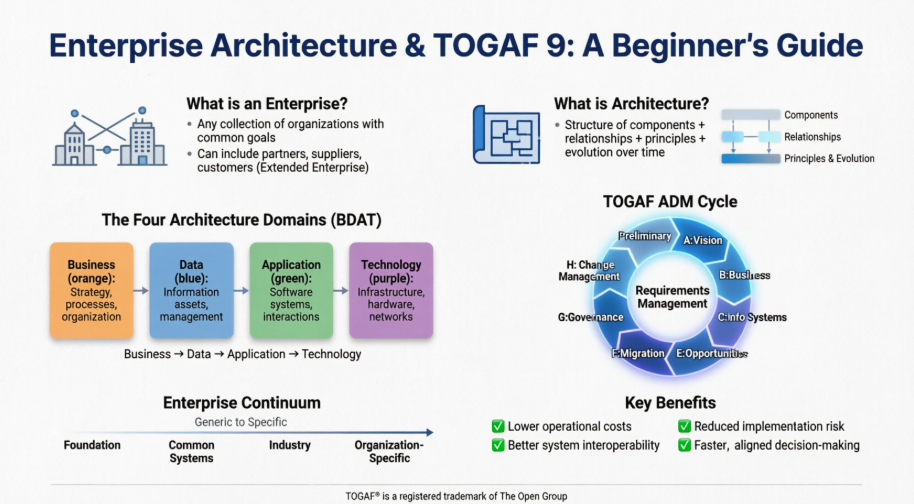
In everyday language, "enterprise" often means a large corporation. In architecture, it means something broader: any collection of organizations that shares common goals. This could be:
A single company or one of its divisions
A government agency or a specific department
A supply chain connecting manufacturers, distributors, and retailers
A consortium of businesses collaborating on a shared platform
Modern organizations also operate as extended enterprises. Your company might handle sales internally, but outsource warehousing, payment processing, and customer support. For architecture purposes, the "enterprise" includes all these connected entities because they must work together seamlessly.
Why this matters: Enterprise Architecture doesn’t stop at your company’s legal boundaries. It maps how people, processes, data, and technology interact across the entire value chain.
When we hear "architecture," we picture skyscrapers and blueprints. In business and IT, the concept is similar but applied differently.
TOGAF defines architecture as:
The structure of components, their inter-relationships, and the principles and guidelines governing their design and evolution over time.
Let’s break that down:
Components: The actual pieces that exist (departments, software, databases, servers, networks).
Inter-relationships: How those pieces connect and communicate (data flows, reporting lines, API integrations).
Principles & Guidelines: The rules that dictate how things should be designed (e.g., "All customer data must be encrypted," or "New systems must integrate with existing ERP platforms").
Evolution over time: How the structure adapts as the business grows, regulations change, or new technology emerges.
Think of it like city planning: Roads, bridges, and buildings are components. Traffic patterns and utility grids are relationships. Zoning laws and building codes are principles. Urban development plans show how the city evolves. Enterprise Architecture does the same for an organization’s business and technology landscape.
Many companies grow organically. Over time, they accumulate disconnected systems, duplicated processes, inconsistent data, and conflicting technology choices. This leads to:
High operational costs
Slow response to market changes
Poor customer experiences
Security vulnerabilities
Wasted IT spending
Enterprise Architecture (EA) solves this by creating an integrated, future-ready blueprint. Instead of patching problems reactively, EA aligns technology investments with business strategy from the start.
More Effective Business Operations
Lower operational costs through standardized processes
Faster decision-making and greater organizational agility
Shared capabilities across departments instead of duplicated efforts
Smarter Technology & Digital Transformation
Systems that actually talk to each other (interoperability)
Easier upgrades and system replacements
Stronger security and compliance postures
Applications that can move across environments without breaking
Better Investments & Risk Management
Clear visibility into what already exists before buying new tools
Flexibility to build, buy, or outsource based on data, not guesswork
Reduced risk in major technology initiatives
Faster, more transparent procurement processes
EA doesn’t just save money. It creates a structured way for businesses to adapt, innovate, and execute strategy without constantly fighting technical debt.
Designing an enterprise from scratch is incredibly complex. You need to coordinate executives, IT teams, legal, operations, vendors, and end-users. Without a structured approach, projects become inconsistent, expensive, and misaligned.
That’s where an architecture framework comes in.
A framework is a structured toolkit and methodology that helps organizations design, plan, implement, and govern their enterprise architecture. A good framework provides:
A step-by-step method for designing target states
A common vocabulary so everyone speaks the same language
Templates, guidelines, and modeling techniques
A catalog of reusable building blocks
Recommended standards and compliance guidelines
Why not just create your own process? Because architecture spans multiple domains, involves long-term planning, and requires consistency across dozens of projects. A proven framework reduces reinvention, prevents blind spots, and ensures your architecture can scale as your business grows.
TOGAF stands for The Open Group Architecture Framework. It is the most widely adopted enterprise architecture framework in the world, used by thousands of organizations across every industry.
Open Standard: Not owned by a single vendor. Free to use and continuously improved by a global community.
Framework + Method: TOGAF provides both the structure (what to consider) and the process (how to do it).
Iterative & Adaptable: Designed to work for startups, multinationals, government agencies, and supply chains.
Best-Practice Driven: Built from decades of real-world architecture experience across industries.
TOGAF doesn’t tell you exactly what software to buy or how to structure your IT department. Instead, it gives you a repeatable, risk-managed way to make those decisions consistently and strategically.
Enterprise Architecture is too broad to tackle all at once. TOGAF divides it into four interconnected domains. Practitioners often refer to them by the acronym BDAT:
Business Architecture
Defines strategy, organizational structure, governance, and key business processes.
Answers: What does the business do? How is it organized? What processes deliver value?
Data Architecture
Maps how information is created, stored, managed, shared, and secured.
Answers: What data do we have? Where does it live? How does it flow? Who owns it?
Application Architecture
Describes the software systems in use, how they interact, and how they support business processes.
Answers: What applications run our operations? How do they exchange data? Where are the overlaps?
Technology Architecture
Covers the underlying infrastructure: servers, networks, cloud platforms, middleware, databases, and security tools.
Answers: What hardware and software infrastructure powers our applications? Is it scalable and secure?
Business goals drive the need for specific capabilities → Capabilities are enabled by applications → Applications process and store data → Everything runs on technology infrastructure. Changing one layer affects the others, which is why EA maps them together rather than in isolation.
Real-World Example: An Online Retailer
Business: Order fulfillment workflow, customer service policies
Data: Customer profiles, product catalog, transaction history
Applications: E-commerce storefront, inventory management system, payment gateway
Technology: Cloud hosting, content delivery network, API gateways, database clusters
TOGAF isn’t a single manual. It’s organized into six core parts plus a supporting reference library. Think of it as a main playbook and a set of specialized supplements.
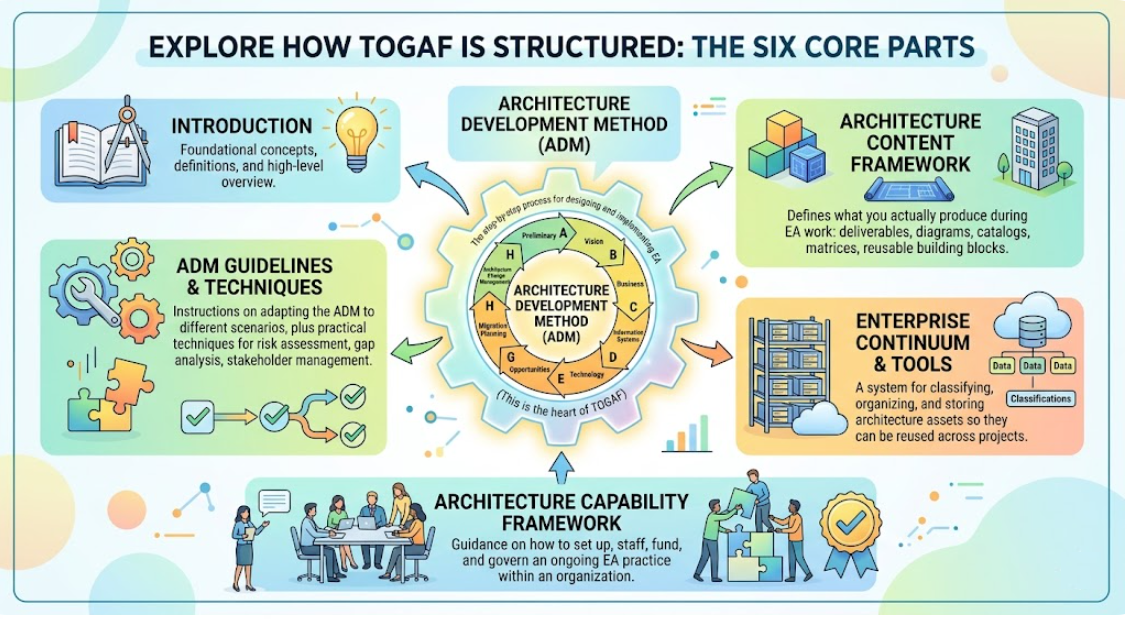
Introduction: Foundational concepts, definitions, and high-level overview.
Architecture Development Method (ADM): The step-by-step process for designing and implementing EA. (This is the heart of TOGAF.)
ADM Guidelines & Techniques: Instructions on how to adapt the ADM to different scenarios, plus practical techniques for tasks like risk assessment, gap analysis, and stakeholder management.
Architecture Content Framework: Defines what you actually produce during EA work: deliverables, diagrams, catalogs, matrices, and reusable building blocks.
Enterprise Continuum & Tools: A system for classifying, organizing, and storing architecture assets so they can be reused across projects.
Architecture Capability Framework: Guidance on how to set up, staff, fund, and govern an ongoing EA practice within an organization.
This is a collection of supplementary materials: industry-specific guidance, reference models, templates, case studies, and adaptation techniques. It’s not part of the core standard, but it’s heavily used by practitioners to accelerate real-world work.
The ADM is TOGAF’s step-by-step cycle for developing enterprise architecture. It’s not a rigid, linear checklist. It’s designed to be iterative, flexible, and responsive to change.
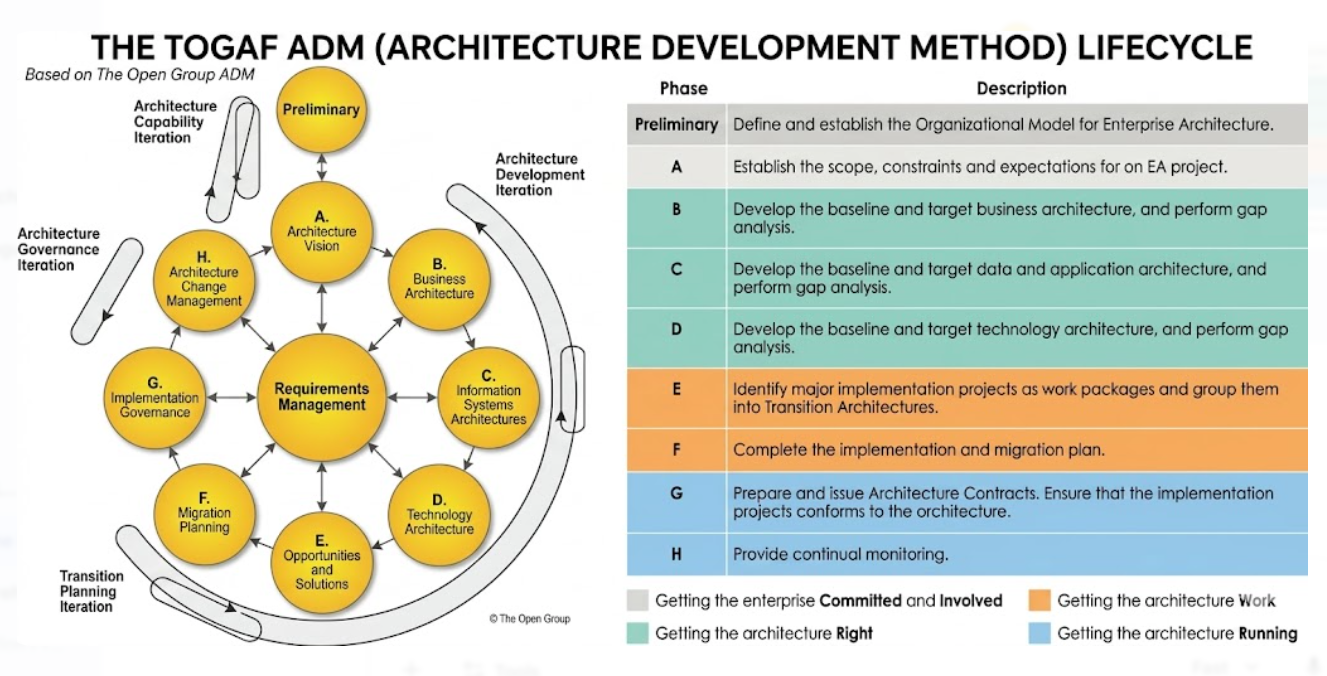
Here’s how the cycle flows in practice:
Preliminary Phase: Set up your EA practice. Define governance structures, select tools, establish architecture principles, and customize the framework to your organization’s culture.
Phase A – Architecture Vision: Define the scope, identify stakeholders, create a high-level vision of the future state, and secure approval to proceed.
Phase B – Business Architecture: Map current business processes and design the target business model that will deliver the vision.
Phase C – Information Systems Architectures: Design the Data and Application architectures that will support the business model.
Phase D – Technology Architecture: Design the infrastructure, networks, and platforms required to run the applications and data systems.
Phase E – Opportunities & Solutions: Identify how to close the gap between current and target states. Decide what to build, buy, or reuse. Group changes into manageable work packages.
Phase F – Migration Planning: Create a detailed roadmap and timeline. Prioritize projects, assess costs and risks, and align with broader organizational change initiatives.
Phase G – Implementation Governance: Oversee the actual build-out. Ensure projects follow the architectural blueprint, manage contracts, and handle compliance.
Phase H – Architecture Change Management: Once deployed, monitor the architecture. Handle change requests, adapt to new business needs, and decide when to refresh or redesign.
Requirements Management: Runs continuously at the center of the cycle. Captures, stores, and feeds business and technical requirements into each phase as they evolve.
Key Insight: You don’t always run through all phases in order. You might revisit Business Architecture after discovering a technology constraint, or loop back to Phase A if stakeholder priorities shift. The cycle is designed to learn, adapt, and refine.
One of the biggest wastes in IT is reinventing solutions that already exist. TOGAF solves this with two complementary concepts:
This is a classification system that organizes architecture assets from generic to specific:
Foundation: Universal standards and models (e.g., security protocols, data formats)
Common Systems: Cross-industry patterns (e.g., identity management, cloud infrastructure models)
Industry: Sector-specific architectures (e.g., healthcare data exchange, retail supply chain models)
Organization-Specific: Custom designs tailored to your company’s unique needs
As you move right, architectures become more specific. As you move left, they become more reusable.
This is the actual storage system (digital or physical) where you keep all EA work. It typically includes:
Architecture models and diagrams
Standards and compliance rules
Reference materials and templates
Governance logs and approval records
Current and future architecture landscapes
Why this matters: When starting a new project, architects don’t start from a blank page. They search the repository, find reusable components, adapt them, and contribute the new work back. This creates a compounding effect where every project makes the next one faster and cheaper.
Enterprise Architecture isn’t a one-time project. It’s an ongoing organizational practice that requires structure, people, and governance.
Architecture Board: A cross-functional group of executives and senior architects who review proposals, resolve conflicts, and ensure alignment with business strategy.
Architecture Governance: Processes to ensure projects follow the blueprint, manage exceptions, track compliance, and handle change requests without derailing the overall vision.
Architecture Contracts: Formal agreements between sponsors and delivery teams that define scope, quality standards, fitness-for-purpose, and compliance expectations.
Skills & Roles: Clearly defined responsibilities for lead architects, domain architects, business analysts, and governance coordinators.
Tooling & Standards: Consistent modeling tools, terminology, and documentation standards so teams can collaborate effectively.
Real-World Reality Check: EA only succeeds when it’s treated like any other business capability. It needs budget, executive sponsorship, clear metrics, and integration with existing project management and IT governance processes. Without governance, architectures become shelfware. With it, they become living blueprints that guide execution.
Enterprise Architecture might sound abstract, but at its core, it’s simply structured planning for how an organization works and how technology enables it. TOGAF provides the language, the process, and the tools to do this consistently, reduce risk, and align technology investments with business outcomes.
Here’s the natural progression you’ve just learned:
Define the enterprise and its boundaries
Understand architecture as structure, relationships, rules, and evolution
Recognize why fragmented systems hurt performance and why EA solves it
Use a framework to bring consistency and reuse to complex design work
Apply TOGAF as a flexible, open-standard methodology
Map the four domains (Business, Data, Applications, Technology)
Follow the ADM cycle to design, plan, implement, and evolve
Classify and store assets in the Continuum and Repository for reuse
Establish governance, roles, and processes to make EA sustainable
Map familiar systems: Pick a company you know well and try to identify its Business, Data, Application, and Technology layers. Notice where they align and where gaps exist.
Explore reference materials: The TOGAF Library contains industry-specific guides and case studies that show how real organizations apply these concepts.
Focus on the ADM flow: Practice tracing how a business requirement moves through the phases, from vision to implementation to change management.
Think iteratively: Architecture isn’t about perfect upfront planning. It’s about structured learning, validation, and continuous adaptation.
You now have a complete, foundational understanding of Enterprise Architecture and the TOGAF framework. From here, you can dive deeper into specific phases, modeling techniques, or governance practices with confidence that you understand how everything connects.
TOGAF ADM Tools: Comprehensive overview of Visual Paradigm's TOGAF Architecture Development Method (ADM) tools, featuring the ADM Process Navigator, guided step-by-step workflows, form-filling capabilities, deliverable composer, auto-versioning, shape/color legends, model extractor for element reuse, and architecture repository management. Supports all TOGAF ADM phases from Preliminary through Phase H with actionable instructions and sample deliverables.
Introduction of Visual Paradigm: Official documentation introducing Visual Paradigm as a world-leading enterprise management and software development suite. Covers Visual Paradigm editions, licensing options, software maintenance, system requirements, and trademark disclaimers. Highlights the platform's capabilities for enterprise architecture, project management, software development, and team collaboration in a unified environment.
Step-by-Step Enterprise Architecture Tutorial with TOGAF ADM: Detailed hands-on tutorial demonstrating how to execute TOGAF ADM phases using Visual Paradigm. Walks through the Preliminary Phase with practical examples: scoping impacted organizations using ArchiMate diagrams, performing architecture maturity assessments with radar charts, completing activity steps, and generating/archiving TOGAF deliverables in the Architecture Repository.
TOGAF ADM Software: Product page highlighting Visual Paradigm's revolutionary TOGAF ADM software designed for EA teams. Features visual process maps for navigating ADM phases, integrated ArchiMate modeling, radar charts for maturity analysis, breakdown structures, scheduling tools, task management, form-based data entry, incremental artifact development, and one-click TOGAF deliverable generation with customizable report editor.
TOGAF Software for Enterprise Architecture: In-depth guide explaining why TOGAF projects fail and how Visual Paradigm addresses common challenges. Compares traditional EA tools vs. Visual Paradigm's Guide-Through and Just-in-Time process approaches. Details benefits: structured ADM phases with embedded instructions, progress indicators, incremental analysis/diagramming, automatic data transformation, task assignment, and seamless EA/PM/agile integration.
TOGAF ADM Tool for Enterprise Architecture Tutorial: Step-by-step tutorial (published May 4, 2018; 78,537 views) demonstrating Visual Paradigm's TOGAF ADM capabilities. Covers project setup, opening the ADM navigator, executing Preliminary Phase activities (scoping organizations, maturity assessment), using ArchiMate diagrams and forms, completing steps, generating deliverables, and managing the Architecture Repository. Includes sample data tables and diagram examples.
**Step-by-Step Enterprise Architecture Tutorial **(Incomplete URL): Note: This URL appears truncated. Content extracted matches the full tutorial at reference #3 above, covering TOGAF ADM phases, Visual Paradigm's guided process, ArchiMate modeling, deliverable generation, and Architecture Repository usage.
TOGAF ADM and Architecture Content Framework: Technical guide explaining the relationship between TOGAF ADM and the Architecture Content Framework. Defines key concepts: deliverables (contractually specified outputs), artifacts (catalogs/matrices/diagrams), and building blocks (reusable components). Details the content metamodel for describing architectural elements and their relationships. Emphasizes using the Content Framework as a companion to ADM for structured input/output management.
Understanding the Difference Between TOGAF and ADM: Educational article (October 4, 2024) clarifying distinctions between TOGAF (the comprehensive framework) and ADM (the core methodology within TOGAF). Compares scope, functionality, components, phases, focus areas, governance coverage, use cases, flexibility, documentation requirements, and target audiences via detailed comparison table. Includes guidance on leveraging Visual Paradigm's TOGAF ADM Guide-Through tool for implementation.
The Evolution of TOGAF 10: Empowering Enterprise Architecture in the Age of Agility: Insightful article (August 1, 2024) on TOGAF 10's enhancements for agile environments. Highlights modular structure for selective adoption, streamlined documentation, continuous evolution capabilities, and stronger IT-business alignment. Discusses how Visual Paradigm's TOGAF Guide-Through tool bridges framework theory and practical implementation with guided workflows, collaborative modeling, automated documentation, and ADM integration.

