
In today's rapidly evolving digital landscape, enterprise architects face mounting pressure to deliver clear, actionable architecture models that align business strategy with technology execution. Traditional manual modeling approaches, while thorough, often struggle to keep pace with organizational agility demands.
This case study explores how a mid-sized financial services organization leveraged Visual Paradigm's AI-powered ArchiMate viewpoint generation capabilities to accelerate their enterprise architecture transformation initiative. By combining the rigor of the ArchiMate specification with generative AI automation, the organization achieved significant improvements in modeling velocity, stakeholder engagement, and architectural consistency—providing valuable insights for any team considering AI-assisted enterprise architecture practices.
Viewpoints is one of the very important concepts in ArchiMate. Each viewpoint contains a dedicated set of ArchiMate elements that allows architect designers to model a specific aspect of an enterprise architecture. The official ArchiMate 3 specification provides 23 ArchiMate example viewpoints for architecture designers to follow. In this ArchiMate viewpoints guide we will go over all these 23 ArchiMate viewpoints, with clear description and ArchiMate diagram examples for each of them.
In the ArchiMate language, a viewpoint is a relevant subset of ArchiMate elements and relationships, put together on a diagram in representing a particular part of an architecture.
ArchiMate suggests a set of example viewpoints that can be used as starting points for modeling efforts. Each of these ArchiMate viewpoint comprises elements from different ArchiMate layers, addressing specific stakeholder concerns. Organizations are welcomed to apply any of these viewpoint examples in their architecture model, or to define their own ones.
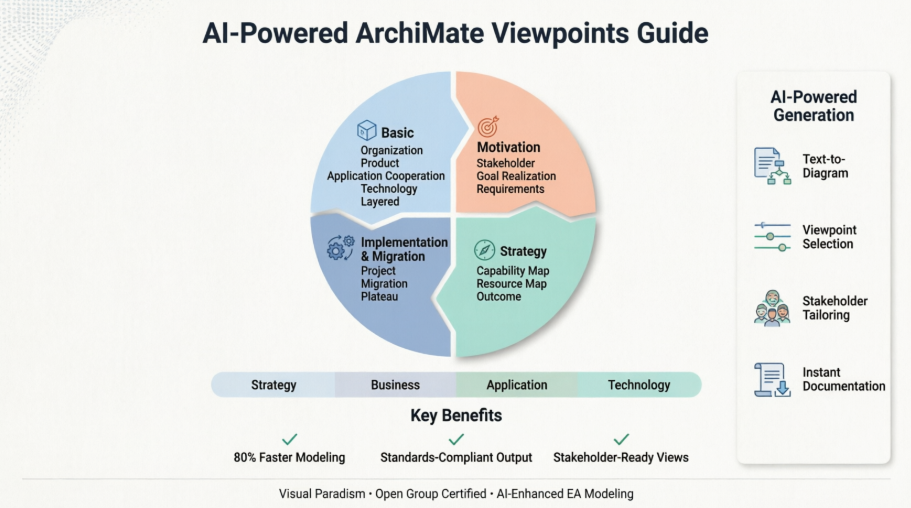
The example viewpoints suggested by ArchiMate are grouped into four main categories:
Basic Viewpoints: Concepts from the three layers of Business, Application, and Technology may be used.
Motivation Viewpoints: For modeling motivational aspects of an architecture.
Strategy Viewpoints: For describing the strategic aspect of the enterprise by describing the high-level strategic direction and make-up of the enterprise.
Implementation and Migration Viewpoints: For modeling the management of architecture change, the transition from baseline to target architecture and relationships between programs and projects.
It is important to note that the example viewpoints officially published in the ArchiMate specification should not constrain modeling activities. You should modify the example viewpoints or even to define your own viewpoints in addressing specific stakeholder concerns.
ArchiMate basic viewpoints cover ArchiMate elements and concepts of the three main ArchiMate layers: Business, Application, and Technology. Listed below is a table of ArchiMate 3.1 example viewpoints, grouped into four categories that indicate which the direction and scope they cover:
Composition: Viewpoints that define internal compositions and aggregations of elements.
Support: Viewpoints where you are looking at elements that are supported by other elements. Typically from one layer and upwards to an above layer.
Cooperation: Towards peer elements which cooperate with each other. Typically across aspects.
Realization: Viewpoints where you are looking at elements that realize other elements. Typically from one layer and downwards to a below layer.
Composition:
| Name | Perspective | Concerns |
|---|---|---|
| Organization | Structure of the enterprise in terms of roles, departments, etc. | Identification of competencies, authority, and responsibilities |
| Information Structure | Shows the structure of the information used in the enterprise. | Structure and dependencies of the used data and information, consistency and completeness |
| Technology | Infrastructure and platforms underlying the enterprise's information systems in terms of networks, devices, and system software. | Stability, security, dependencies, costs of the infrastructure |
| Layered | Provides overview of architecture(s). | Consistency, reduction of complexity, impact of change, flexibility |
| Physical | Physical environment and how this relates to IT infrastructure. | Relationships and dependencies of the physical environment and how this relates to IT infrastructure |
Support:
| Name | Perspective | Concerns |
|---|---|---|
| Product | Shows the contents of products. | Product development, value offered by the products of the enterprise |
| Application Usage | Relates applications to their use in, for example, business processes. | Consistency and completeness, reduction of complexity. |
| Technology Usage | Shows how technology is used by applications. | Dependencies, performance, scalability |
Cooperation:
| Name | Perspective | Concerns |
|---|---|---|
| Business Process Cooperation | Shows the relationships between various business processes. | Dependencies between business processes, consistency and completeness, responsibilities |
| Application Cooperation | Shows application components and their mutual relationships. | Relationships and dependencies between applications, orchestration/choreography of services, consistency and completeness, reduction of complexity |
Realization:
| Name | Perspective | Concerns |
|---|---|---|
| Service Realization | Shows how services are realized by the requisite behavior. | Added-value of business processes, consistency and completeness, responsibilities |
| Implementation and Deployment | Shows how applications are mapped onto the underlying technology. | Structure of application platforms and how they relate to supporting technology |
In the coming sections, we will go over all the ArchiMate basic viewpoints in detail. For each viewpoint, the stakeholder(s) targeted, the concerns to address, the purpose and scope are covered. Besides, ArchiMate diagram examples will be provided.
In addition to the specified elements, the Grouping element, Junction, and Or Junction can be used in every viewpoint.
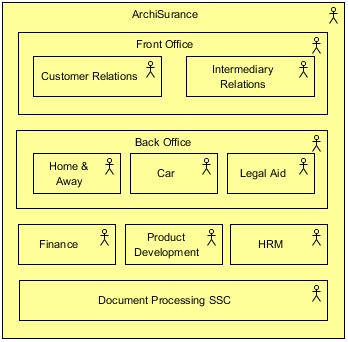
The organization viewpoint is used to present the organizational structure of an organization unit such as a corporate, company, a department, or even a network of companies. Typically, the structure is presented in nested way. However, it is not uncommon to present like a traditional organizational chart. The organization viewpoint is commonly used in identifying competencies and responsibilities of an organization unit.
| Stakeholders | Enterprise, process and domain architects, managers, employees, shareholders |
|---|---|
| Concerns | Identification of competencies, authority, and responsibilities |
| Purpose | Designing, deciding, informing |
| Scope | Single layer/Single aspect |
| Elements | Business actor, Business role, Business collaboration, Location, Business interface |
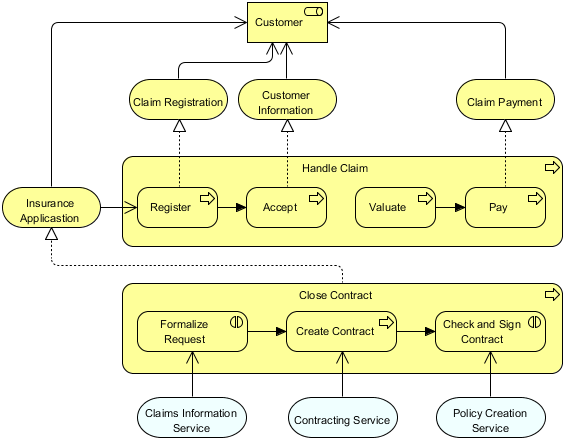
The business process cooperation viewpoint is used to model the flow of main business processes of an enterprise. It can be used to create a high-level design of business processes, providing operational manager with insight into their dependencies. You can also model the mapping of business processes with business functions, and how business services can be realized by business processes.
| Stakeholders | Process and domain architects, operational managers |
|---|---|
| Concerns | Dependencies between business processes, consistency and completeness, responsibilities |
| Purpose | Designing, deciding |
| Scope | Multiple layer/Multiple aspect |
| Elements | Business actor, Business role, Business collaboration, Location, Business interface, Business process/function/interaction, Business event, Business service, Business object, Representation, Application component/collaboration, Application interface, Application process/function/interaction, Application event, Application service, Data object |
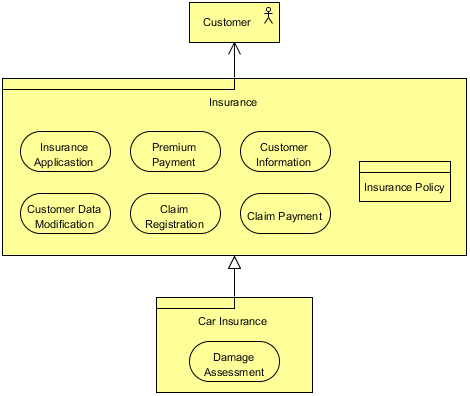
The product viewpoint focuses on the value that the product will offer to the customers. It shows the composition product in terms of the constituting (business, application, or technology) services, and the contract(s) or other agreements involved. You can also show the interfaces through which this product is offered, and the events associated with the product. A product viewpoint is typically used to model the services involved in using the product, which can be a composition of existing services or new services required to be created.
| Stakeholders | Product developers, product managers, process and domain architects |
|---|---|
| Concerns | Product development, value offered by the products of the enterprise |
| Purpose | Designing, deciding |
| Scope | Multiple layer/Multiple aspect |
| Elements | Business actor, Business role, Business collaboration, Business interface, Business process/function/interaction, Business event, Business service, Business object, Product, Contract, Application component/collaboration, Application interface, Application process/function/interaction, Application event, Application service, Data object, Technology service, Artifact, Material, Value |
The application cooperation viewpoint presents the information flows between applications components, and the services the components provide and require. People use this viewpoint to create an overview of the application landscape. Besides, this viewpoint can also be used to model the cooperation of services that together support the execution of a business process.
| Stakeholders | Enterprise, process, application, and domain architects |
|---|---|
| Concerns | Relationships and dependencies between applications, orchestration/choreography of services, consistency and completeness, reduction of complexity |
| Purpose | Designing |
| Scope | Multiple layer/Multiple aspect |
| Elements | Location, Application component/collaboration, Application interface, Application process/function/interaction, Application event, Application service, Data object |
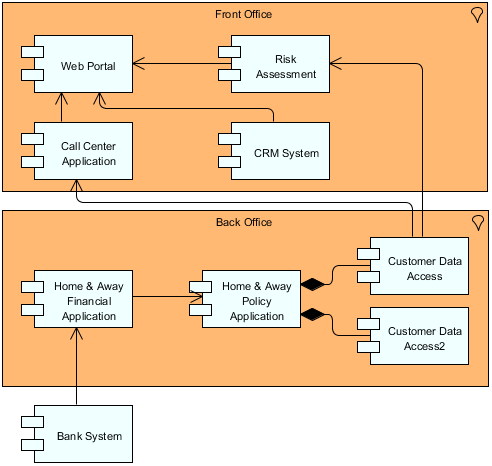
The application usage viewpoint shows how applications work together to support business processes, and how applications are used by other applications. It can be used to identify the services needed by business processes and other applications, or in designing business processes by describing the services that are available.
| Stakeholders | Enterprise, process, and application architects, operational managers |
|---|---|
| Concerns | Consistency and completeness, reduction of complexity |
| Purpose | Designing, deciding |
| Scope | Multiple layer/Multiple aspect |
| Elements | Business actor, Business role, Business collaboration, Business process/function/interaction, Business event, Business object, Application component/collaboration, Application interface, Application process/function/interaction, Application event, Application service, Data object |
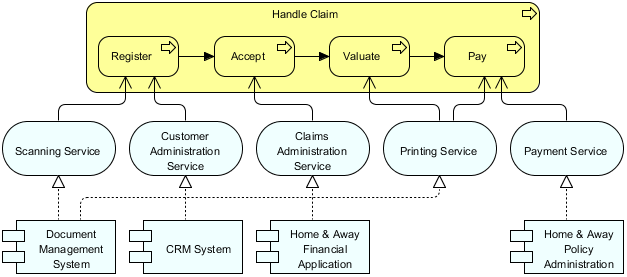
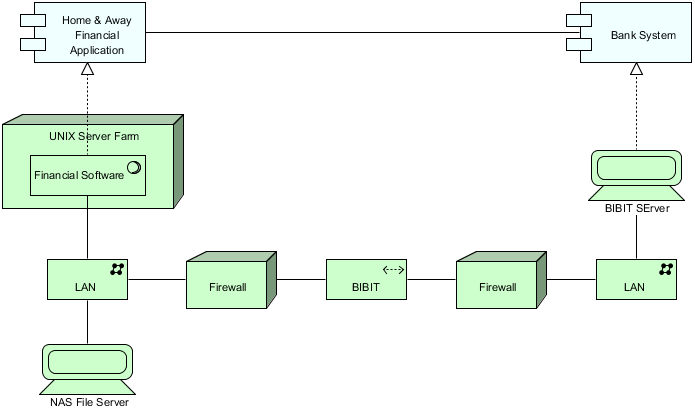
The implementation and deployment viewpoint shows the realization of applications on the infrastructure. This involves the mapping of applications and components onto artifacts, and the mapping of the information used by these applications and components onto the underlying storage infrastructure.
| Stakeholders | Application and domain architects |
|---|---|
| Concerns | Structure of application platforms and how they relate to supporting technology |
| Purpose | Designing, deciding |
| Scope | Multiple layer/Multiple aspect |
| Elements | Application component/collaboration, Application interface, Application process/function/interaction, Application event, Application service, Data object, System software, Technology interface, Path, Technology process/function/interaction, Technology service, Artifact |
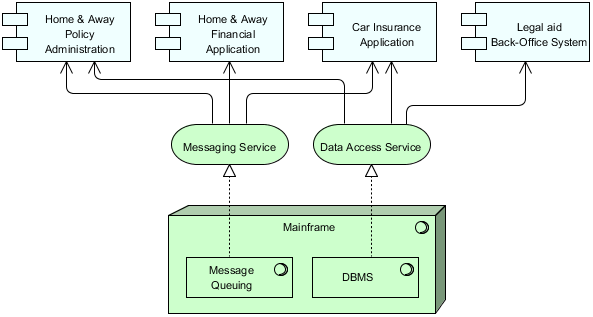
The technology viewpoint shows how the application layer is supported by the software and hardware technology elements like physical devices, networks, or system software (e.g., O/S, databases, and middleware).
| Stakeholders | Infrastructure architects, operational managers |
|---|---|
| Concerns | Stability, security, dependencies, costs of the infrastructure |
| Purpose | Designing |
| Scope | Single layer/Multiple aspect |
| Elements | Location, Node, Technology collaboration, Device, System software, Technology interface, Communication network, Path, Technology process/function/interaction, Technology service, Technology event, Artifact |
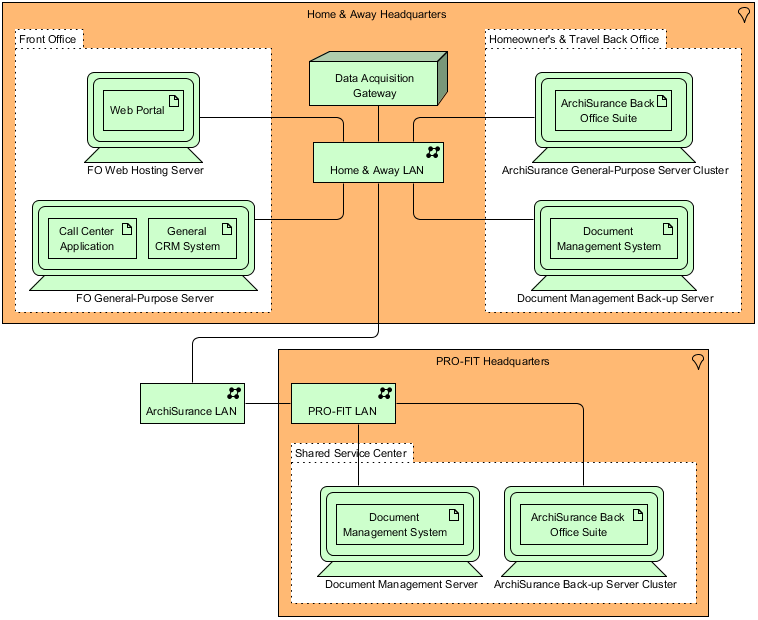
The technology usage viewpoint shows how applications are supported by the software and hardware technology. This viewpoint is commonly applied when there is a need of performance or scalability analysis, since it relates the physical infrastructure to the logical world of applications.
| Stakeholders | Application, infrastructure architects, operational managers |
|---|---|
| Concerns | Dependencies, performance, scalability |
| Purpose | Designing |
| Scope | Multiple layer/Multiple aspect |
| Elements | Application component/collaboration, Application process/function/interaction, Application event, Data object, Node, Device, Technology collaboration, System software, Technology interface, Communication network, Path, Technology process/function/interaction, Technology service, Technology event, Artifact |
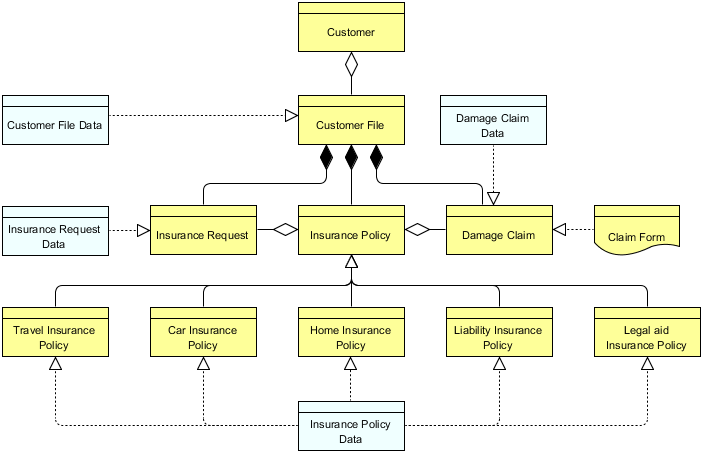
The information structure viewpoint is works like a traditional information models commonly created in developing information system. The viewpoint shows the structure of the information used in the enterprise. It may also show how the information at the business level is represented at the application level in the form of the data structures used there, and how these are then mapped onto the underlying technology infrastructure.
| Stakeholders | Domain and information architects |
|---|---|
| Concerns | Structure and dependencies of the used data and information, consistency and completeness |
| Purpose | Designing |
| Scope | Multiple layer/Single aspect |
| Elements | Business object, Representation, Data object, Artifact, Meaning |
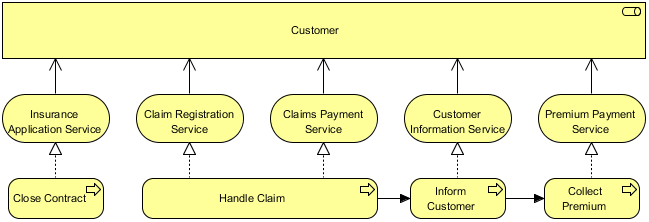
The service realization viewpoint models how business services are realized by the underlying processes / application components.
| Stakeholders | Process and domain architects, product and operational managers |
|---|---|
| Concerns | Added-value of business processes, consistency and completeness, responsibilities |
| Purpose | Designing, deciding |
| Scope | Multiple layer/Multiple aspect |
| Elements | Business actor, Business role, Business collaboration, Business interface, Business process/function/interaction, Business event, Business service, Business object, Representation, Application component/collaboration, Application interface, Application process/function/interaction, Application event, Application service, Data object |
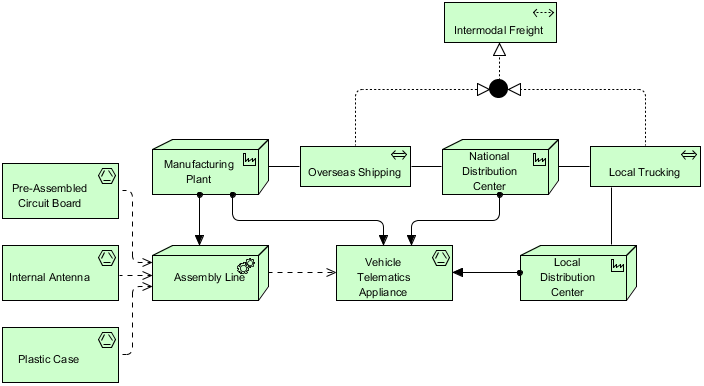
The physical viewpoint shows the equipment that can create, use, store, move, or transform materials, and how the equipment is connected via the distribution network, and what other active elements are assigned to the equipment.
| Stakeholders | Infrastructure architects, operational managers |
|---|---|
| Concerns | Relationships and dependencies of the physical environment and how this relates to IT infrastructure |
| Purpose | Designing |
| Scope | Multiple layer/Multiple aspect |
| Elements | Location, Node, Device, Equipment, Facility, Path, Communication network, Distribution network, Material |
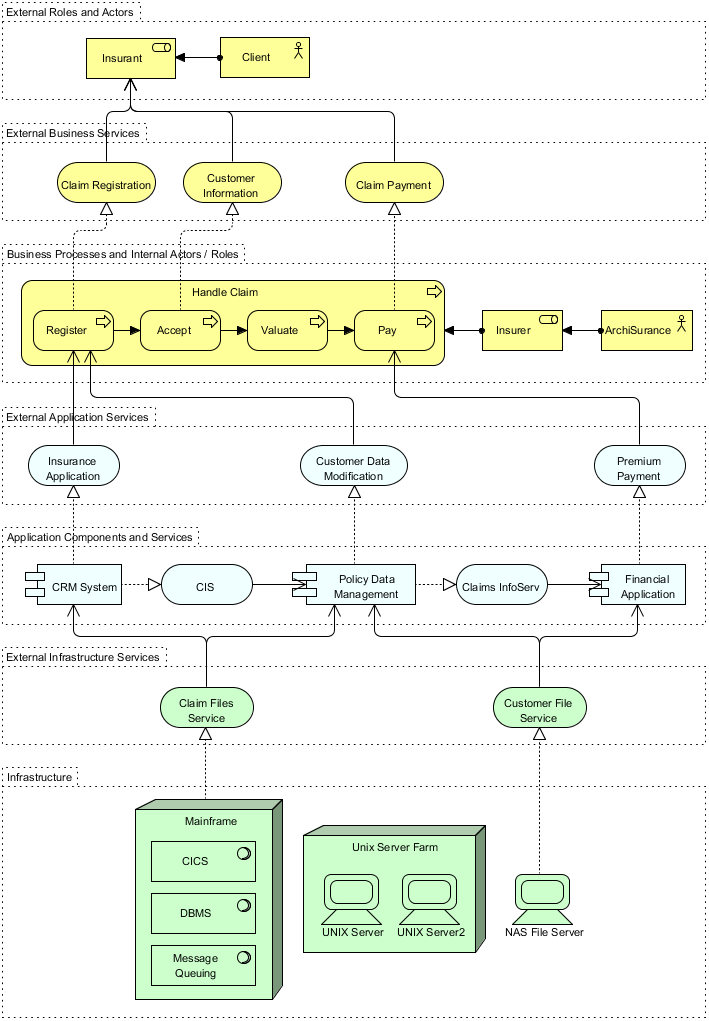
The layered viewpoint presents a bird-eye view of core elements of all layers and aspects of an Enterprise Architecture. The structural principle behind a fully layered viewpoint is that each dedicated layer exposes, by means of the "realization" relationship, a layer of services, which are further on "serving" the next dedicated layer. With this viewpoint, you can easily separate the internal structure and organization of a dedicated layer from its externally observable behavior expressed as the service layer that the dedicated layer realizes.
| Stakeholders | Enterprise, process, application, infrastructure, and domain architects |
|---|---|
| Concerns | Consistency, reduction of complexity, impact of change, flexibility |
| Purpose | Designing, deciding, informing |
| Scope | Multiple layer/Multiple aspect |
| Elements |
The ArchiMate motivation viewpoints defined a set of example viewpoints for modeling the motivational aspects of an enterprise architecture.
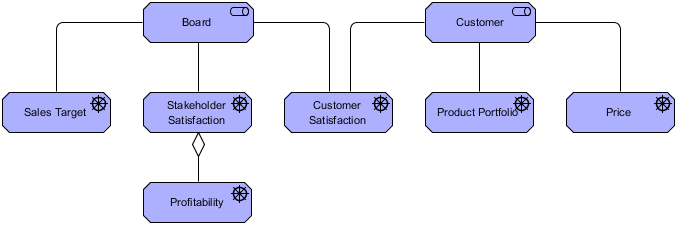
The stakeholder viewpoint is used to model the stakeholders, drivers of changes (both internal and external), and the assessments of these drivers, in terms of SWOT analysis. It may also be used to model the links to the initial goals that address these concerns and assessments. These goals form the basis for the requirements engineering process, including goal refinement, contribution and conflict analysis, and the derivation of requirements that realize the goals.
| Stakeholders | Stakeholders, business managers, enterprise and ICT architects, business analysts, requirements managers |
|---|---|
| Concerns | Architecture mission and strategy, motivation |
| Purpose | Designing, deciding, informing |
| Scope | Motivation |
| Elements | Stakeholder, Driver, Assessment, Goal, Outcome |
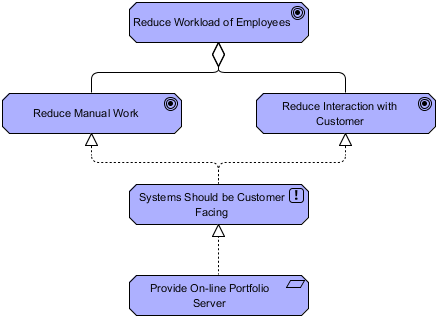
The goal realization viewpoint models the refinement of high level goals into more specific goals, and the refinement of these specific goals further into requirements or constraints. The refinement of goals into sub-goals is modeled using the aggregation, while the refinement of goals into requirements is modeled using the realization.
| Stakeholders | Stakeholders, business managers, enterprise and ICT architects, business analysts, requirements managers |
|---|---|
| Concerns | Architecture mission, strategy and tactics, motivation |
| Purpose | Designing, deciding |
| Scope | Motivation |
| Elements | Goal, Principle, Requirement, Constraint, Outcome |
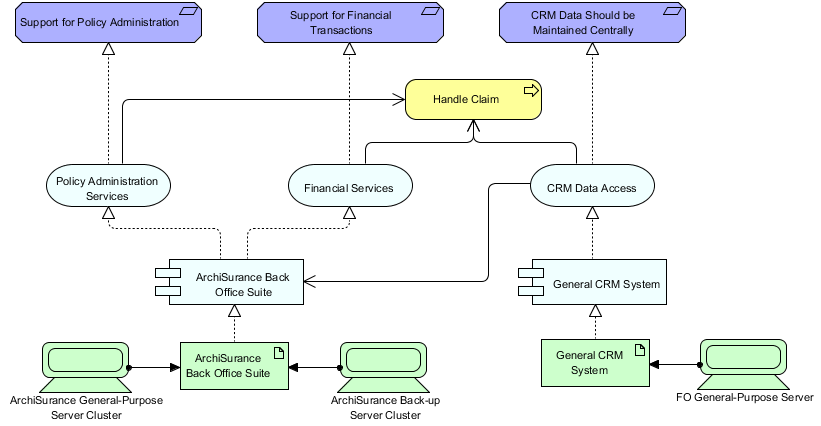
The requirements realization viewpoint shows the realization of requirements by core elements such as business actors, business services, business processes, application services, application components, etc. Typically, the requirements result from the goal refinement viewpoint.
| Stakeholders | Enterprise and ICT architects, business analysts, requirements managers |
|---|---|
| Concerns | Architecture strategy and tactics, motivation |
| Purpose | Designing, deciding, informing |
| Scope | Motivation |
| Elements | Goal, Requirement/constraint, Outcome, Value, Meaning, Core element |
The motivation viewpoint can be used to present a complete or partial overview of the motivation aspect by relating stakeholders, their primary goals, the principles that are applied, and the main requirements on services, processes, applications, and objects.
| Stakeholders | Enterprise and ICT architects, business analysts, requirements managers |
|---|---|
| Concerns | Architecture strategy and tactics, motivation |
| Purpose | Designing, deciding, informing |
| Scope | Motivation |
| Elements | Stakeholder, Driver, Assessment, Goal, Principle, Requirement, Constraint, Outcome, Value, Meaning |
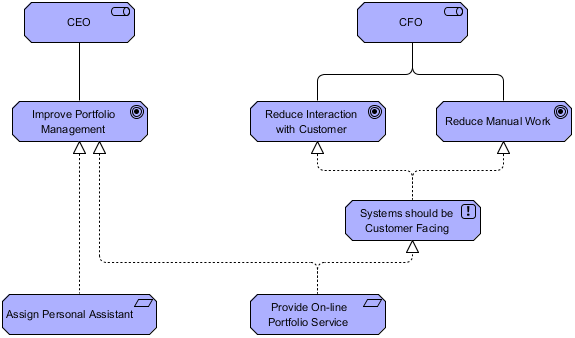
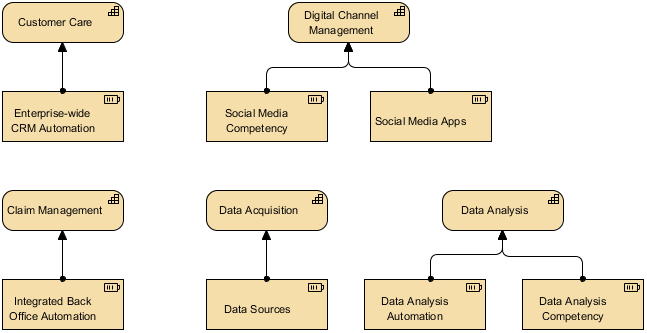
The ArchiMate strategy viewpoints defined a number of example viewpoints for use in modeling the strategic aspects of the enterprise. They can be used in modeling the high-level strategic direction and make-up of the enterprise.
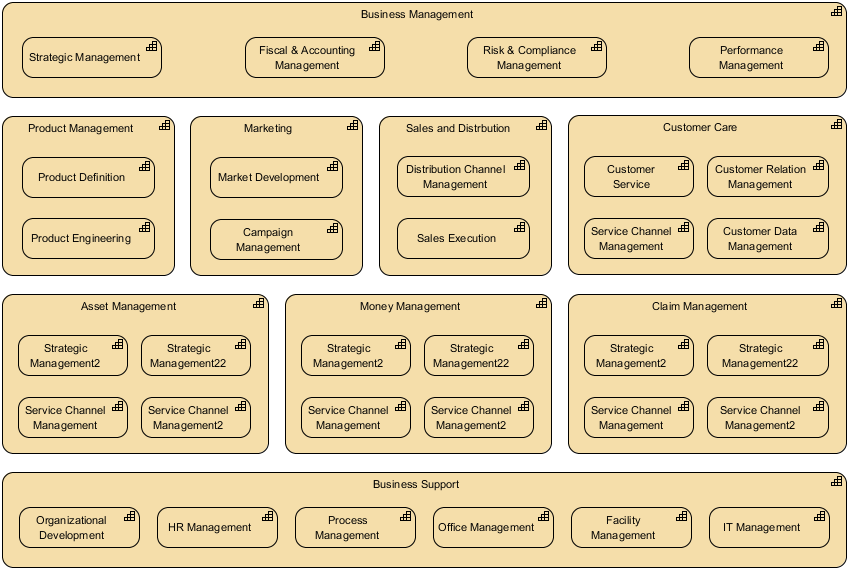
The capability map viewpoint presents a structured overview of the capabilities of the enterprise. A capability map typically shows two or three levels of capabilities across the entire enterprise. Very often, capability map viewpoint is to be used as a heat map.
| Stakeholders | CxOs, business managers, enterprise and business architects |
|---|---|
| Concerns | Strategy development |
| Purpose | Designing, deciding |
| Scope | Strategy |
| Elements | Course of action, Capability, Resource, Outcome |
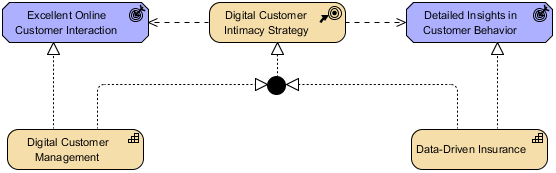
The capability map viewpoint allows the business architect to create a structured overview of the capabilities of the enterprise. A capability map typically shows two or three levels of capabilities across the entire enterprise. It can, for example, be used as a heat map to identify areas of investment. In some cases, a capability map may also show specific outcomes delivered by these capabilities.
| Stakeholders | Business managers, enterprise and business architects |
|---|---|
| Concerns | Architecture strategy and tactics, motivation |
| Purpose | Designing, deciding |
| Scope | Strategy |
| Elements | Outcome, Capability, Resource |
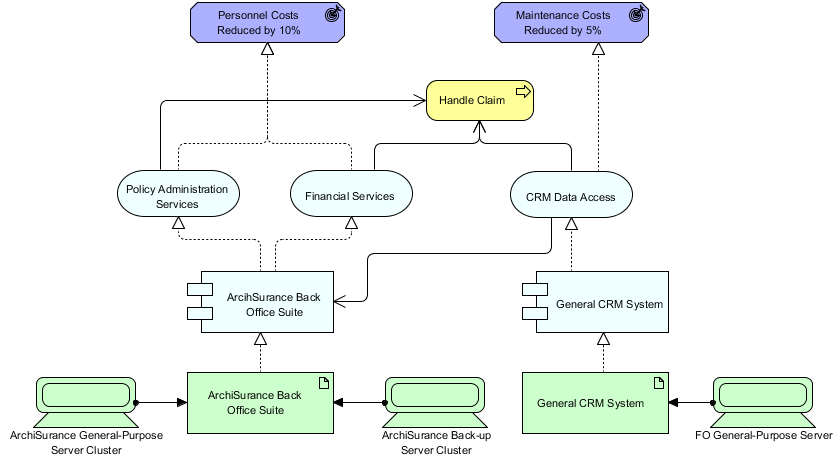
The outcome realization viewpoint is used to show how the highest-level, business-oriented results are produced by the capabilities and underlying core elements.
| Stakeholders | Business managers, enterprise and business architects |
|---|---|
| Concerns | Business-oriented results |
| Purpose | Designing, deciding |
| Scope | Strategy |
| Elements | Capability, Resource, Outcome, Value, Meaning, Core element |
The resource map viewpoint shows a structured overview of the resources of the enterprise. A resource map typically involves two or three levels of resources across the entire enterprise. It can be used as a heat map to identify areas of investment.
| Stakeholders | Business managers, enterprise and business architects |
|---|---|
| Concerns | Architecture strategy and tactics, motivation |
| Purpose | Designing, deciding |
| Scope | Strategy |
| Elements | Resource, Capability, Work package |
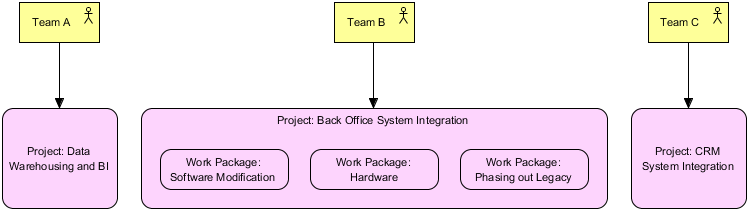
The ArchiMate implementation and migration viewpoints are defined for modeling the management of architecture change, the transition from baseline to target architecture and relationships between programs and projects.
A project viewpoint is primarily used to shows the management of architecture change, which involves the modeling of projects to be managed, governed and delivered during the migration from baseline to target architectural.
| Stakeholders | (operational) managers, enterprise and ICT architects, employees, shareholders |
|---|---|
| Concerns | Architecture vision and policies, motivation |
| Purpose | Deciding, informing |
| Scope | Implementation and Migration |
| Elements | Goal, Work package, Implementation event, Deliverable, Business actor, Business role |
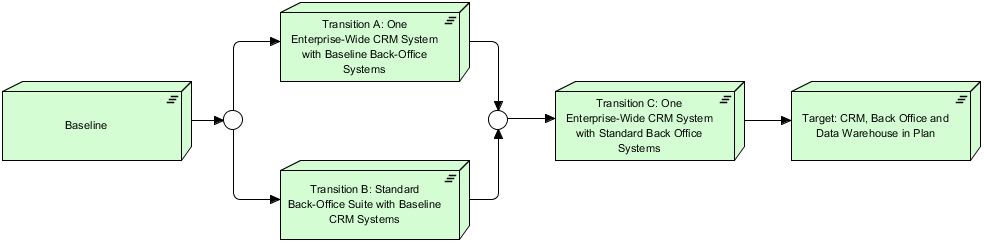
The migration viewpoint entails models and concepts that can be used for specifying the transition from an existing architecture to a desired architecture.
| Stakeholders | Enterprise architects, process architects, application architects, infrastructure architects and domain architects, employees, shareholders |
|---|---|
| Concerns | History of models |
| Purpose | Designing, deciding, informing |
| Scope | Implementation and Migration |
| Elements | Plateau, Gap |
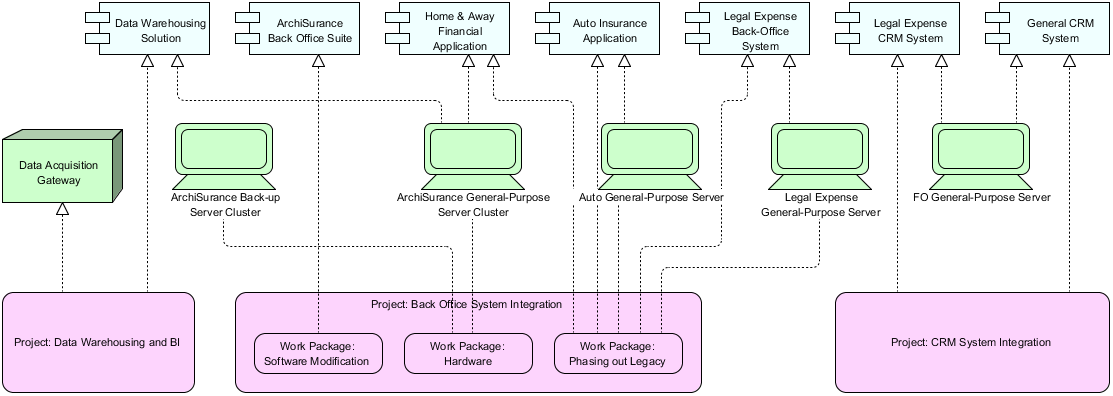
The implementation and migration viewpoint is used to relate programs and projects to the parts of the architecture that they implement. This view allows modeling of the scope of programs, projects, project activities in terms of the plateaus that are realized or the individual architecture elements that are affected.
| Stakeholders | (operational) managers, enterprise and ICT architects, employees, shareholders |
|---|---|
| Concerns | Architecture vision and policies, motivation |
| Purpose | Deciding, informing |
| Scope | Multiple layer/Multiple aspect |
| Elements | Goal, Requirement, Constraint, Work package, Implementation event, Deliverable, Plateau, Gap, Business actor, Business role, Location, Core element |
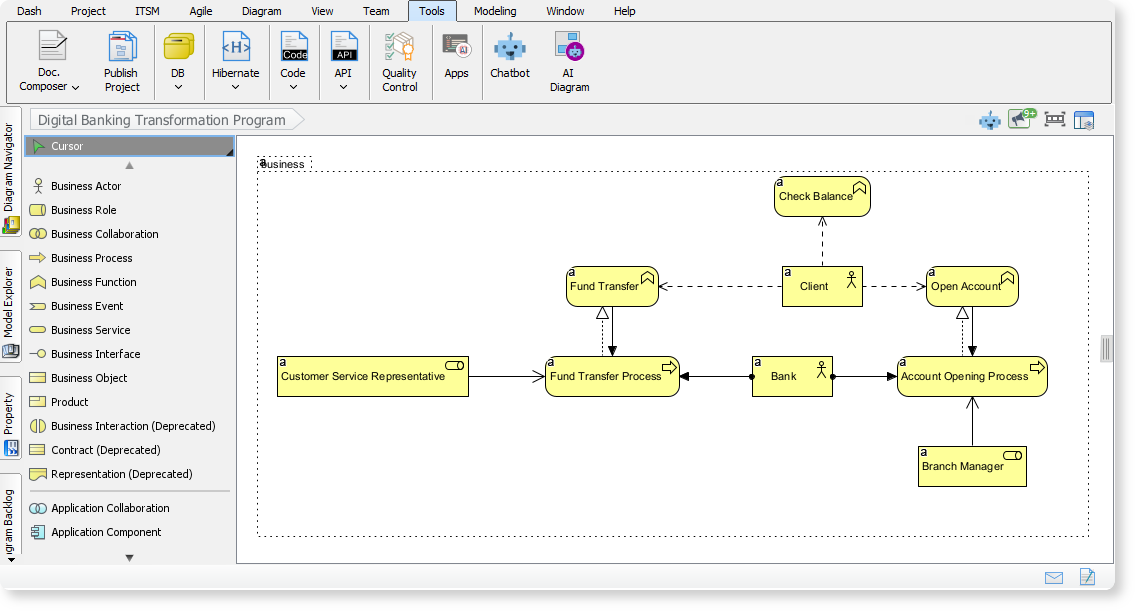
Before this release, creating a comprehensive Enterprise Architecture model often meant starting from a blank canvas. Architects and analysts faced the difficult task of translating high-level business requirements into detailed, structured diagrams. This required deep knowledge of the ArchiMate specification, careful selection of viewpoints, and laborious manual drawing, which often slowed down project kickoffs and strategic communication.
This challenge is amplified when needing to communicate the architecture to different stakeholders, as each group requires a specific, tailored view—the ArchiMate Viewpoint. Generating dozens of these specialized views by hand was simply not practical for agile teams.
We built this feature to dramatically accelerate the initial stages of EA modeling and improve stakeholder communication. By automating the creation of ArchiMate elements and structuring them according to official Viewpoints, Visual Paradigm frees you to focus on strategy and validation, not on manual diagramming.
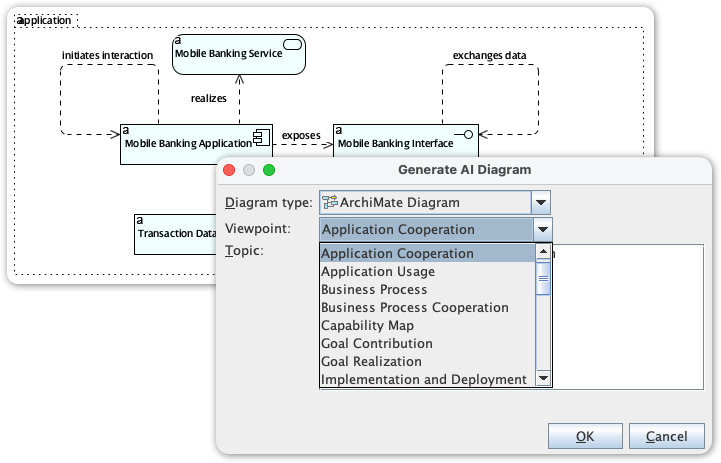
The new AI ArchiMate Generator and Viewpoints feature allows you to:
Generate a Complete Diagram: Simply type a topic or a high-level requirement, and the AI drafts a comprehensive ArchiMate model.
Access All Official Viewpoints: Instantly structure the output to fit any of the official ArchiMate viewpoints, ensuring the model is tailored for the intended audience. Supported viewpoints include:
Application Cooperation
Application Usage
Business Process
Business Process Cooperation
Capability Map
Goal Contribution
Goal Realization
Implementation and Deployment
Implementation Migration
Information Structure
Introductory
Migration
Motivation
Organization
Outcome Realization
Physical
Principles
Product
Project
Requirements Realization
Resource Map
Service Realization
Stakeholder
Technology
Technology Usage
Customize the Output: Define the desired audience (e.g., engineers, product managers) and tone (e.g., formal, technical) to ensure the generated model and accompanying explanation are perfectly tailored.
Maintain Quality Control: Receive a generated, editable draft that you can refine and fact-check, ensuring the model aligns with your organizational standards while drastically reducing drawing time.
Getting started with your first AI-generated ArchiMate model takes only a few simple steps:
Click on Tools.
Select AI Diagram
Select a specific ArchiMate Viewpoint from the dropdown menu (e.g., Product Viewpoint).
Enter a topic
Hit OK
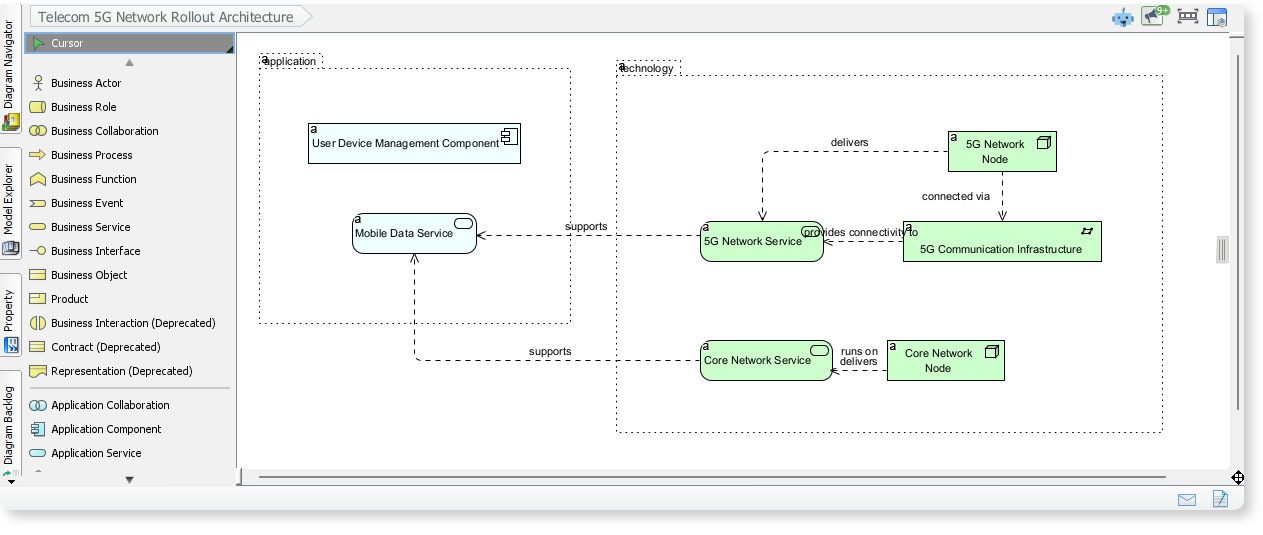
Here is an ArchiMate diagram generated with VP AI Diagram Tool, outlines the core components involved in rolling out a 5G network. It shows how application services, network services, and infrastructure elements work together to deliver mobile data and 5G connectivity.
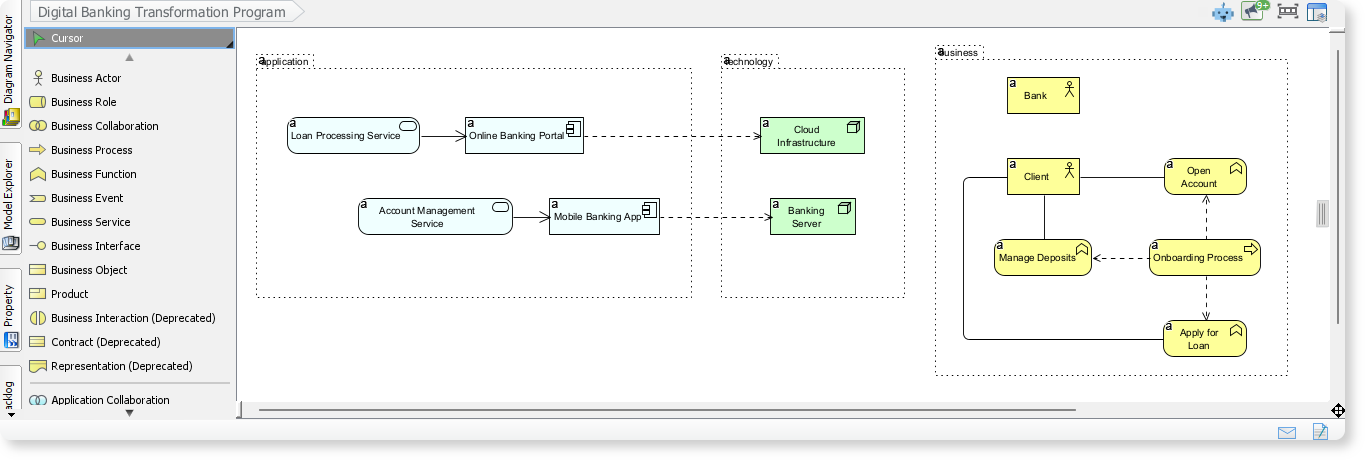
By entering "Digital Banking Transformation Program" into the AI Diagram Tool, an ArchiMate diagram is generated to illustrate how business processes, application services, and technology components interact in a modern digital banking environment are generated. ArchiMate diagrams help you understand how different layers of an enterprise architecture work together to deliver seamless digital banking experiences.
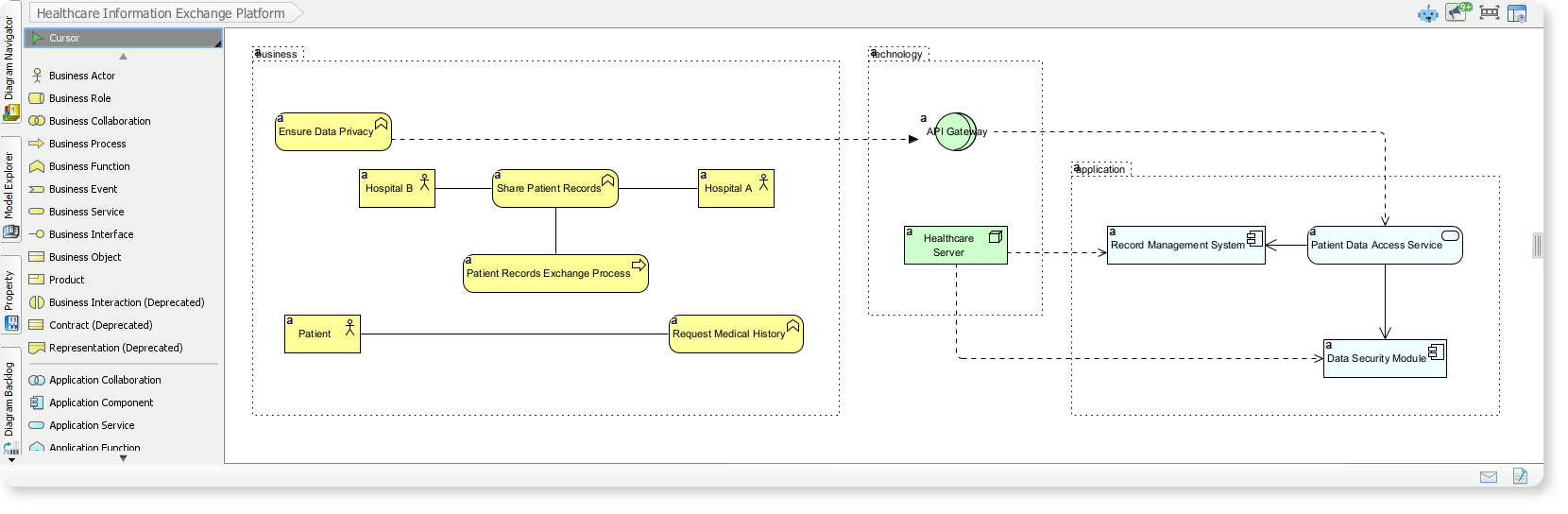
This ArchiMate diagram illustrates how hospitals, patients, and supporting applications collaborate to exchange medical records securely across a healthcare network. The AI-generated ArchiMate diagrams provide complete structure, help you visualize how business workflows, application layers, and technology components align to deliver a unified and secure healthcare information exchange.
Visual Paradigm provides an Open Group-certified ArchiMate modeling tool that integrates generative AI to automatically design, organize, and document enterprise architecture (EA) diagrams. By combining strict compliance with the ArchiMate standard with AI-driven automation, the platform removes the manual effort from mapping complex business workflows, application layers, and IT infrastructures.
Visual Paradigm fully supports the ArchiMate specification across all structural and dynamic layers.
Layered Modeling Support: Seamlessly links components across the Strategy, Motivation, Business, Application, Technology, Physical, and Implementation layers.
Official Viewpoints: Includes native support for all official viewpoints (e.g., Layered, Application Cooperation, Business Process Cooperation, Technology Usage, and Strategy). These viewpoints structure your models specifically to address targeted stakeholder concerns.
Custom Viewpoints: Enables architects to design and apply custom viewpoints to model specific corporate framework perspectives.
Model Synchronization: Reuses elements across multiple diagrams. Any change made to a single component automatically updates across every viewpoint instance to ensure model integrity.
The built-in AI Diagram Generator transforms text-based strategic briefs into standards-compliant models.
Text-to-Diagram Generation: You can input a plain-text prompt (e.g., "Generate an ArchiMate diagram for an end-to-end e-commerce ecosystem using the Layered Architecture viewpoint") and the AI instantly generates a fully editable diagram.
Automated Element Mapping: The AI automatically selects the correct standard shapes, connectors (such as realization, assignment, or serving), and structural boundaries.
Viewpoint Enforcement: The AI configures and filters the diagram according to the chosen official viewpoint. It handles complex visibility rules so that stakeholders see exactly what is relevant to them.
Rule Validation: The engine matches its generation against official ArchiMate syntax rules, checking that element interactions are valid according to the underlying framework.
The intelligence layer extends past initial layout creation to assist with ongoing architectural management.
Interactive Refinement: Use conversational commands through the Visual Paradigm AI Chatbot to add layers, alter node dependencies, or swap out viewpoints dynamically.
Instant Documentation: The AI auto-generates structured reports, element summaries, and impact matrices directly from your visual model, ensuring your project documentation remains aligned with the visual architecture.
Cross-Standard Flexibility: The underlying AI workspace is trained across multiple modeling standards. If your project blends architectures, it easily handles bridges between ArchiMate, UML, SysML, and BPMN.
This case study demonstrates that integrating AI-powered ArchiMate viewpoint generation into enterprise architecture practices delivers tangible benefits: faster model creation, improved stakeholder alignment, and consistent adherence to architectural standards. For the financial services organization featured here, the ability to rapidly generate tailored viewpoints for executives, technical teams, and project managers transformed architecture from a documentation exercise into a strategic communication tool. While AI automation handles the structural heavy lifting, human expertise remains essential for validating business logic, refining relationships, and ensuring models reflect organizational reality. As enterprise architecture continues to evolve, tools that blend specification rigor with intelligent automation will become indispensable for architects seeking to deliver value at the speed of business.

