
The Architecture Development Method (ADM) is the core engine of enterprise architecture. However, like any powerful engine, it requires steering mechanisms, calibration tools, and safety checks to perform effectively in real-world environments. ADM Guidelines and Techniques provide exactly that: a structured set of resources that help architects adapt the ADM to specific organizational contexts, ensure alignment with business needs, and manage the complexities of transformation.
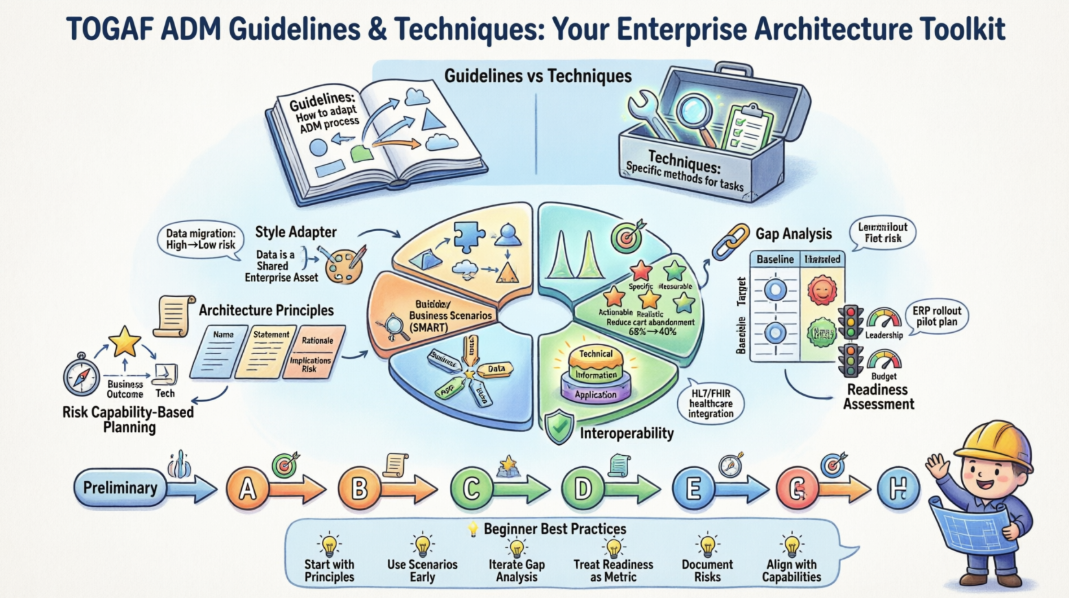
This guide breaks down the essential guidelines and techniques, explains how they function within the architecture lifecycle, and provides practical, beginner-friendly examples to illustrate their real-world application.
Before diving into individual tools, it is crucial to understand how TOGAF categorizes them:
| Category | Purpose | When Used |
|---|---|---|
| Guidelines | Explain how to adapt the ADM process to different scenarios, organizational styles, or architectural paradigms. | Applied at the process level to shape how the ADM cycle is executed. |
| Techniques | Provide specific methods to complete defined tasks within the ADM phases. | Applied at the task level to analyze, validate, or plan architectural work. |
Think of guidelines as the rulebook for customizing your approach, and techniques as the tools in your architect’s toolbox.
Concept: The TOGAF framework is intentionally generic. When working within a specific architectural style (e.g., Service-Oriented Architecture, microservices, cloud-native, or data-mesh), architects must recognize and address the distinctive features of that style without rewriting the entire ADM.
How It Works:
Identify the distinctive characteristics of the chosen style.
Adjust models, viewpoints, and modeling notations in Phases B, C, and D.
Extend the Architecture Content Metamodel only if necessary.
Usually, no major ADM restructuring is required; adaptation happens through viewpoint selection and phase tailoring.
🌱 Beginner Example:
If your enterprise adopts a Service-Oriented Architecture (SOA), you won’t change the ADM phases. Instead, in Phase C (Application Architecture), you’ll select viewpoints that explicitly map business processes to reusable services, emphasize open standards for interoperability, and highlight service orchestration layers in your architecture models.
Concept: Principles are enduring, high-level rules that guide decision-making across the enterprise. They bridge business strategy and technical execution, ensuring consistency and alignment.
Standard TOGAF Template:
| Section | Description |
|---|---|
| Name | Memorable, avoids specific technologies or ambiguous words. |
| Statement | Clear, unambiguous rule. |
| Rationale | Business benefits and relationship to other principles. |
| Implications | Required actions, costs, resources, and organizational impact. |
Criteria for Good Principles: Understandable, Robust, Complete, Consistent, Stable.
🌱 Beginner Example:
Name: Data is a Shared Enterprise Asset
Statement: All organizational data must be managed, secured, and accessible as a unified enterprise resource.
Rationale: Eliminates data silos, improves decision accuracy, and reduces compliance risks.
Implications: Requires a centralized data governance board, standardized metadata policies, and cross-departmental access protocols. Legacy systems will need integration upgrades.
Concept: A structured technique to discover, document, and validate business requirements by modeling real-world situations, actors, environments, and desired outcomes.
The SMART Framework for Scenarios:
Specific: Clearly defines what needs to be done.
Measurable: Includes clear success metrics.
Actionable: Segments the problem to enable solutions.
Realistic: Solvable within time, cost, and technical constraints.
Time-bound: Has a clear deadline or expiration.
Usage in ADM: Heavily used in Phase A (Architecture Vision) to build stakeholder consensus, and in Phase B (Business Architecture) to derive architectural requirements.
🌱 Beginner Example:
Scenario: "Online shoppers abandon carts when checkout requires more than three steps and lacks guest checkout."
Specific: Streamline checkout flow to ≤2 steps, enable guest mode.
Measurable: Reduce cart abandonment rate from 68% to <40% within 6 months.
Actionable: Redesign UI, integrate payment gateway API, optimize session management.
Realistic: Achievable using existing e-commerce platform plugins.
Time-bound: Complete and deploy before Q3 peak shopping season.
This scenario directly informs Application Architecture (payment integration) and Data Architecture (session/cart persistence).
Concept: A validation technique that identifies shortfalls between the Baseline (current state) and Target (future state) architectures. It ensures nothing critical is accidentally omitted or incorrectly eliminated.
How It Works:
Create a matrix: Baseline Architecture Building Blocks (ABBs) on the vertical axis, Target ABBs on the horizontal axis.
Add a final row labeled "New ABBs" and a final column labeled "Eliminated ABBs".
Mark intersections: Included (exists in both), New (target only), Eliminated (baseline only).
Review all "New" and "Eliminated" entries. Decide if gaps require procurement/development, or if eliminations are intentional.
🌱 Beginner Example:
Migrating from an on-premise email server to a cloud-based productivity suite.
Baseline ABB: On-prem Exchange Server, Local Backup System
Target ABB: Cloud Mailbox, SaaS Backup, Mobile Sync Service
Gap Identified: "Advanced Threat Protection" exists in baseline but is missing in target.
Action: Procure a cloud-native security module to fill the gap before migration.
Concept: The ability of systems, organizations, or processes to share information and services seamlessly. Critical in extended enterprises, partnerships, and multi-vendor environments.
Categories of Interoperability:
Operational/Business: How business processes are shared or aligned.
Information: How data is structured, shared, and governed.
Technical: How infrastructure, networks, and platforms connect.
IT Implementation Layers:
Presentation: Common UI/portal for unified user experience.
Information: Shared data models, ontologies, and quality standards.
Application: Integrated functionality (e.g., single change-of-address service across all apps).
Technical: Shared infrastructure, communication protocols, and standards.
Usage in ADM: Defined in Phase A, detailed in Phases B/C/D, selected in Phase E, and logically implemented in Phase F.
🌱 Beginner Example:
A regional healthcare network integrates three independent hospital systems.
Technical: All systems adopt HL7/FHIR standards for data exchange.
Information: Standardized patient identifiers and clinical data dictionaries.
Application: Unified referral management system across all sites.
Presentation: Single clinician dashboard displaying consolidated patient records.
Concept: Evaluates whether an organization is culturally, operationally, and financially prepared to adopt the changes proposed by the architecture. Identifies risks and mitigation actions before implementation.
Usage in ADM:
Phase A: Initial high-level readiness assessment.
Phases E & F: Detailed findings shape the Implementation and Migration Plan (e.g., training programs, change champions, phased rollouts).
🌱 Beginner Example:
Before deploying an enterprise-wide ERP, the architecture team assesses:
Are users trained on the new interface? (Readiness: Low)
Is leadership committed to process changes? (Readiness: Medium)
Is budget allocated for parallel run periods? (Readiness: High)
Result: Phase F adds a 3-month pilot, dedicated change management team, and executive communication plan to address low/medium readiness areas.
Concept: A continuous process to identify, assess, and mitigate risks throughout the architecture lifecycle. TOGAF distinguishes between:
Initial Risk: Categorization before mitigation actions.
Residual Risk: Categorization after mitigation is applied.
Recommended Process: Classification → Identification → Initial Assessment → Mitigation & Residual Assessment → Monitoring.
Usage in ADM: Present in all phases. Initial assessment begins in Phase A. Mitigation plans are tracked in Phase G (Implementation Governance). Unmitigated critical risks may trigger a new ADM cycle.
🌱 Beginner Example:
Risk: Legacy data migration may corrupt financial records.
Initial Assessment: High impact, High probability.
Mitigation: Implement automated data validation scripts, run parallel dry migrations, and establish rollback procedures.
Residual Risk: Low impact, Low probability.
Monitoring: Tracked during Phase G implementation audits.
Concept: A business-led planning technique that focuses on business outcomes (capabilities) rather than isolated IT projects. It aligns cross-functional efforts to deliver specific organizational abilities.
Relationship to EA: Enterprise Architecture maps capabilities to architectural domains and prioritizes projects that incrementally build those capabilities.
🌱 Beginner Example:
A logistics company wants to improve its "Real-Time Fleet Tracking" capability.
Instead of buying GPS hardware in isolation, capability-based planning aligns:
Business: Redefine dispatch workflows
Data: Unify GPS, weather, and traffic data streams
Application: Develop a centralized routing engine
Technology: Deploy low-latency edge computing devices
All efforts are coordinated to deliver the single business capability, with clear milestones and value realization checkpoints.
| ADM Phase | Primary Guidelines & Techniques Applied |
|---|---|
| Preliminary | Define Architecture Principles, select architectural style adaptations |
| Phase A | Business Scenarios, Initial Risk & Readiness Assessments, Interoperability requirements |
| Phase B | Business Scenarios (detailed), Gap Analysis (Business), Capability mapping |
| Phase C | Gap Analysis (Data/Application), Interoperability modeling, Style-specific viewpoints |
| Phase D | Gap Analysis (Technology), Technical interoperability standards |
| Phase E | Business Transformation Readiness (detailed), Risk mitigation planning, Capability-based work packaging |
| Phase F | Finalize migration based on readiness & risk assessments |
| Phase G | Monitor risks, enforce compliance with principles & interoperability standards |
| Phase H | Reassess readiness for change, trigger new cycles if re-architecting is required |
Start with Principles: Before drawing diagrams, define 5–7 clear Architecture Principles. They become your decision-making compass.
Use Business Scenarios Early: Don’t assume requirements. Model real-world situations with stakeholders to uncover hidden needs.
Run Gap Analysis Iteratively: Don’t wait until the end of Phase B/C/D. Run lightweight gap checks during each phase to catch omissions early.
Treat Readiness as a Metric, Not a Checkbox: If an organization scores low on transformation readiness, adjust your migration plan accordingly. Forcing change without readiness guarantees failure.
Document Risks Transparently: Use a simple risk register. Update it at every phase gate. Unmitigated risks should be escalated to the Architecture Board.
Align with Capabilities, Not Just Systems: Always ask: “What business outcome does this architecture enable?” This keeps EA grounded in value delivery.
ADM Guidelines and Techniques transform enterprise architecture from a theoretical exercise into a disciplined, business-driven practice. Guidelines provide the flexibility to adapt the framework to your organization’s reality, while techniques offer the analytical rigor needed to validate designs, manage risks, and ensure successful transformation.
By mastering these tools, architects can confidently navigate complex environments, align technology with business strategy, and deliver architectures that are not only technically sound but also practically implementable and sustainably governed.

