
Architecture Governance is the practice by which Enterprise Architectures and other architectures are managed, controlled, and aligned at an enterprise-wide level. It is not about rigid bureaucracy or stifling innovation; rather, it is a structured approach to ensure that architectural decisions support business strategy, mitigate risk, and deliver measurable value.
At its core, Architecture Governance operates across a hierarchy of domains, typically including Corporate Governance, Technology Governance, IT Governance, and Architecture Governance itself. Each domain may exist at global, regional, or local levels, but Architecture Governance focuses specifically on the creation, monitoring, and evolution of architectural artifacts and decisions.
Successful architecture governance is built on six foundational principles:
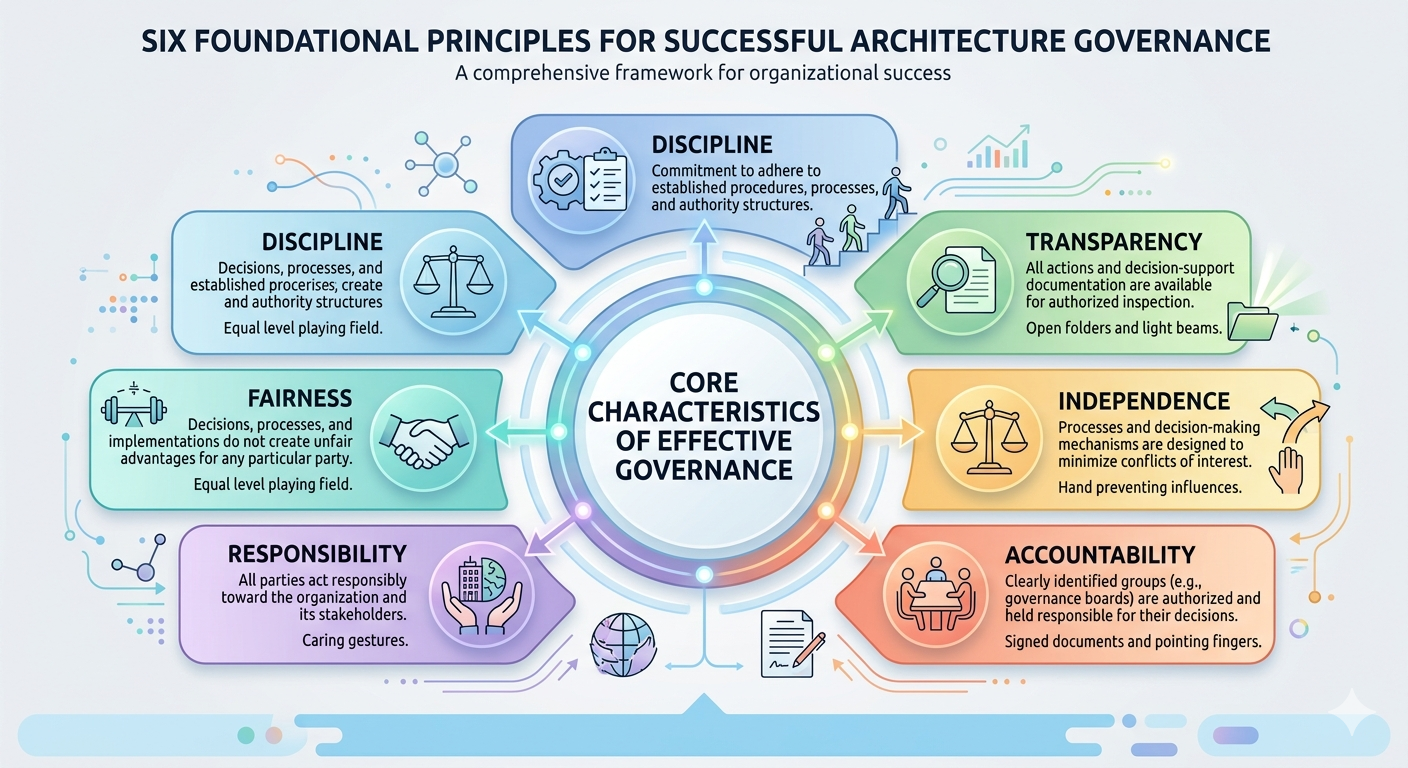
Discipline: Commitment to adhere to established procedures, processes, and authority structures.
Transparency: All actions and decision-support documentation are available for authorized inspection.
Independence: Processes and decision-making mechanisms are designed to minimize conflicts of interest.
Accountability: Clearly identified groups (e.g., governance boards) are authorized and held responsible for their decisions.
Responsibility: All parties act responsibly toward the organization and its stakeholders.
Fairness: Decisions, processes, and implementations do not create unfair advantages for any particular party.
A robust governance initiative requires a flexible, content-agnostic framework. This ensures that new regulations, technologies, or business priorities can be integrated without disrupting established processes.
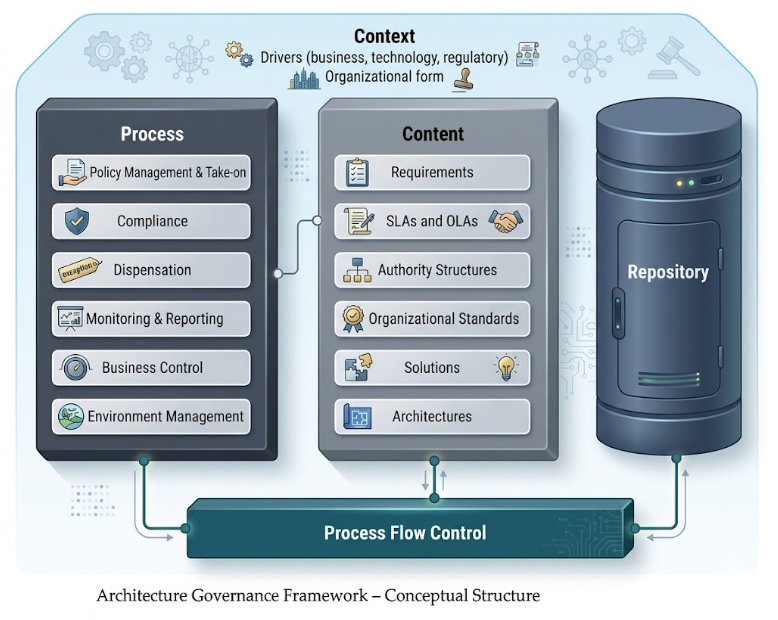
The framework is divided into three interrelated layers:
Process: The workflows, reviews, approvals, and monitoring activities.
Content: The actual policies, standards, principles, and architectural artifacts being governed.
Context: The organizational environment, regulatory landscape, and business drivers that shape governance requirements.
This separation allows organizations to update standards (content) or adapt to new market conditions (context) without redesigning the underlying governance workflows (process).
Policy Management & Take-On: Establishing, reviewing, and retiring architectural standards and principles.
Compliance & Dispensation: Evaluating project adherence to standards and formally approving exceptions when necessary.
Monitoring & Reporting: Tracking architectural decisions, risks, and implementation progress.
Business Control & Environment Management: Aligning architectural outcomes with business objectives and managing the broader IT ecosystem.
Governance requires people, roles, and reporting lines. A typical structure includes:
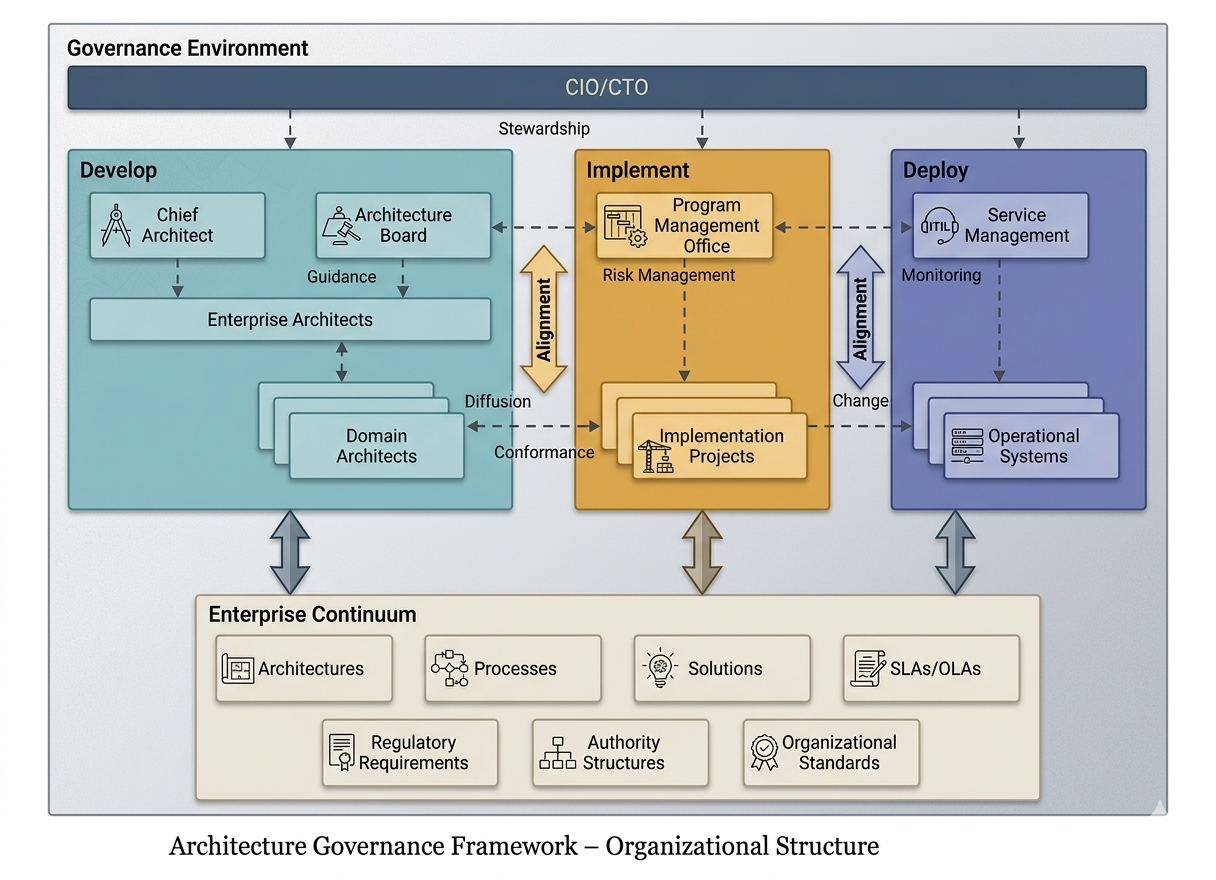
Global/Local Governance Boards: Cross-functional groups that oversee strategic alignment.
Design Authorities: Subject-matter experts who validate technical and architectural decisions.
Working Parties: Project-level teams responsible for implementing governed standards.
An Enterprise Architecture imposed without executive backing will fail. The Architecture Board is a cross-organizational body of key stakeholders responsible for reviewing, maintaining, and enforcing the overall architecture.
Primary Responsibilities:
Providing the basis for all decision-making regarding architectural changes
Ensuring consistency across sub-architectures
Establishing targets for component re-use
Maintaining architectural flexibility to meet business needs and leverage new technologies
Enforcing Architecture Compliance
Improving the maturity of the architecture discipline
Supporting a visible escalation path for out-of-bound decisions
The board also handles operational tasks like monitoring Architecture Contracts and producing usable governance materials.
Architecture Contracts are formal agreements between development partners and sponsors that define deliverables, quality expectations, and fitness-for-purpose of an architecture. They bridge the gap between architectural intent and practical implementation.
A governed contract ensures:
Continuous monitoring of integrity, changes, decision-making, and audits
Strict adherence to enterprise principles, standards, and requirements
Proactive identification of risks across development and implementation
Clear accountability, responsibility, and discipline for all architectural artifacts
Formal understanding of the governance body’s authority and scope
Compliance ensures that individual projects align with the enterprise architecture. It is evaluated across four distinct levels:
Conformant: The implementation fully matches the architecture specification.
Compliant: Some features in the specification are not implemented, but those that are align with the specification.
Non-conformant: The implementation deviates from the specification in ways that violate architectural intent.
Irrelevant: The implementation shares no features with the architecture specification.
Why Compliance Matters:
Catches errors early, reducing costly late-stage changes
Enforces best practices across the enterprise
Provides an overview of alignment with mandated standards
Identifies where standards themselves need updating
Documents collaboration and resource-sharing strategies
Communicates technical readiness to management
Guides procurement and vendor selection
An Architecture Compliance Review is a structured scrutiny of a specific project against established architectural criteria, business objectives, and governance spirit. It follows a standardized 12-step process:
Request Review: Triggered by governance policy or project milestone.
Identify Organization & Principals: Assign the Architecture Review Coordinator and project leads.
Assign Lead Architect: Designate the Lead Enterprise Architect and supporting team.
Determine Scope: Map where the system fits within the corporate architecture and identify cross-departmental impacts.
Tailor Checklists: Adapt review criteria to address specific business and technical requirements.
Schedule Review Meeting: Coordinate with the Lead Architect and project team.
Interview Principals: Gather background, technical details, and context using tailored checklists.
Analyze Checklists: Compare findings against corporate standards, resolve issues, and draft recommendations.
Prepare Report: Compile findings, gaps, and actionable recommendations.
Present Findings: Share results with the project sponsor and Architecture Board.
Accept & Sign-Off: Formal approval by the Architecture Board and customer.
Distribute Report: Send assessment summary to the Architecture Review Coordinator for tracking.
Business-IT Alignment: Links IT processes, resources, and data directly to organizational strategies.
Best Practice Institutionalization: Embeds proven methodologies and aligns with frameworks like COBIT.
Asset Optimization: Maximizes ROI on existing infrastructure, applications, and data.
Risk Visibility: Promotes transparent, measurable risk management.
Regulatory & Security Compliance: Supports auditability, data protection, and accountability requirements.
Digital Asset Protection: Safeguards the organization’s core technological and informational investments.
Establish clear processes for submitting, adopting, reusing, and retiring architectural policies.
Define correct organizational responsibilities and reporting structures.
Integrate tools and workflows to drive cultural and procedural adoption.
Manage criteria for controls, dispensations, compliance assessments, and SLAs/OLAs.
Ensure all governance activities meet internal/external requirements for effectiveness, confidentiality, integrity, and reliability.
Governance cannot function in a vacuum. It requires a mature, sustainable Architecture Capability. The most effective way to establish this capability is to apply the Architecture Development Method (ADM) to the architecture practice itself.
This is not a one-off project but an ongoing organizational practice. Building the capability requires designing the four architecture domains specifically for the architecture function:
Business Architecture: Define governance processes, organizational structure, information requirements, architecture products, and decision workflows.
Data Architecture: Design the structure of the Enterprise Continuum and Architecture Repository to store, classify, and retrieve architectural assets.
Application Architecture: Specify the functionality and services required to support architecture planning, modeling, and collaboration.
Technology Architecture: Define the infrastructure, tools, and deployment requirements needed to host architecture applications and repositories.
As projects run within this environment, they may request changes to the architecture practice itself, triggering another ADM cycle to evolve and mature the capability.
Scenario: Multiple departments independently purchase cloud-based CRM tools without consulting IT. Data becomes siloed, security risks increase, and integration costs soar.
Governance in Action: An Architecture Board establishes a standard that all customer-facing systems must integrate with the enterprise identity management platform. An Architecture Contract is drafted for any new CRM procurement, specifying required APIs, data encryption standards, and SLA expectations. Before deployment, a Compliance Review validates that the chosen tool meets these criteria. Departments are guided toward approved solutions, saving millions in integration and security remediation.
Scenario: A development team skips a mandatory data validation layer to meet a tight launch deadline.
Governance in Action: During a scheduled Compliance Review, the gap is identified early. Instead of halting the project, the board grants a formal Dispensation (approved exception) with conditions: a compensating manual review process is implemented temporarily, and the missing validation layer is scheduled as a Phase 1 enhancement. This prevents a post-launch data corruption incident while keeping the business timeline intact.
Scenario: An organization hires an external partner to rebuild its legacy ERP system.
Governance in Action: An Architecture Contract is signed before development begins. It specifies that the solution must conform to the enterprise’s microservices architecture, use approved container orchestration, and expose data through a centralized API gateway. The contract includes compliance checkpoints at design, development, and deployment. The vendor knows exactly what “done” means, and the organization avoids vendor lock-in and architectural drift.
Architecture Governance is the bridge between strategic vision and practical execution. It transforms architecture from a theoretical blueprint into a living, controlled, and continuously improving discipline. By establishing a clear framework, empowering an Architecture Board, enforcing Architecture Contracts, and running structured Compliance Reviews, organizations can deliver technology solutions that are secure, aligned, reusable, and business-value driven.
For beginners, the key takeaway is simple: Governance enables innovation safely. It does not slow progress; it ensures that progress is sustainable, measurable, and aligned with the organization’s long-term goals. Start with foundational principles, build cross-functional oversight, document agreements clearly, review consistently, and continuously evolve your architecture capability using proven iterative methods.

