
Phase A: Architecture Vision is the foundational starting point of every iteration of the TOGAF Architecture Development Method (ADM) cycle. It initiates the architecture project, establishes the strategic direction, and secures the organizational commitment required to proceed. Think of Phase A as the "blueprint planning and approval stage" where architects translate high-level business aspirations into a clear, actionable architectural direction.
Without a well-defined Architecture Vision, subsequent phases risk misalignment with business goals, stakeholder disengagement, or scope creep. Phase A ensures that everyone agrees on what is being built, why it matters, and how success will be measured before diving into detailed design.
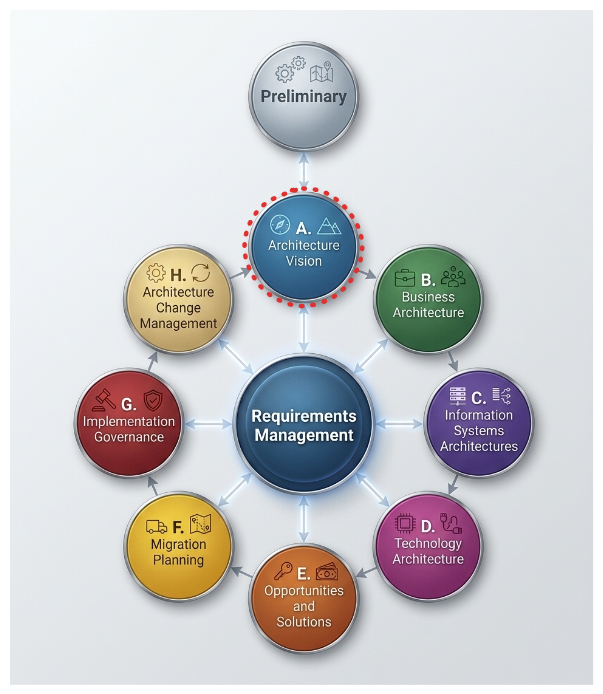
Phase A has two primary objectives that guide all activities within this phase:
Develop a High-Level Aspirational Vision: Create a clear, compelling description of the capabilities and business value that will be delivered once the proposed Enterprise Architecture is successfully implemented.
Secure Formal Approval: Obtain stakeholder and sponsor endorsement for a Statement of Architecture Work, which officially defines the scope, approach, and program of work for the architecture project.
The Architecture Vision is a concise, high-level document that outlines the desired future state of the enterprise. It serves as a strategic tool to communicate benefits, align stakeholders, and set boundaries for detailed architectural work. Key characteristics include:
First-Cut Descriptions: Provides initial, high-level views of both the Baseline Architecture (current state) and Target Architecture (future state) across all four domains: Business, Data, Application, and Technology.
Business-Aligned: Explicitly connects architectural changes to business goals, strategic objectives, and stakeholder concerns.
Forward-Looking: Incorporates an understanding of emerging technologies and their potential impact on the industry and enterprise.
This is the formal, contract-like document produced at the end of Phase A. It defines:
The scope and constraints of the architecture project
The approach and methodology to be used
Timelines, milestones, and resource expectations
Roles and responsibilities
Once signed by the sponsoring organization, it authorizes the architecture team to proceed to Phase B and beyond.
The trigger for Phase A. It is a formal document sent from the sponsoring organization (e.g., executive leadership or business unit head) to the architecture organization, requesting the initiation of an architecture development cycle.
A structured method used primarily in Phase A to identify, articulate, and validate business requirements. It bridges the gap between high-level business strategy and technical architecture by describing real-world business processes, actors, and desired outcomes.
Phase A follows a structured flow to ensure alignment, feasibility, and stakeholder buy-in:
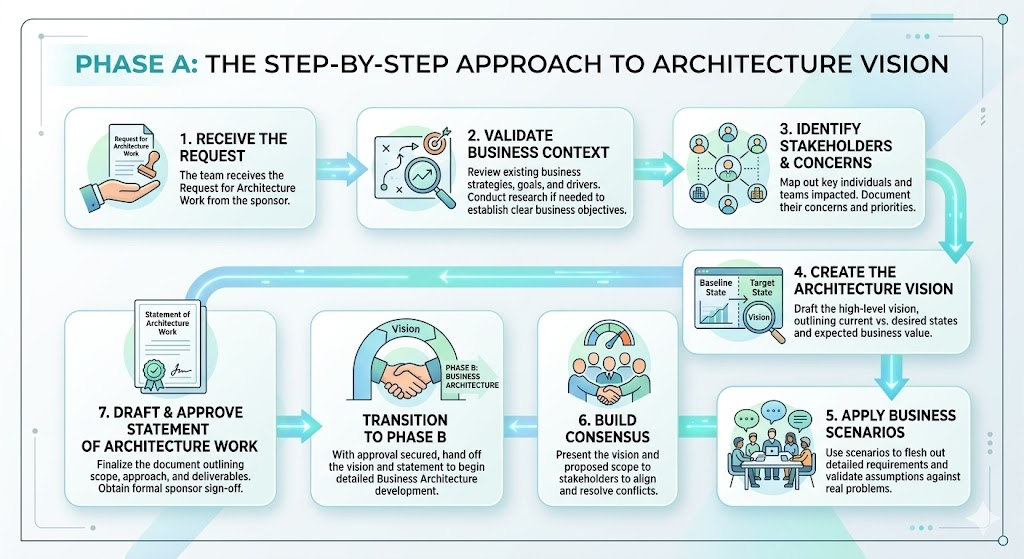
Receive the Request: The architecture team receives the Request for Architecture Work from the sponsor.
Validate Business Context: Review existing business strategies, goals, and drivers. If minimal business architecture work exists, conduct research to establish clear business objectives.
Identify Stakeholders & Concerns: Map out key individuals, teams, or departments impacted by the architecture. Document their concerns and priorities.
Create the Architecture Vision: Draft the high-level vision document, outlining baseline vs. target states, expected business value, and technology implications.
Apply Business Scenarios: Use this technique to flesh out detailed requirements, validate assumptions, and ensure the vision addresses real business problems.
Build Consensus: Present the vision and proposed scope to stakeholders. Facilitate discussions to align expectations and resolve conflicts.
Draft & Approve Statement of Architecture Work: Finalize the document outlining scope, approach, and deliverables. Obtain formal sign-off from the sponsor.
Transition to Phase B: With approval secured, hand off the vision and statement to begin detailed Business Architecture development.
Scenario: A traditional brick-and-mortar retail company wants to modernize its sales model to compete with digital-first competitors. Executive leadership issues a Request for Architecture Work to create an integrated "omnichannel" architecture.
Validate Context: The architecture team reviews the company's 3-year strategic plan, which prioritizes customer experience, inventory visibility, and mobile sales.
Stakeholder Mapping: Key stakeholders include the CIO, VP of Sales, Store Operations Manager, IT Security Lead, and Customer Support Director. Concerns range from real-time inventory sync to data privacy.
Architecture Vision Drafted:
Baseline: Separate POS systems, manual inventory counts, siloed customer databases, no mobile app.
Target: Unified commerce platform, real-time cloud inventory, integrated CRM, customer mobile app, secure API layer.
Business Value: 25% increase in online conversion, 15% reduction in stockouts, unified customer experience.
Business Scenarios Used: The team maps a scenario: "Customer buys online, picks up in-store." They identify required capabilities (real-time inventory check, secure payment handoff, staff notification system) and derive architecture requirements from it.
Consensus & Approval: The CIO, VP of Sales, and Operations Manager review the vision. Adjustments are made to prioritize Phase 1 rollout in 5 flagship stores. The Statement of Architecture Work is signed, authorizing the project.
Next Step: The team moves to Phase B to detail the Business Architecture for the omnichannel model.
Business Scenarios are not just stories; they are a structured analysis tool used to ensure the architecture solves actual business problems.
How It Works:
Identify the Problem: What business process or gap is driving this architecture project?
Map the Environment: Describe the business and technology context where the problem occurs.
Define Desired Outcomes: What does success look like? How will it be measured?
Identify Actors: Who (human) and what (system) are involved? What are their roles?
Validate & Refine: Check if the scenario accurately reflects reality and if the proposed architecture adequately addresses it.
Why It Matters in Phase A: It prevents architects from designing in a vacuum. By grounding the vision in real business workflows, stakeholders can immediately see the relevance and value, accelerating approval and reducing rework later.
Secure Executive Sponsorship Early: Architecture without political backing will stall. Ensure leadership is visibly committed.
Keep the Vision High-Level: Phase A is not for detailed design. Focus on strategic direction, capabilities, and business value.
Leverage Existing Strategy Documents: Reuse validated business goals, KPIs, and market analyses rather than reinventing them.
Use Business Scenarios Iteratively: Apply them at multiple levels of detail to refine requirements progressively.
Build Consensus, Don't Dictate: The Architecture Vision must be a shared understanding. Without stakeholder sign-off, implementation will face resistance.
Skipping Stakeholder Alignment: Assuming technical excellence will drive adoption. Architecture is as much about people as it is about technology.
Over-Scoping Phase A: Trying to design detailed data models or system integrations too early. Save that for Phases B, C, and D.
Ignoring Emerging Technologies: Failing to consider how cloud, AI, or IoT could enable or disrupt the vision.
Weak Statement of Architecture Work: Vague scope, unclear deliverables, or missing milestones lead to uncontrolled projects and stakeholder frustration.
Phase A: Architecture Vision is the critical launchpad of the TOGAF ADM cycle. It transforms strategic business intent into a clear, approved architectural direction. By developing a compelling Architecture Vision, validating requirements through Business Scenarios, and securing formal approval via the Statement of Architecture Work, architects set the stage for successful, aligned, and value-driven enterprise transformation.
Key Takeaways for Beginners:
Phase A is about direction, alignment, and approval, not detailed design.
The Architecture Vision connects business strategy to future architecture.
Business Scenarios ensure the architecture solves real business problems.
The signed Statement of Architecture Work is your green light to proceed.
Stakeholder consensus is non-negotiable; architecture fails without buy-in.
Mastering Phase A ensures that every subsequent phase operates within clear boundaries, focused on delivering measurable business value.

