
Within the TOGAF Architecture Development Method (ADM), Phase D: Technology Architecture serves as the critical bridge between business/application requirements and the physical/digital infrastructure that makes them possible. While earlier phases define what the business needs to do and what applications and data will support it, Phase D defines how the technology will be structured, deployed, and governed to deliver those capabilities reliably, securely, and efficiently.
Technology Architecture encompasses the fundamental organization of an enterprise’s IT systems. It covers hardware, software, networks, communications, middleware, processing capabilities, and the technical standards that govern their design and evolution over time.
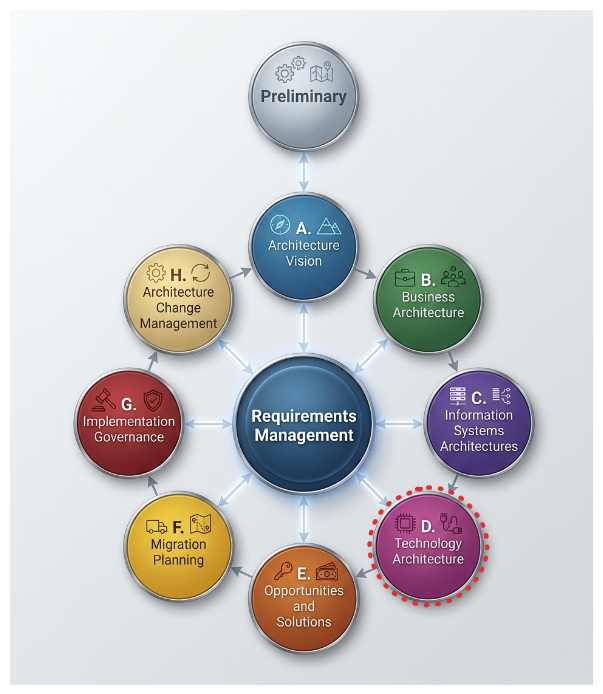
Phase D is guided by three primary objectives that ensure alignment with enterprise goals and stakeholder expectations:
Develop the Target Technology Architecture: Design a future-state technical landscape that enables the delivery of the business, data, and application building blocks defined in earlier phases.
Address Stakeholder Concerns & the Statement of Architecture Work: Ensure the technical design responds to performance, security, scalability, compliance, and cost requirements identified during Phase A.
Identify Architecture Roadmap Components: Perform a structured gap analysis between the current (Baseline) and future (Target) technology states to identify projects, upgrades, or retirements that will populate the implementation roadmap.
For beginners, the following concepts form the foundation of a successful Technology Architecture:
| Concept | Explanation |
|---|---|
| Baseline Architecture | A snapshot of the current technology landscape: existing servers, networks, cloud services, legacy systems, and technical debt. |
| Target Architecture | The desired future technology state that supports business goals, application modernization, and data strategies. |
| Gap Analysis | A systematic comparison of Baseline vs. Target to identify what must be added, upgraded, integrated, or decommissioned. |
| Architecture Building Blocks (ABBs) | Abstract, vendor-neutral definitions of required technology capabilities (e.g., “secure API gateway,” “scalable container orchestration”). |
| Solution Building Blocks (SBBs) | Concrete products, platforms, or custom developments that implement the ABBs (e.g., “Kong API Gateway,” “AWS EKS,” “Cisco SD-WAN”). |
| Technical Reference Models | Predefined, industry-standard frameworks (like the TOGAF Technical Reference Model) that provide a consistent taxonomy and structure for technology components. |
The TOGAF standard recommends a structured, iterative approach to developing the Technology Architecture:
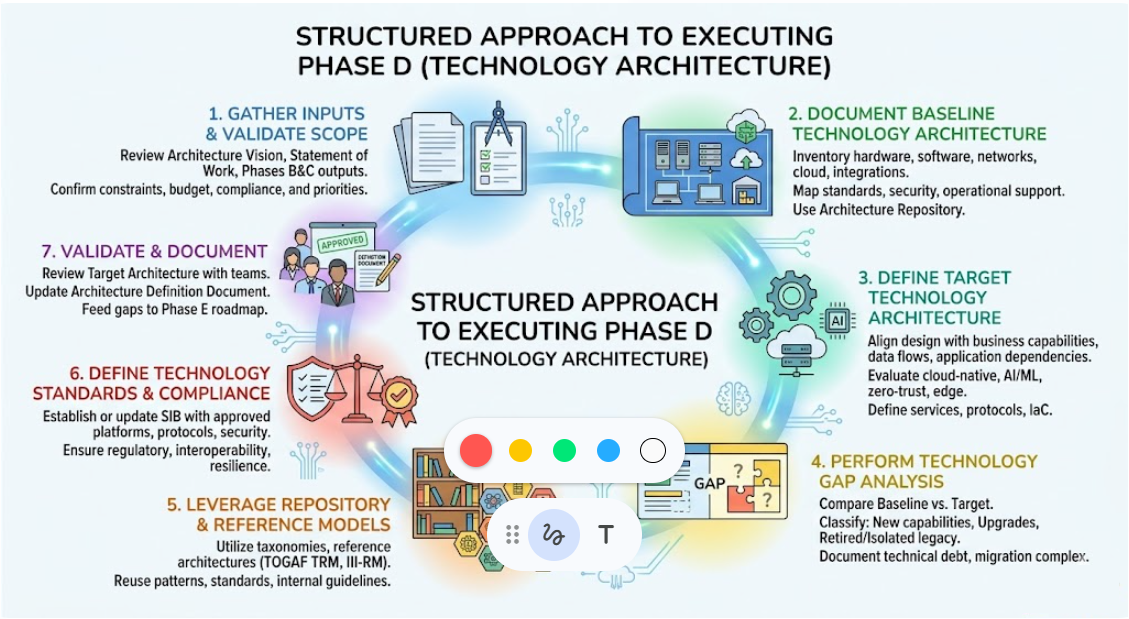
Review the Architecture Vision, Statement of Architecture Work, and outputs from Phases B & C.
Confirm technology constraints, budget limits, compliance mandates, and stakeholder priorities.
Inventory existing hardware, software, networks, cloud subscriptions, and integration layers.
Map current technical standards, security postures, and operational support models.
Leverage existing artifacts from the Architecture Repository to avoid redundant documentation.
Align technical design with business capabilities, data flows, and application dependencies.
Evaluate emerging technologies (cloud-native architectures, AI/ML infrastructure, zero-trust security, edge computing) that can drive innovation or reduce costs.
Define required platform services, middleware, communication protocols, and infrastructure-as-code practices.
Compare Baseline and Target architectures.
Classify gaps as:
New capabilities to be procured or developed
Existing systems to be upgraded or integrated
Legacy components to be retired or isolated
Document technical debt and migration complexities.
Utilize standardized taxonomies and reference architectures (e.g., TOGAF TRM, III-RM) to ensure consistency.
Reuse industry-specific technology patterns, vendor-neutral standards, and internal technical guidelines.
Establish or update the Standards Information Base (SIB) with approved platforms, protocols, and security frameworks.
Ensure alignment with regulatory, interoperability, and operational resilience requirements.
Review the Target Architecture with infrastructure, security, and operations teams.
Update the Architecture Definition Document with Technology Architecture sections.
Feed identified gaps and transition states into Phase E for roadmap development.
Architecture Vision & Statement of Architecture Work (Phase A)
Business, Data, and Application Architectures (Phases B & C)
Existing technology inventory & operational metrics
Architecture Repository assets (reference models, standards, past projects)
Stakeholder concerns (security, performance, cost, compliance)
Target Technology Architecture Description
Technology Gap Analysis Report
Updated Architecture Requirements Specification (Technology)
Candidate Architecture Roadmap Components
Revised Standards Information Base entries
Updated Architecture Definition Document
Scenario: A mid-sized retail company wants to launch a real-time personalized shopping experience.
| Aspect | Baseline (Current State) | Target (Future State) | Gap / Action |
|---|---|---|---|
| Hosting | Single on-premise data center, physical servers | Multi-cloud hybrid (AWS + Azure) with auto-scaling | Procure cloud subscriptions, migrate workloads, decommission legacy servers |
| Application Runtime | Monolithic Java app on VMs | Containerized microservices on Kubernetes | Implement container platform, refactor app, train DevOps team |
| Data Integration | Nightly batch ETL jobs | Real-time streaming via Kafka + API gateway | Deploy streaming infrastructure, build API management layer |
| Security | Perimeter firewall, basic IAM | Zero-trust architecture, MFA, secrets management | Implement identity federation, deploy PAM solution, update security policies |
| Network | Traditional VLANs, static routing | Software-Defined Networking (SDN), global CDN | Migrate to SD-WAN, integrate CDN provider, update monitoring tools |
How Phase D Drives This:
Translates business goals (“personalized real-time shopping”) into technical requirements (low-latency APIs, scalable compute, secure data pipelines).
Uses gap analysis to identify that legacy servers and batch ETL cannot support the target state.
Outputs a set of technology work packages (cloud migration, Kubernetes deployment, zero-trust rollout) that Phase E will sequence into an implementation roadmap.
Start with Business Outcomes, Not Technology Trends: Avoid “shiny object syndrome.” Every technology choice must trace back to a business, data, or application requirement.
Leverage Reference Models Early: Use the TOGAF Technical Reference Model (TRM) or industry-specific patterns as a baseline to ensure comprehensive coverage and standard terminology.
Engage Cross-Functional Teams: Involve infrastructure, security, network, and operations teams during Phase D to ensure feasibility and operational readiness.
Document Standards Clearly: Maintain a living Standards Information Base. Ambiguous or outdated standards lead to vendor lock-in and integration failures.
Plan for Evolution, Not Perfection: Technology architectures change rapidly. Design for modularity, interoperability, and incremental migration rather than monolithic overhauls.
Validate Against Non-Functional Requirements: Explicitly address performance, scalability, resilience, security, and cost constraints before finalizing the Target Architecture.
Phase D: Technology Architecture is the engineering backbone of the TOGAF ADM. It transforms abstract business and application needs into a concrete, actionable technical blueprint. By systematically documenting the baseline, designing the target, performing rigorous gap analysis, and aligning with enterprise standards, architects ensure that technology investments are strategic, secure, and sustainable.
When executed effectively, Phase D provides the clarity and structure needed for Phase E (Opportunities & Solutions) to sequence implementation projects, manage risk, and deliver continuous business value. Mastering this phase equips beginners with the foundational skills to bridge strategy and execution in modern enterprise architecture.

