
In the modern software development landscape, the transition from monolithic legacy systems to agile microservices is as much a cultural challenge as it is a technical one. When organizations face extreme pressure—such as tight deadlines for national retail contracts or the weight of technical debt—the discipline of Agile often breaks down into "Mini-Waterfall," where structure is sacrificed for speed.
This case study focuses on EcoStream, a SaaS platform struggling to balance rapid feature deployment with the structural integrity of its architecture. By utilizing Unified Modeling Language (UML) as a diagnostic lens, we peel back the layers of team communication, sprint governance, and process flow to reveal why high-pressure environments often trigger systemic failure. This article explores how formalizing our understanding of team interactions and development states can provide the clarity needed to regain control of the product lifecycle.
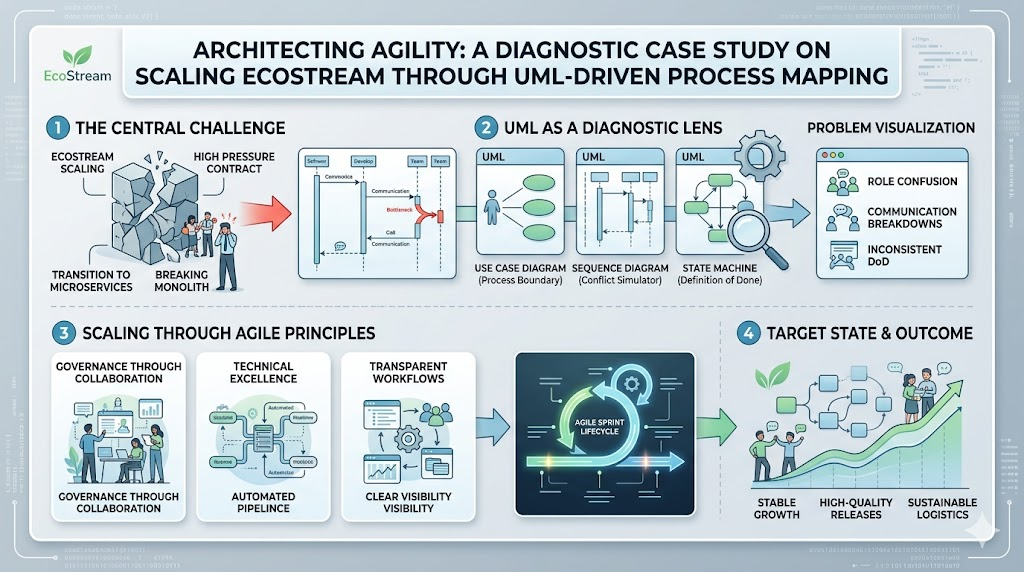
EcoStream is an established mid-sized technology company that provides a software-as-a-service (SaaS) platform connecting local organic farmers with urban retail grocery chains. While the platform has successfully served 50 local farms, the company is attempting to transition from a monolithic architecture to a microservices-based architecture to accommodate a massive contract with a national grocery retailer. This expansion requires integrating real-time logistics tracking, automated demand forecasting, and complex multi-vendor inventory management.
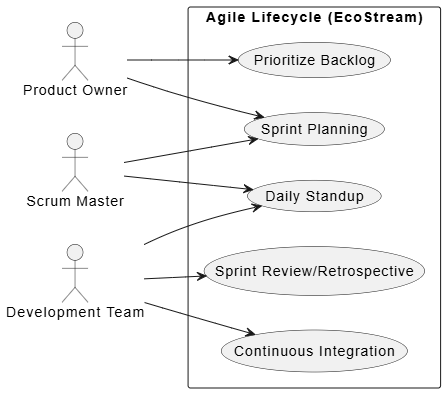
EcoStream Use Case Diagaram Example
Below is the UML modeling for the EcoStream project using PlantUML syntax.
This diagram defines the interaction between the stakeholders (PO, Developers) and the Agile process requirements (Sprint planning, refinement, and delivery).
@startuml
left to right direction
actor "Product Owner" as PO
actor "Development Team" as Dev
actor "Scrum Master" as SM
rectangle "Agile Lifecycle (EcoStream)" {
usecase "Prioritize Backlog" as UC1
usecase "Sprint Planning" as UC2
usecase "Daily Standup" as UC3
usecase "Continuous Integration" as UC4
usecase "Sprint Review/Retrospective" as UC5
}
PO --> UC1
PO --> UC2
Dev --> UC3
Dev --> UC4
Dev --> UC5
SM --> UC2
SM --> UC3
@enduml
Goal: Define the scope of the next 2-week iteration.
Actors: Product Owner (PO), Development Team, Scrum Master (SM).
Preconditions: The Product Backlog is refined and prioritized by the PO.
Main Flow:
PO presents the top-priority user stories.
Dev team estimates the effort required for stories using Planning Poker.
SM facilitates capacity planning based on historical velocity.
The team commits to the Sprint Backlog.
Post-conditions: A committed Sprint Backlog is created; the Sprint begins.
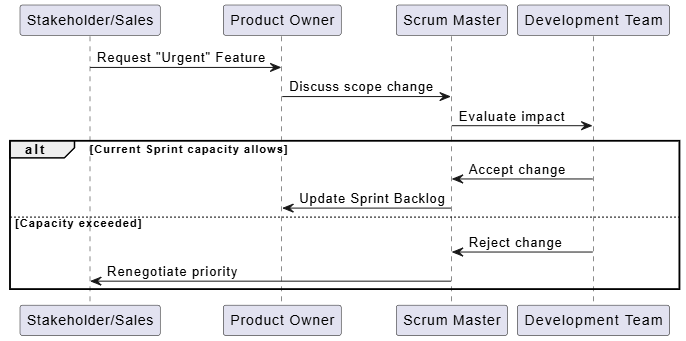
This diagram illustrates the "Injecting Urgent Requirements" scenario—a common anti-pattern in our case study where the Stakeholder interrupts the team during an active sprint.
@startuml
participant "Stakeholder/Sales" as S
participant "Product Owner" as PO
participant "Scrum Master" as SM
participant "Development Team" as Dev
S -> PO: Request "Urgent" Feature
PO -> SM: Discuss scope change
SM -> Dev: Evaluate impact
alt Current Sprint capacity allows
Dev -> SM: Accept change
SM -> PO: Update Sprint Backlog
else Capacity exceeded
Dev -> SM: Reject change
SM -> S: Renegotiate priority
end
@enduml
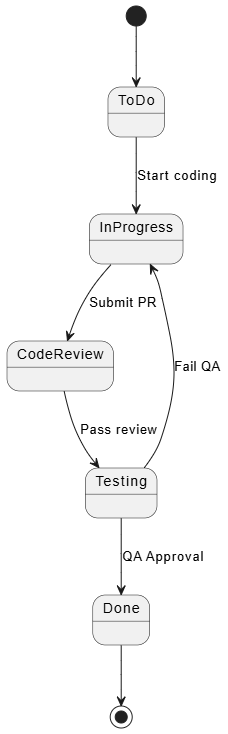
This diagram models the lifecycle of a single User Story within the Agile process, tracking it from "To Do" to "Done."
@startuml
[*] --> ToDo
ToDo --> InProgress : Start coding
InProgress --> CodeReview : Submit PR
CodeReview --> Testing : Pass review
Testing --> Done : QA Approval
Testing --> InProgress : Fail QA
Done --> [*]
@enduml
The current development team is struggling with the transition, leading to a significant degradation in product quality and team morale. The primary challenges are:
Architectural Debt: The legacy monolith is brittle. Teams are finding that modifying a feature for the new national retailer frequently breaks core functionality for existing local farmers.
Communication Silos: The shift to a microservices approach has resulted in "feature silos." The Logistics team, the Inventory team, and the Payments team are working in isolation, leading to integration nightmares during the final stages of the sprint.
"Waterfall-in-Agile" Traps: Despite claiming to use Scrum, the organization is effectively practicing "Mini-Waterfall." Requirements are handed down in 50-page documents, sprints are treated as mini-deadlines with no room for discovery, and the definition of "Done" is inconsistently applied across squads.
Technical Bottlenecks: Manual testing cycles and a lack of automated CI/CD pipelines mean that deployments occur only once a month, leading to high-risk releases and frequent rollbacks.
Timeline: The "National Retailer" launch is non-negotiable and scheduled for 6 months from today.
Team Composition: 3 cross-functional squads of 7 people each (Product Owner, Scrum Master, 3 Developers, 1 QA, 1 DevOps).
Objective: Successfully migrate the core inventory module to a microservice while maintaining 99.9% uptime for the existing farmer network.
Budget: Fixed; additional hiring is not permitted.
Impediment Management: The team faces constant external dependencies (e.g., waiting on legacy API documentation) which are not being tracked in the Sprint Backlog.
Velocity Fluctuations: Sprint velocity has been volatile (ranging from 12 points to 45 points), indicating poor estimation practices and over-commitment.
The "Hero" Culture: Knowledge is concentrated in two senior engineers. When they are overwhelmed, development stops, creating a bottleneck for the rest of the team.
Stakeholder Pressure: The Sales team continues to promise custom features to the national retailer, which are being injected into active sprints, causing scope creep and disrupting the planned workflow.
To understand how these departmental silos impact the development lifecycle, consider the following visualization of the current bottleneck:
Scrum Implementation: Evaluate if the current roles (PO, SM) are functioning correctly or if they have reverted to traditional Project Management roles.
Prioritization Techniques: Analyze how the Product Owner should handle the tension between the "National Retailer" requirements and "Core Platform" stability.
Technical Excellence: Propose a strategy for moving from manual to automated testing within the constraints of an active high-pressure project.
To effectively resolve the systemic issues within the EcoStream project, we must view our UML models not just as documentation, but as diagnostic maps. By visualizing the friction points between stakeholders, processes, and technical states, we can identify where the team’s Agile implementation is breaking down.
The Use Case Diagram: This acts as the process boundary. It clarifies roles and responsibilities. In our case study, the overlap between the Product Owner and Scrum Master in the "Sprint Planning" use case is critical. If the PO is dictating capacity rather than just priorities, the diagram helps us highlight the misalignment of power within the Scrum framework.
The Sequence Diagram: This serves as a conflict simulator. By modeling the "Urgent Requirement" injection, we can see the exact points of failure in communication. This diagram illustrates why "Hero Culture" thrives: when Sales bypasses the PO or when the team lacks a formal negotiation mechanism, the communication path becomes a bottleneck.
The State Machine Diagram: This represents the Definition of Done (DoD). It is the most objective measure of progress. For EcoStream, if stories are frequently moving from Testing back to InProgress, the State Machine visually confirms that the team’s "Done" criteria are either misunderstood or too loosely enforced.
When applying these diagrams to the EcoStream case study, focus your analysis on three core pillars:
Transparency vs. Silos: Look at the Sequence Diagram. Does the interaction model show open communication across squads, or does it confirm that the Product Owner is the only bridge between the National Retailer and the Developers? Excessive reliance on a single bridge is a classic symptom of failing Agile projects.
State Consistency: The State Machine diagram illustrates the flow of a single story. If the team is experiencing "mini-waterfall" tendencies, you will often find that the CodeReview or Testing states are being skipped or compressed at the end of the sprint, leading to technical debt.
Governance through Process: The Use Case diagram demonstrates that Scrum is a collaborative governance model. If the team finds that the "Continuous Integration" use case is failing, it suggests that the technical process (DevOps) is not being sufficiently supported by the Agile process (Sprint planning).
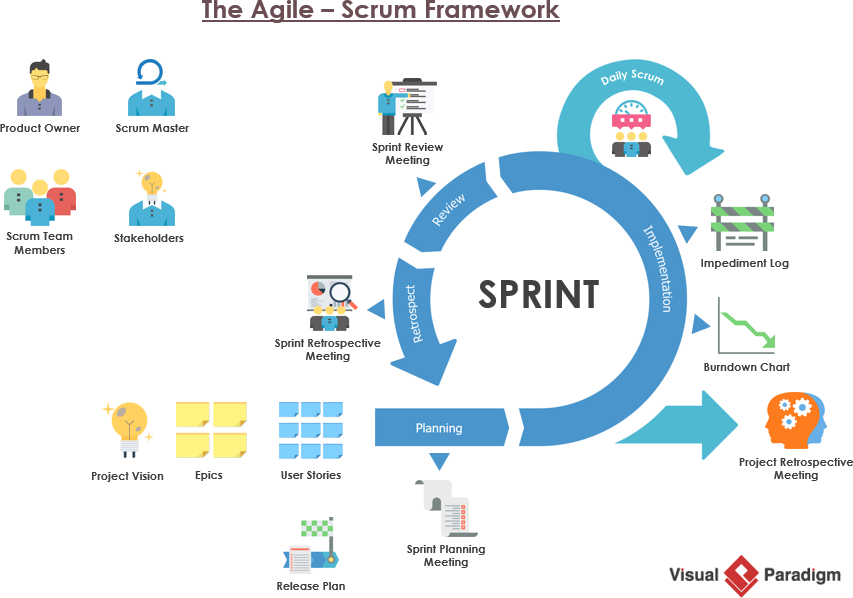
By mapping these abstract interactions to the specific pain points of EcoStream—such as the volatile velocity and the pressure from the national retailer—you can move from subjective complaints to objective architectural and process-driven solutions.
Are you interested in exploring how to modify these diagrams to represent a "target state" for EcoStream after they successfully implement a more mature CI/CD pipeline?
The analysis of the EcoStream project underscores a vital lesson in software engineering: Agile is a framework for discovery, not just a mechanism for delivery. The UML diagrams presented here serve as more than mere documentation; they act as a rigorous audit of the team’s current operational health. By visualizing the "urgent requirement" bottlenecks through sequence diagrams and identifying the breakdowns in the "Definition of Done" via state machines, we move the conversation from blame to architecture.
For EcoStream to successfully scale its sustainable logistics platform, the solution lies in tightening the governance of its Agile processes while simultaneously automating the technical path to production. Bridging the gap between the Product Owner's vision and the development team’s capacity requires clear, visual language that aligns all stakeholders on a single truth. By leveraging these modeling standards, teams can transform their workflow from a chaotic reaction to market pressure into a disciplined, high-velocity engine that delivers value without compromising the stability of their core architecture.

