
In the world of enterprise architecture, organizations rarely start from scratch. Instead, they build upon existing knowledge, industry standards, and proven solutions. The Enterprise Continuum is a foundational concept that provides a structured, repeatable way to classify, organize, and reuse architectural assets. It acts as a virtual repository and a common language, enabling architects to move efficiently from abstract ideas to concrete, organization-specific implementations. This guide breaks down the concept, its components, and how it operates in real-world scenarios.
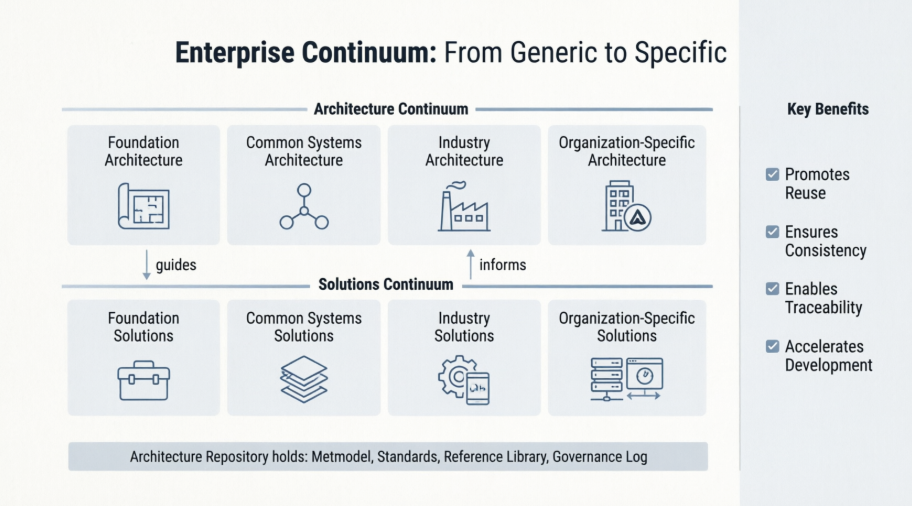
A continuum is a continuous spectrum or progression. In architecture, it represents a smooth transition from generic and abstract concepts on one end, to specific and concrete implementations on the other.
Think of it like designing a house:
You start with universal principles of construction (foundation, load-bearing walls, plumbing standards).
You adapt them to regional building codes and climate patterns.
You apply neighborhood-specific styles and utility connections.
Finally, you customize it for a specific family’s layout, furniture, and smart-home devices.
The Enterprise Continuum applies this same progression to IT and business architecture, ensuring that every decision builds logically upon what came before.
The Enterprise Continuum is not a physical database, but a classification model that organizes all architecture and solution artifacts an enterprise creates, acquires, or references. Its primary purposes are:
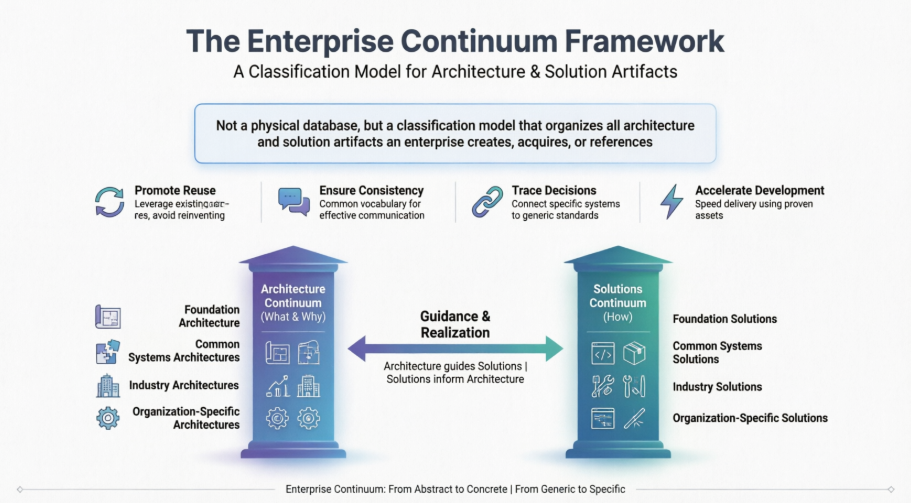
Promote Reuse: Avoid reinventing the wheel by leveraging existing architectures and solutions.
Ensure Consistency: Provide a common vocabulary so buy-side and supply-side architects can communicate effectively.
Trace Decisions: Show how a highly specific system traces back to generic standards and principles.
Accelerate Development: Speed up architecture delivery by pulling from proven assets rather than starting blank.
The Enterprise Continuum is divided into two complementary pillars:
The Architecture Continuum (The What and Why)
The Solutions Continuum (The How)
The Architecture Continuum stores reusable architecture assets such as models, patterns, building blocks, and specifications. It evolves from generic foundations to organization-specific designs.
| Level | Description | Beginner-Friendly Example |
|---|---|---|
| Foundation Architecture | Generic, technology-agnostic principles, components, and standards that apply across all industries. | TOGAF Technical Reference Model (TRM), basic networking protocols, generic security frameworks. |
| Common Systems Architecture | Patterns that address cross-cutting concerns shared by many domains (e.g., security, management, integration). | Identity & Access Management (IAM) architecture, enterprise service bus patterns, data governance models. |
| Industry Architecture | Sector-specific architectures that incorporate regulatory, operational, and market realities. | Banking core transaction architecture, healthcare HL7/FHIR data exchange models, retail POS ecosystem designs. |
| Organization-Specific Architecture | Tailored architectures built for a single enterprise, incorporating its unique processes, policies, and legacy systems. | A specific company’s customized omnichannel commerce architecture, including their unique workflow approvals and integrations. |
Key Insight: Architects typically start on the left (Foundation) and move rightward, adding business context, constraints, and specificity at each step.
While the Architecture Continuum defines what should be built, the Solutions Continuum tracks what actually exists or can be purchased. It contains implementations of the architectures defined above.
| Level | Description | Beginner-Friendly Example |
|---|---|---|
| Foundation Solutions | Basic, widely available technologies and services that form the bedrock of IT environments. | Operating systems (Linux, Windows), programming languages (Java, Python), cloud infrastructure (AWS, Azure), ITIL service management. |
| Common Systems Solutions | Commercial or open-source products that solve cross-industry problems. | ERP platforms (SAP, Oracle), cybersecurity suites (CrowdStrike, Palo Alto), enterprise messaging (Kafka, RabbitMQ). |
| Industry Solutions | Products and services pre-configured or optimized for a specific vertical market. | Core banking software (Temenos, Fiserv), retail inventory & supply chain platforms (Manhattan Associates), electronic health record systems (Epic, Cerner). |
| Organization-Specific Solutions | The actual deployed systems, custom code, configurations, and SLAs running in a specific company. | The exact version of the ERP installed, custom API wrappers built by internal developers, vendor support contracts, and internal deployment scripts. |
Key Insight: Solutions are the tangible realization of architecture. They are often procured, integrated, or developed to fulfill architectural requirements.
The relationship between the Architecture and Solutions Continua is one of guidance and realization:
Left-to-Right Flow (Design → Implementation): Foundation Architectures guide the selection of Foundation Solutions. Industry Architectures inform the procurement of Industry Solutions.
Right-to-Left Flow (Implementation → Architecture): Successful solutions are analyzed, abstracted, and fed back into the architecture side as reusable patterns or updated standards.
Traceability: Every deployed system (Solution) can be traced back to the architectural rules, principles, and models that shaped it.
This bidirectional flow ensures that architecture stays grounded in reality, while solutions remain aligned with strategic design.
The Architecture Development Method (ADM) is the engine that populates and leverages the Enterprise Continuum.
Early ADM Cycles Are Harder: When an organization first adopts enterprise architecture, its repository is nearly empty. Architects must rely heavily on external reference models and industry standards.
Populating the Repository: As each ADM cycle completes, new artifacts (baseline descriptions, target architectures, transition plans) are classified and stored in the continuum.
Later ADM Cycles Are Faster: With a mature repository, architects can quickly pull reusable building blocks, adapt them to new requirements, and focus only on what’s truly unique.
Continuous Evolution: The continuum is never static. Market changes, new regulations, and technology shifts continuously feed new requirements into the left side, while deployed innovations mature on the right.
The Architecture Repository is the physical or digital implementation of the Enterprise Continuum. It’s a structured storage system that holds different classes of architectural assets. A mature repository includes:
| Component | Purpose |
|---|---|
| Architecture Metamodel | Defines how architecture is structured in your organization (customized framework, modeling rules, content standards). |
| Architecture Capability | Governance structures, processes, and roles that manage the repository and ensure compliance. |
| Architecture Landscape | Snapshots of what exists or is planned, divided into: • Strategic (executive-level, long-term) • Segment (department/business unit level) • Capability (detailed operational view) |
| Standards Information Base (SIB) | The rulebook. Contains mandatory standards, approved technologies, vendor agreements, and compliance requirements. |
| Reference Library | Accelerators: templates, patterns, best practices, and external reference models. |
| Governance Log | Audit trail of compliance reviews, dispensations, exceptions, and approval decisions. |
| Architecture Requirements Repository | Centralized store of all authorized, board-approved architecture requirements. |
| Solutions Landscape | Maps actual Solution Building Blocks (SBBs) to the architectures they support. |
Beginner Tip: Think of the repository as a library. The metamodel is the cataloging system, the SIB is the rulebook, the landscape is the current reading list, and the reference library is the collection of guidebooks.
A conceptual continuum only becomes powerful when supported by the right tools. Architecture tools are essential to:
Promote Reuse: Search and retrieve existing building blocks instead of recreating them.
Enable Sharing: Allow cross-team collaboration and stakeholder visibility.
Ensure Consistency: Enforce naming conventions, modeling standards, and compliance rules.
Automate Reporting: Generate views, impact analyses, and compliance dashboards.
Tool standardization across an enterprise prevents fragmentation. When everyone uses compatible modeling languages and repositories, architecture assets become truly portable and interoperable.
Scenario: A mid-sized national logistics company wants to modernize its tracking and delivery platform.
Foundation Level: Architects start with generic cloud architecture principles (scalability, API-first design) and select foundation solutions like Kubernetes and REST standards.
Common Systems Level: They apply a common logistics integration architecture (real-time messaging, event-driven design) and evaluate common solutions like Apache Kafka and GPS tracking SDKs.
Industry Level: They incorporate supply chain industry architectures (EDI standards, freight brokerage workflows) and consider industry solutions like Transportation Management Systems (TMS) from established vendors.
Organization-Specific Level: Finally, they tailor the architecture to their exact fleet, legacy warehouse databases, union labor rules, and customer SLAs. They deploy customized routing algorithms, vendor-specific API wrappers, and internal monitoring dashboards.
Result: Instead of building a monolithic custom system from scratch, the team assembled a solution by progressing logically through the continuum, saving months of development time and reducing risk.
The Enterprise Continuum is a classification model that organizes architectural and solution assets from generic to specific.
It consists of two pillars: the Architecture Continuum (designs, models, requirements) and the Solutions Continuum (products, implementations, deployments).
Both continua evolve through four stages: Foundation → Common Systems → Industry → Organization-Specific.
The continuum enables reuse, traceability, and consistent communication across stakeholders.
The Architecture Repository is the practical implementation of the continuum, housing landscapes, standards, governance logs, and reference materials.
Tools and standardization are critical to making the continuum operational and scalable.
As organizations mature in their architecture practice, the continuum becomes increasingly valuable, turning past projects into future accelerators.
Building Block: A reusable component of capability (Architecture Building Block = design; Solution Building Block = product/implementation).
Baseline Architecture: The current state of the enterprise.
Target Architecture: The desired future state.
Transition Architecture: An intermediate state that delivers incremental value while moving from baseline to target.
Artifact: A specific work product (diagram, matrix, catalog) that describes part of the architecture.
Deliverable: A contractually specified output that is reviewed, signed off, and archived.
Standards Information Base (SIB): The authoritative list of rules, technologies, and standards that new architectures must follow.
By mastering the Enterprise Continuum, architects transform enterprise architecture from a theoretical exercise into a strategic, repeatable, and highly efficient engine for business transformation.

