In the evolving landscape of systems engineering, SysML v2 represents a paradigm shift—moving from diagram-centric modeling to a precise, text-based language that bridges the gap between requirements, design, and executable behavior. At the heart of this transformation lies the state machine: a powerful construct for modeling reactive, event-driven systems.
This article unpacks a practical ThermostatController example to demonstrate how SysML v2 enables engineers to define robust, data-driven state logic with clarity and rigor. We'll explore how structural components integrate with inline state behaviors, how guards leverage live attribute values for intelligent transitions, and how the new entry; then initial node pattern enforces deterministic startup semantics. Whether you're modeling embedded controllers, automotive systems, or IoT devices, mastering these patterns ensures your state machines are not just visually coherent—but semantically sound, maintainable, and ready for simulation or code generation. By the end, you'll have a reusable mental model for architecting state-based behavior that scales with system complexity.
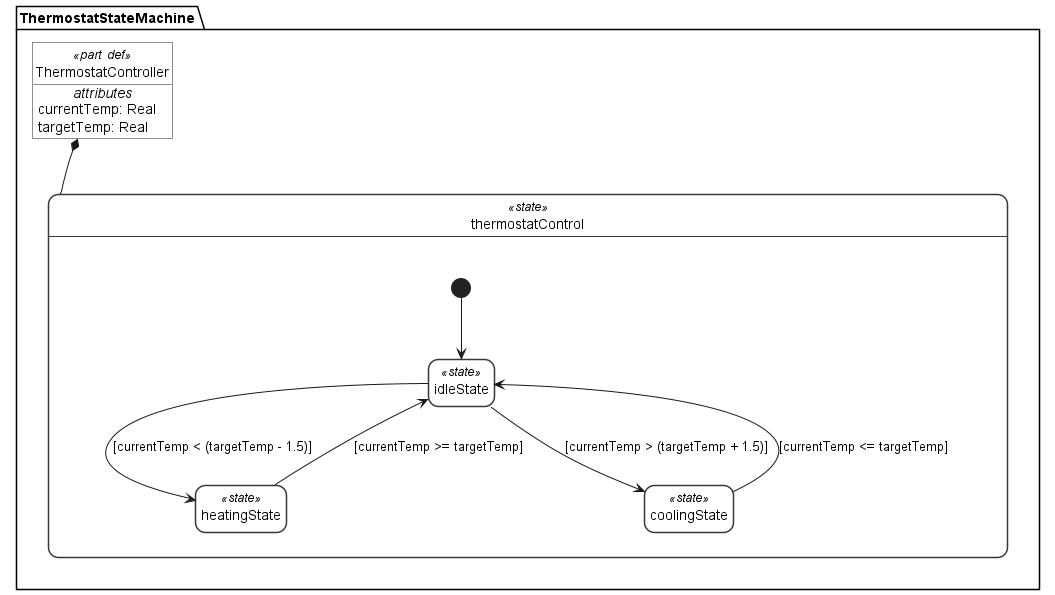
package ThermostatStateMachine {
private import ScalarValues::*;
// 1. Structural Component
part def ThermostatController {
    attribute currentTemp : Real;
    attribute targetTemp : Real;

    // 2. State-Based Behavior (Inline Usage)
    state thermostatControl {

        // Initial Transition
        entry; then idleState;

        // State Blocks
        state idleState {
            entry action;
            do action;
            exit action;
        }

        state heatingState {
            entry action;
            do action;
            exit action;
        }

        state coolingState {
            entry action;
            do action;
            exit action;
        }

        // 3. Transitions & Guards
        transition idleToHeating first idleState if currentTemp < (targetTemp - 1.5) then heatingState;
        transition heatingToIdle first heatingState if currentTemp >= targetTemp then idleState;
        transition idleToCooling first idleState if currentTemp > (targetTemp + 1.5) then coolingState;
        transition coolingToIdle first coolingState if currentTemp <= targetTemp then idleState;
    }
}
}
🧠 Key Architecture Concepts## Definition vs. Inline Usage
-
Definitions (state def) create standalone blueprints.
-
Definitions cannot read external part attributes.
-
Usages (state) live inside specific parts.
-
Usages read component attributes directly.
-
Use inline usage for data-driven guards.
The Initial Node Pattern
-
SysML v2 drops the classic graphical circle.
-
It uses the entry; then ; syntax.
-
This forces immediate execution on system boot.
📝 Syntax Element Breakdown## 1. State Actions
Every state can manage three distinct operational phases:
-
entry action;: Fires instantly upon entering the state.
-
do action;: Executes continuously while inside the state.
-
exit action;: Triggers right before leaving the state.
2. Transition Chains
Transitions dictate system pathing via a strict keyword sequence. They must follow this precise order:
$$\ text{transition} \rightarrow \text{first [Source]} \rightarrow \text{if [Guard]} \rightarrow \text{then [Target]}$$
-
first: Declares the active origin state.
-
if: Validates a Boolean conditional guard.
-
then: Defines the destination state target.
⚠️ Vital Compilation Quick-Tips
-
Keep transitions on one line. Multi-line breaks confuse the compiler.
-
Never leave actions empty. Use the action; keyword placeholder.
-
Check your closing braces. Do not close states prematurely.
Conclusion
The ThermostatController example illustrates more than just temperature regulation—it showcases how SysML v2 elevates state machine design from informal sketches to verifiable, executable specifications. By embracing inline state usages over standalone definitions, engineers gain direct access to component attributes, enabling dynamic, context-aware guards that reflect real-world operating conditions. The strict transition → first → if → then syntax, while demanding precision, eliminates ambiguity and ensures transitions are both human-readable and tool-interpretable.
Remember the vital quick-tips: keep transitions single-line for parser compatibility, never omit action placeholders, and validate brace scope to avoid subtle modeling errors. These aren't just syntactic preferences—they're guardrails that preserve model integrity across teams and toolchains. As you apply these patterns beyond thermostats—to safety-critical systems, autonomous workflows, or distributed architectures—this disciplined approach to state behavior becomes a strategic asset. SysML v2 doesn't just describe what your system does; it defines how and when it decides, turning architectural intent into reliable, testable behavior. Start small, validate often, and let your state machines evolve with confidence.
References
- Visual Paradigm Archives - Visual Paradigm Product Updates: Official archive of Visual Paradigm product announcements, release notes, and feature updates.
- SysML v2 Studio Launched: The Most Reliable AI SysML v2 Tool: Launch announcement detailing SysML v2 Studio's competitive advantages, AI capabilities, and reliability features.
- SysML v2 Studio Mastering Guide - 02 Flexible Access: Video tutorial demonstrating flexible access patterns, hybrid workflows, and synchronization between web and desktop environments.
- SysML v2 Studio Official Web App Portal: Direct access to the browser-based SysML v2 Studio environment with project management, AI assistant, and real-time modeling capabilities.
- Visual Paradigm SysML v2 Studio Features Page: Comprehensive overview of SysML v2 Studio's core features, technical capabilities, and use cases for systems engineering.
- SysML v2 Studio Tutorial Video: Step-by-step walkthrough of the interface, code-to-diagram synchronization, and beginner modeling workflows.
- Visual Paradigm SysML v2 AI Studio Community Article: Community-driven insights, practical tips, and user experiences with SysML v2 Studio's AI features.
- Creating Your First SysML v2 Project Tutorial: Official beginner tutorial for setting up projects, using templates, and authoring initial SysML v2 models.
- Visual Paradigm User Guide: Central repository for documentation, best practices, and advanced usage patterns across Visual Paradigm tools.
- SysML v2 Studio Mastering Guide: In-depth guide covering advanced modeling techniques, validation strategies, and team collaboration workflows.
- Enhanced AI Diagram Generator Update: Release notes detailing improvements to AI-powered diagram generation, including SysML v2-specific enhancements.
- Visual Paradigm Traditional Chinese Site: Regional portal offering Traditional Chinese language support and localized product information.