
The Architecture Development Method (ADM) is the central, step-by-step process within the TOGAF framework for designing, planning, implementing, and governing an enterprise information technology architecture. It is not a rigid prescription, but a proven, repeatable, and highly adaptable methodology that translates business requirements into a structured, actionable architecture.
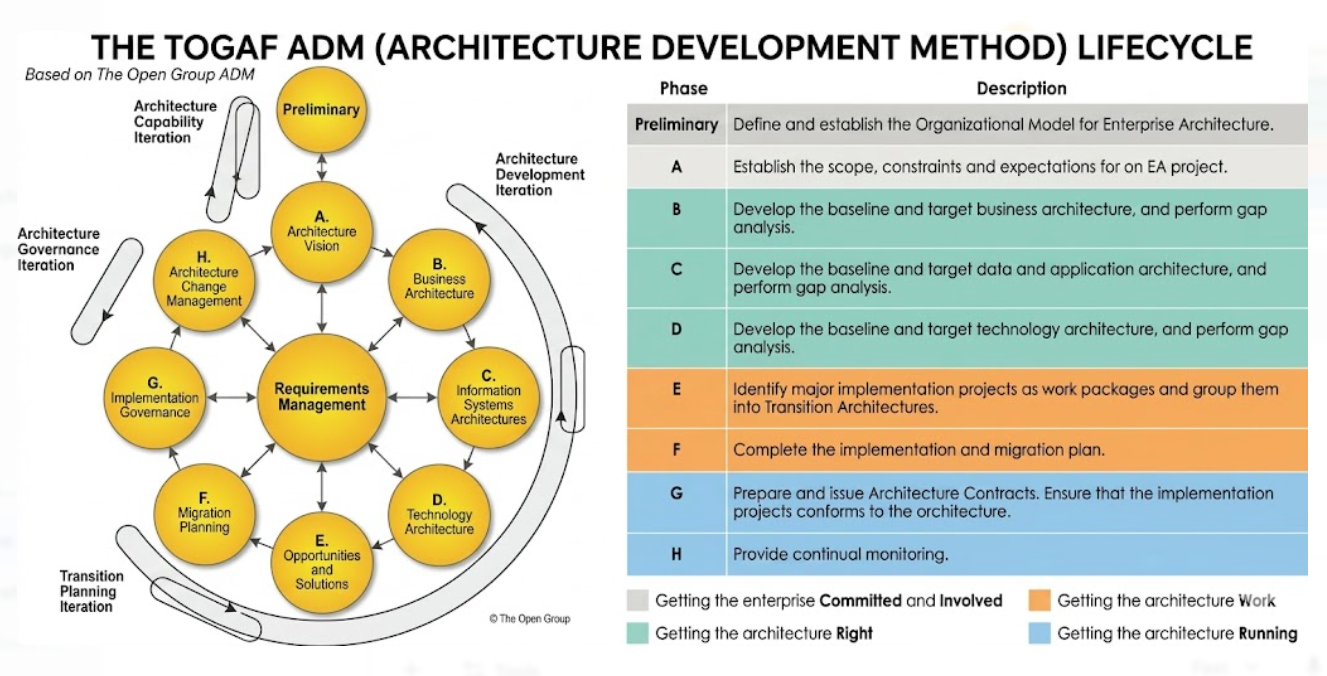
At its core, the ADM is iterative, requirements-driven, and designed to deliver measurable business value while managing risk and ensuring alignment between IT and business strategy.
The ADM is structured as a continuous cycle of phases. Each phase has a clear objective, produces specific outputs, and feeds into the next. Below is a beginner-friendly overview of each phase:
| Phase | Name | Primary Objective |
|---|---|---|
| Preliminary | Preparation & Initiation | Establish the architecture capability, define architecture principles, customize the TOGAF framework, and set up governance structures. |
| Phase A | Architecture Vision | Define scope, constraints, and expectations. Identify stakeholders, create a high-level Architecture Vision, and secure approval via a Statement of Architecture Work. |
| Phase B | Business Architecture | Develop the baseline and target business architectures. Define how the organization operates to achieve business goals and address stakeholder concerns. |
| Phase C | Information Systems Architectures | Develop Data and Application architectures. Define how information is managed and which applications support business processes. |
| Phase D | Technology Architecture | Develop the technology baseline and target. Define the hardware, software, networks, and infrastructure required to support the business, data, and application layers. |
| Phase E | Opportunities & Solutions | Identify major implementation projects, group them into work packages, and determine whether an incremental approach is needed. Define initial Transition Architectures. |
| Phase F | Migration Planning | Finalize the detailed Implementation and Migration Plan. Assess dependencies, costs, risks, and business value to create a realistic roadmap from baseline to target. |
| Phase G | Implementation Governance | Provide architectural oversight during implementation. Ensure projects conform to the defined architecture, manage Architecture Contracts, and handle compliance reviews. |
| Phase H | Architecture Change Management | Establish a controlled process for managing changes to the deployed architecture. Monitor business value, handle change requests, and trigger new ADM cycles when necessary. |
| Central | Requirements Management | Continuously capture, store, prioritize, and feed architecture requirements into and out of all phases. This process runs throughout the entire ADM cycle. |
The ADM is intentionally iterative to handle complexity and evolving business needs:
Cycling Around the ADM: Completing one full cycle naturally feeds into the next, allowing continuous architecture evolution.
Iterating Between Phases: Architects may loop back to earlier phases. For example, after defining Technology Architecture (Phase D), new insights may require revisiting Business Architecture (Phase B).
Cycling Within a Single Phase: A phase can be repeated internally to refine content, clarify requirements, or resolve stakeholder concerns before moving forward.
As architectures evolve, outputs are versioned to track maturity:
Version 0.1: High-level outline or draft (often created in Phase A).
Version 0.5: Detailed but still under review.
Version 1.0: Approved baseline or target architecture, formally signed off by stakeholders.
Versioning ensures traceability and allows teams to manage changes without losing architectural intent.
The ADM does not operate in isolation. It actively draws from and contributes to other TOGAF elements:
| Component | Relationship to ADM |
|---|---|
| Enterprise Continuum | Acts as a classification system for architecture artifacts. As the ADM progresses, outputs are classified from generic (Foundation) to specific (Organization-Specific). |
| Architecture Repository | Stores all architecture assets, reference models, standards, and governance logs. The ADM continuously populates and retrieves assets from here to promote reuse. |
| Foundation Architecture | Provides generic building blocks, standards, and principles (e.g., TOGAF Technical Reference Model) that the ADM can adopt during early phases. |
| Guidelines & Techniques | Support the ADM with proven methods: Architecture Principles, Business Scenarios, Gap Analysis, Risk Management, Interoperability Requirements, and Capability-Based Planning. |
The TOGAF standard explicitly states that the ADM does not dictate scope. Organizations must define boundaries based on feasibility, authority, and resource availability.
Varying maturity levels of architecture practices
Industry-specific regulatory or compliance requirements
Integration with existing frameworks (ITIL, PRINCE2, COBIT, Agile)
Organizational size (SMEs may use a simplified ADM; large enterprises may use a federated approach)
Contractual or outsourcing mandates
Breadth: How much of the enterprise is covered? (e.g., a single division vs. the entire global organization)
Depth: How detailed should the architecture be? (e.g., high-level capability maps vs. detailed system specifications)
Time Period: What timeframe does the Architecture Vision cover? Will Transition Architectures be needed to bridge gaps over time?
Architecture Domains: Which domains (Business, Data, Application, Technology) will be addressed? Resource constraints often mean not all four are developed simultaneously in early cycles.
Governance ensures that the architecture is not just designed, but actually implemented and maintained as intended. Without governance, architectural plans often diverge from reality during execution.
Architecture Board: A cross-functional executive body that reviews architectural decisions, enforces compliance, and resolves escalations.
Architecture Contracts: Formal agreements between sponsors and implementation teams defining deliverables, quality standards, and fitness-for-purpose.
Compliance Reviews: Structured assessments to verify that projects align with the target architecture and enterprise standards.
Governance Repository Information Areas:
Reference Data: Guidelines, standards, and external frameworks (e.g., COBIT, IT4IT)
Process Status: Tracking compliance requests, dispensations, and audit investigations
Audit Information: Historical records of governance decisions for future reference and continuous improvement
A successful Enterprise Architecture must align Business, Data, Application, and Technology (BDAT) architectures. However, creating these domains in isolation leads to fragmentation.
The ADM provides an integration framework that:
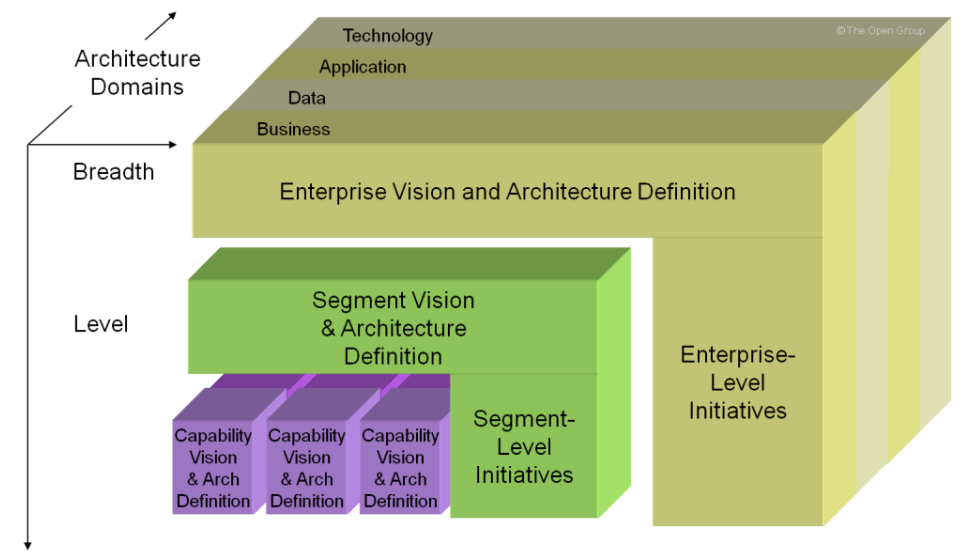
Ensures consistent terminology and modeling standards across domains
Maps dependencies between business processes, data flows, applications, and infrastructure
Balances granularity and detail so that high-level strategy connects smoothly with technical implementation
Uses standardized interchange formats and maturity models to bridge architectural artifacts
Scenario: A traditional brick-and-mortar retailer wants to launch a unified omnichannel e-commerce platform.
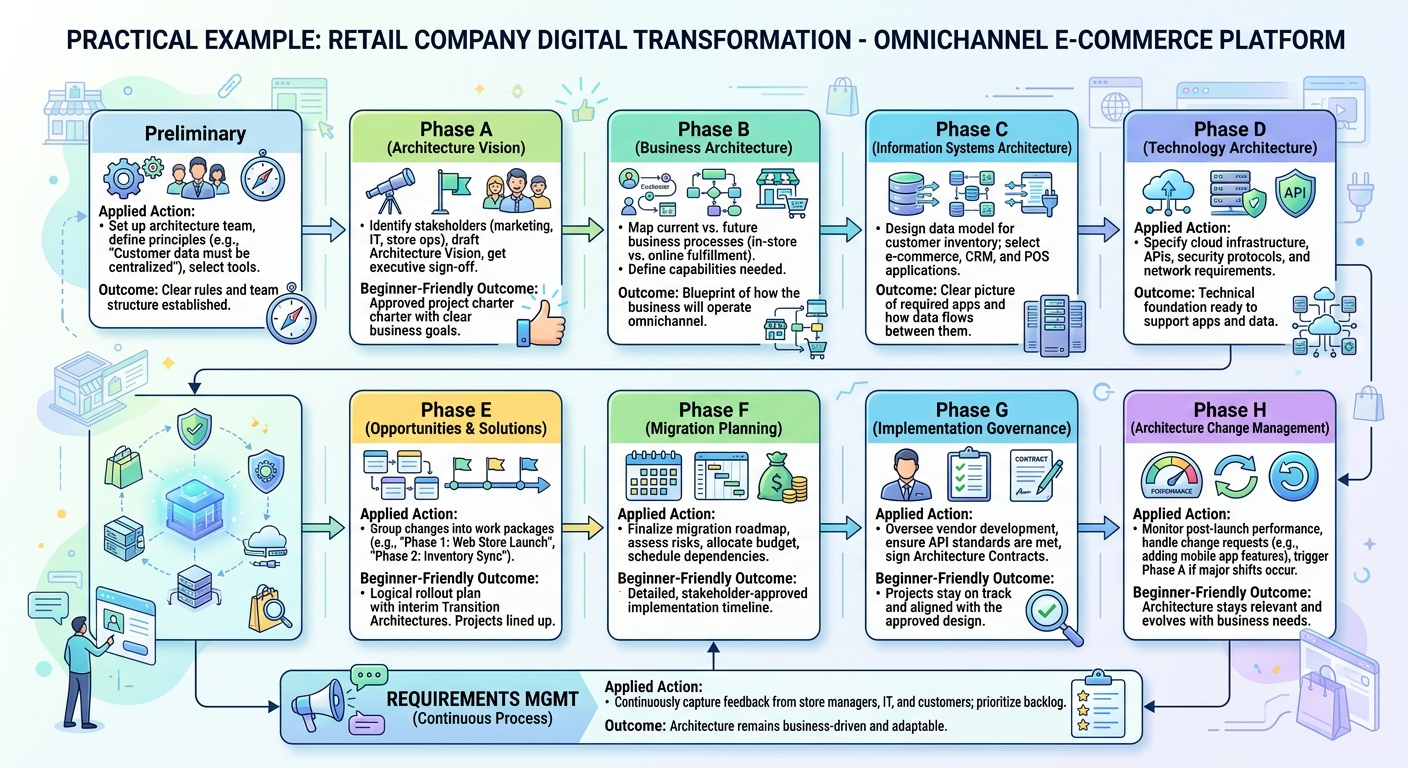
| ADM Phase | Applied Action | Beginner-Friendly Outcome |
|---|---|---|
| Preliminary | Set up architecture team, define principles (e.g., "Customer data must be centralized"), select tools. | Clear rules and team structure established. |
| Phase A | Identify stakeholders (marketing, IT, store ops), draft Architecture Vision, get executive sign-off. | Approved project charter with clear business goals. |
| Phase B | Map current vs. future business processes (in-store vs. online fulfillment). Define capabilities needed. | Blueprint of how the business will operate omnichannel. |
| Phase C | Design data model for customer inventory; select e-commerce, CRM, and POS applications. | Clear picture of required apps and how data flows between them. |
| Phase D | Specify cloud infrastructure, APIs, security protocols, and network requirements. | Technical foundation ready to support apps and data. |
| Phase E | Group changes into work packages (e.g., "Phase 1: Web Store Launch", "Phase 2: Inventory Sync"). | Logical rollout plan with interim Transition Architectures. |
| Phase F | Finalize migration roadmap, assess risks, allocate budget, schedule dependencies. | Detailed, stakeholder-approved implementation timeline. |
| Phase G | Oversee vendor development, ensure API standards are met, sign Architecture Contracts. | Projects stay on track and aligned with the approved design. |
| Phase H | Monitor post-launch performance, handle change requests (e.g., adding mobile app features), trigger Phase A if major shifts occur. | Architecture stays relevant and evolves with business needs. |
| Requirements Mgmt | Continuously capture feedback from store managers, IT, and customers; prioritize backlog. | Architecture remains business-driven and adaptable. |
The ADM is a cycle, not a straight line. Iteration is built-in to handle complexity and change.
Requirements are central. Requirements Management runs continuously and feeds every phase.
Scope is your responsibility. The ADM provides the method, but you decide breadth, depth, timeframe, and domain coverage.
Reuse accelerates delivery. Leverage the Enterprise Continuum and Architecture Repository instead of reinventing solutions.
Governance makes it real. Without compliance oversight and architecture contracts, designs rarely match implementation.
Tailor, don't follow rigidly. Adapt phases, skip non-essential steps, and integrate with your existing project management frameworks.
Business value drives every phase. Each iteration should deliver measurable improvements, even in incremental Transition Architectures.
The TOGAF Architecture Development Method is a structured yet flexible framework for translating business strategy into actionable, governed technology architecture. By understanding its phases, embracing iteration, scoping intelligently, and enforcing governance, organizations can systematically modernize their operations, reduce risk, and deliver sustained business value. For beginners, the key is to start small, focus on high-impact business requirements, and let the ADM's iterative nature guide continuous improvement.

