
Phase B of the TOGAF Architecture Development Method (ADM) focuses on the development of the Business Architecture. This phase establishes the fundamental organization of a business, detailing how processes, people, principles, and structures interrelate to achieve strategic objectives. It serves as the critical foundation for all subsequent architecture domains (Data, Application, and Technology). Without a clearly defined Business Architecture, technical solutions risk being misaligned with actual business needs, leading to wasted investment and operational friction.
Business Architecture answers the core question: How must the enterprise operate to meet its business goals and strategic drivers?
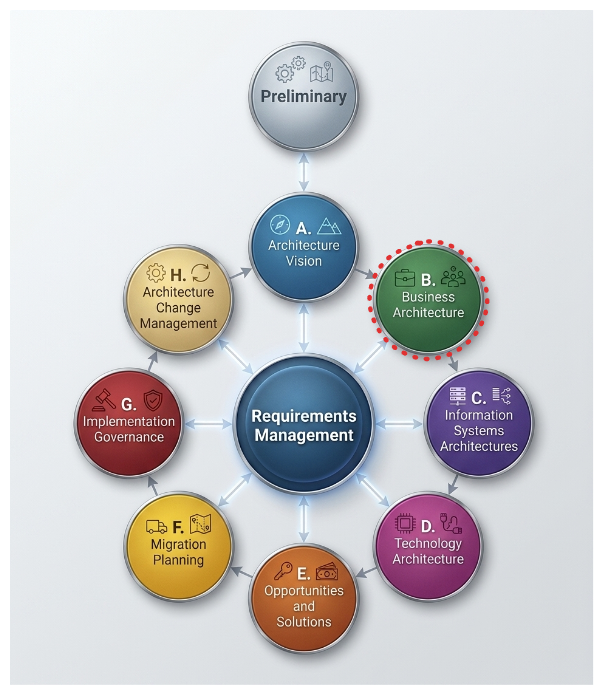
Phase B is designed to achieve two primary objectives:
Develop the Target Business Architecture: Define how the enterprise must operate to achieve its business goals, respond to strategic drivers outlined in the Architecture Vision, address the Statement of Architecture Work, and resolve key stakeholder concerns.
Identify Candidate Architecture Roadmap Components: Analyze the gaps between the current (Baseline) and future (Target) Business Architectures to identify initial work packages, capabilities, or initiatives that will transition the enterprise toward its target state.
To navigate Phase B effectively, you must understand several core architectural concepts:
| Concept | Definition | Why It Matters |
|---|---|---|
| Business Architecture | A holistic, multi-dimensional view of business capabilities, end-to-end value delivery, information, and organizational structure, along with their relationships to strategy, products, policies, and stakeholders. | Provides the strategic blueprint that guides all technical and operational design decisions. |
| Baseline Architecture | The documented current state of the business, including existing processes, capabilities, organizational units, and value streams. | Establishes a factual starting point. You cannot plan a journey without knowing your origin. |
| Target Architecture | The documented future state that the business aims to achieve to meet strategic objectives. | Defines the destination and serves as the benchmark for all architecture work. |
| Business Capability | A specific ability that a business possesses or exchanges to achieve a purpose. It is what the business does, independent of how or who does it. | Enables stable, reusable planning that survives organizational restructuring or system changes. |
| Value Stream | An end-to-end collection of value-adding activities that create an overall result for a customer, stakeholder, or end user. | Reveals why capabilities are needed and highlights inefficiencies or bottlenecks from a customer perspective. |
| Organization Map | A visual representation of business units, third parties, and partners, showing who owns or participates in capabilities and value streams. | Clarifies accountability, identifies stakeholders to engage, and maps cross-functional dependencies. |
Phase B follows a structured, repeatable approach. Below is a practical breakdown of how to execute it:
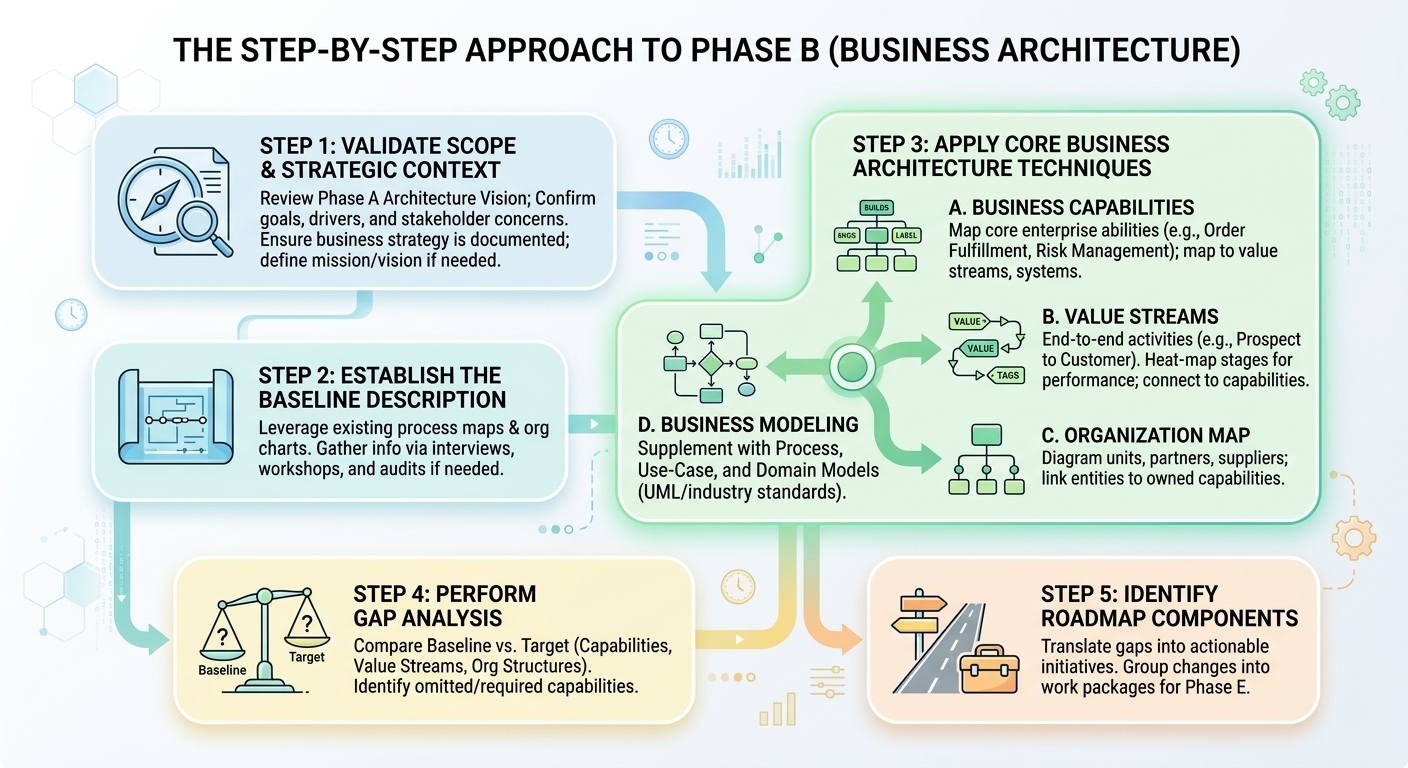
Review the Architecture Vision from Phase A to confirm the scope, business goals, strategic drivers, and key stakeholder concerns.
Ensure the business strategy is clearly documented. If not, conduct preliminary research to define mission, vision, and success metrics before proceeding.
Leverage existing architecture documentation, process maps, or organizational charts if available.
If no documentation exists, gather information through stakeholder interviews, workshops, and system audits to document the current state accurately.
TOGAF recommends four primary techniques to develop both Baseline and Target architectures:
Create a Business Capability Map that lists all core abilities of the enterprise (e.g., "Customer Acquisition," "Order Fulfillment," "Risk Management").
Map each capability to organizational units, value streams, information systems, and strategic plans.
Benefit: Provides a stable, technology-agnostic view of the business that remains valid even when departments or software change.
Identify end-to-end sequences of activities that deliver value to stakeholders (e.g., "Prospect to Customer," "Claim to Settlement").
Use heat mapping to color-code value stream stages based on performance, pain points, or strategic importance.
Map value stream stages to business capabilities to identify where gaps or redundancies exist.
Diagram the enterprise's internal business units, external partners, suppliers, and customers.
Link each entity to the capabilities they own and the value streams they participate in.
Benefit: Reveals cross-functional dependencies, clarifies ownership, and identifies which teams must be involved in architecture decisions.
Supplement capability and value stream maps with detailed models such as:
Activity/Business Process Models (workflow diagrams)
Use-Case Models (system-user interactions)
Class Models (domain entity relationships)
These can be standardized using frameworks like UML or industry-specific notations.
Compare the Baseline and Target Business Architectures across capabilities, value streams, and organizational structures.
Identify deliberately omitted items, accidentally overlooked functions, or newly required capabilities.
Document gaps with clear justifications: Are they to be eliminated, improved, or newly developed?
Translate identified gaps into actionable initiatives.
Group related changes into logical work packages.
Feed these candidate components into Phase E (Opportunities & Solutions) for sequencing and planning.
Business Goal: Provide seamless customer experience across online, mobile, and physical stores.
Capability Focus: Order Fulfillment, Inventory Management, Customer Service
Baseline State: Fulfillment is siloed. Online orders ship from a separate warehouse; store associates cannot access online inventory data.
Target State: Unified Order Fulfillment capability enabling ship-from-store, buy-online-pickup-in-store (BOPIS), and real-time inventory visibility.
Value Stream: Customer Purchase Journey (Browse → Add to Cart → Checkout → Fulfill → Return). Heat mapping reveals the "Fulfill" stage as a major bottleneck.
Organization Map: E-commerce team, Store Operations, Logistics Partner, IT Support. Mapping shows unclear ownership of inventory data accuracy.
Outcome: Phase B defines the target capability model, identifies the need for a shared data service, and flags organizational realignment as a roadmap component.
Business Goal: Reduce loan approval time from 14 days to 3 days while maintaining compliance.
Capability Focus: Credit Assessment, Document Verification, Regulatory Compliance, Loan Disbursement
Baseline State: Manual document collection, sequential department handoffs, duplicate data entry.
Target State: Automated document ingestion, parallel processing workflows, integrated compliance checking.
Value Stream: Loan Application to Disbursement. Heat mapping highlights excessive wait times between "Underwriting" and "Compliance Review."
Organization Map: Sales Branches, Underwriting Dept, Compliance Office, Core Banking System Team.
Outcome: Gap analysis reveals missing Automated Document Processing capability. Roadmap component: Implement OCR/AI verification service and redesign handoff protocols.
Phase B should not start from scratch. Effective architects tap into the organization's Architecture Repository to accelerate delivery:
Industry Reference Models: Adopt proven capability maps or process models specific to your sector (e.g., retail, healthcare, telecom).
Enterprise-Specific Views: Reuse existing capability maps, value stream diagrams, or organization maps from past initiatives.
Enterprise Building Blocks: Pull reusable process components, business rules, role definitions, or job descriptions.
Applicable Standards: Incorporate regulatory frameworks, data privacy mandates, or industry best practices that constrain or guide business design.
Upon completion of Phase B, the following artifacts are typically produced or updated:
Architecture Definition Document (Business Architecture Section): Contains the detailed Baseline and Target Business Architecture models.
Business Capability Map & Value Stream Diagrams: Visual representations of current and future states.
Organization Map: Updated chart showing ownership and participation across capabilities/value streams.
Gap Analysis Report: Documented differences between Baseline and Target, with recommendations.
Candidate Architecture Roadmap Components: Initial list of projects, initiatives, or capability increments derived from gaps.
Updated Architecture Requirements Specification: Quantitative business requirements that will guide Phases C and D.
Start with Business Architecture First: It is a prerequisite for Data, Application, and Technology Architectures. Skipping it leads to technology-driven solutions that miss business value.
Align Strictly with Phase A: Every capability, value stream, and organizational change must trace back to the Architecture Vision and Statement of Architecture Work.
Keep Capabilities Technology-Agnostic: Define what the business does, not which system does it. This ensures longevity and flexibility.
Engage Stakeholders Early: Use the Organization Map to identify who needs to be involved. Secure buy-in by demonstrating how changes improve their value stream stages.
Iterate, Don't Perfect: Business Architecture evolves. Deliver a "good enough" baseline and target to enable downstream architecture work, then refine through ADM cycles.
Reuse Before Creating: Always check the Architecture Repository for existing models, industry patterns, or regulatory templates before building new ones.
TOGAF ADM Phase B: Business Architecture is the strategic anchor of the entire architecture development cycle. By systematically mapping capabilities, analyzing value streams, clarifying organizational responsibilities, and rigorously comparing current and future states, architects ensure that technology investments directly serve business outcomes. When executed correctly, Phase B produces a clear, stakeholder-aligned blueprint that seamlessly guides the development of Information Systems and Technology Architectures in subsequent phases, ultimately driving measurable business transformation and sustainable competitive advantage.

