
A Comprehensive, Beginner-Friendly Guide
Phase E marks a critical turning point in the Architecture Development Method (ADM). While previous phases focused on understanding the current state, defining the future state, and analyzing the gaps between them, Phase E shifts the focus to delivery. It answers the fundamental question: How will we actually realize the Target Architecture?
In this phase, architects translate architectural designs into actionable delivery vehicles. They identify major implementation projects, group related changes into manageable units, decide how solutions will be acquired or built, and draft the initial roadmap that will guide the enterprise from its current state to its desired future state.
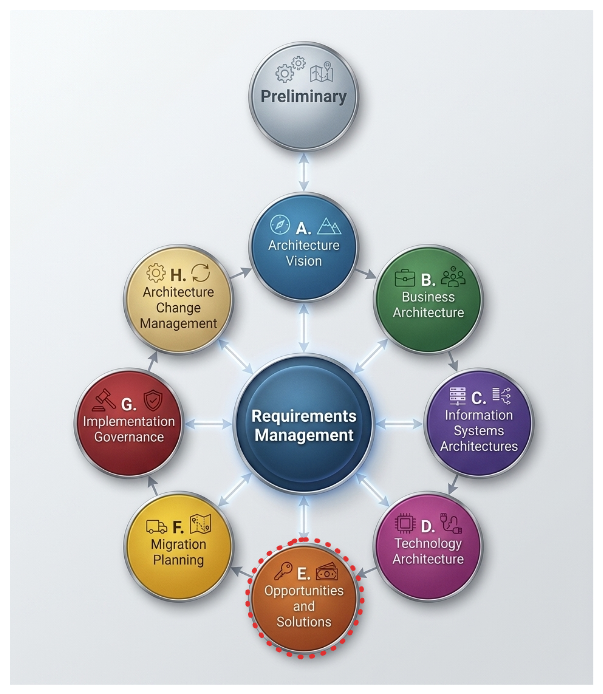
The core objectives of Phase E are to:
Generate the initial Architecture Roadmap based on gap analysis and candidate roadmap components identified in Phases B, C, and D.
Determine whether an incremental delivery approach is required, and if so, identify Transition Architectures that will deliver continuous business value along the way.
Define the overall Solution Building Blocks (SBBs) needed to finalize the Target Architecture, mapping them directly to the Architecture Building Blocks (ABBs) defined earlier.
During Phase E, the architecture team performs the following core activities:
Perform initial implementation planning
Identify major implementation projects
Group changes into logical work packages
Decide on solution acquisition approaches (Make vs. Buy vs. Re-use, Commercial Off-The-Shelf/COTS, Open Source)
Assess priorities across all proposed initiatives
Identify dependencies between projects, systems, and organizational units
Phase E introduces four interconnected concepts that form the foundation of architecture delivery:
| Concept | Description |
|---|---|
| Architecture Roadmap | A timeline that lists individual work packages in the order they will be executed to realize the Target Architecture. It shows the progression from the Baseline to the Target state. |
| Work Packages | Logical groupings of changes required to deliver the Target Architecture. Each package bundles related activities, systems, or processes that can be planned, funded, and executed together. |
| Transition Architectures | Interim, architecturally significant states between the Baseline and Target Architectures. They provide stepping stones that deliver measurable business value at intermediate stages. |
| Implementation & Migration Plan | A detailed schedule of projects that will realize the Target Architecture. While finalized in Phase F, Phase E creates the foundational outline that feeds into it. |
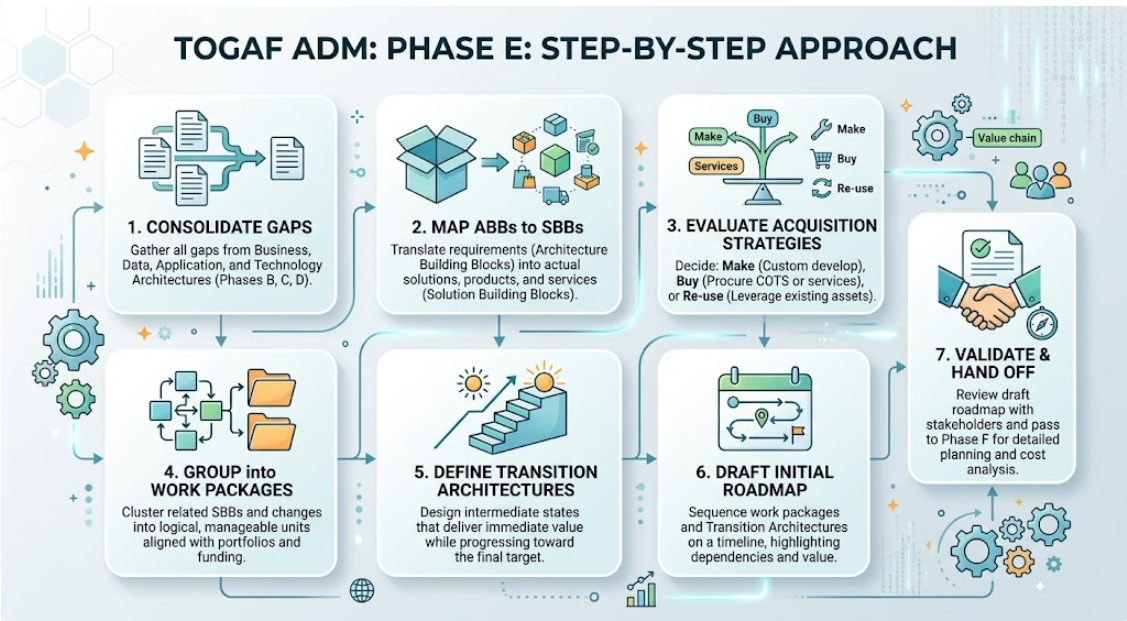
Consolidate Gaps: Gather all identified gaps from the Business, Data, Application, and Technology Architectures (Phases B, C, D).
Map ABBs to SBBs: Translate each Architecture Building Block (what the enterprise needs to do) into one or more Solution Building Blocks (the actual products, services, or custom developments that will fulfill the requirement).
Evaluate Acquisition Strategies: For each SBB, decide whether to:
Make: Custom-develop the solution internally.
Buy: Procure a Commercial Off-The-Shelf (COTS) product or vendor service.
Re-use: Leverage existing internal assets, open-source components, or previously deployed solutions.
Group into Work Packages: Cluster related SBBs and changes into logical, manageable work packages aligned with enterprise portfolios and funding cycles.
Define Transition Architectures: If the gap is too large to close in a single leap, design intermediate states that deliver immediate value while progressing toward the final target.
Draft the Initial Roadmap: Sequence the work packages and Transition Architectures on a timeline, highlighting dependencies and business value milestones.
Validate & Hand Off: Review the draft roadmap with stakeholders and pass the outline to Phase F for detailed migration planning, cost/benefit analysis, and scheduling.
Scenario: A regional retail bank wants to modernize its customer onboarding process.
Baseline Architecture: Paper-based forms, manual compliance checks, legacy database, 5-day processing time.
Target Architecture: Digital mobile/web onboarding, automated KYC/AML checks, cloud-native customer data platform, 1-day processing time.
Phase E in Action:
Gap Analysis Consolidation: Identifies gaps in data capture, compliance automation, system integration, and customer experience.
ABB to SBB Mapping:
ABB: "Automated Identity Verification" → SBB: Buy a third-party KYC API.
ABB: "Unified Customer Data Store" → SBB: Buy a cloud CRM platform.
ABB: "Mobile Onboarding Interface" → SBB: Make a custom mobile app using internal developers.
ABB: "Legacy System Retirement" → SBB: Re-use existing data migration scripts with enhanced validation.
Work Packaging:
Package 1: Cloud CRM deployment & data migration
Package 2: KYC API integration & compliance workflow automation
Package 3: Mobile app development & user testing
Transition Architecture Design:
Transition 1: Launch web-based form with partial automation (reduces processing to 3 days, delivers immediate value).
Transition 2: Full mobile launch with complete KYC integration (achieves 1-day target).
Initial Roadmap Draft: Packages are sequenced based on dependencies (CRM first, then API integration, then mobile app), with Transition 1 scheduled at month 4 and Transition 2 at month 9.
Output: A validated draft roadmap and work package definitions are handed to Phase F for detailed cost estimation, risk assessment, and final migration scheduling.
At the conclusion of Phase E, the architecture team typically produces or updates:
Initial version of the Architecture Roadmap
Defined Work Packages with preliminary scope and value statements
Documented Transition Architectures
Refined Solution Building Blocks inventory
Outline Implementation & Migration Plan (to be finalized in Phase F)
Updated Architecture Definition Document reflecting transition states
Inputs from Phases B, C, D: Gap analysis results, Architecture Building Blocks, and candidate roadmap components.
Feeds into Phase F: Provides the architectural structure that Phase F transforms into a detailed, costed, and risk-assessed Implementation & Migration Plan.
Central to Requirements Management: Requirements continue to flow in and out, ensuring that solution selection aligns with stakeholder needs.
Sets the Stage for Phase G: The work packages and contracts established here become the foundation for architectural oversight during implementation.
Focus on Incremental Value: Avoid "big bang" deployments where possible. Design Transition Architectures that deliver tangible business benefits early and often.
Keep It Practical: Transition Architectures should be technically feasible, financially justified, and organizationally acceptable.
Engage Portfolio & Project Managers Early: Phase E bridges architecture and execution. Collaborating with change management and project offices ensures realistic sequencing and resource alignment.
Document Decision Rationale: Clearly record why a "Make," "Buy," or "Re-use" decision was made for each Solution Building Block. This supports governance, auditability, and future re-use.
Validate with Stakeholders: The initial roadmap must reflect business priorities, not just technical dependencies. Secure stakeholder sign-off before moving to detailed planning.
Phase E: Opportunities & Solutions is the bridge between architectural design and real-world execution. It transforms abstract building blocks and gap analyses into concrete work packages, acquisition strategies, and a phased delivery roadmap. By identifying Transition Architectures and aligning solution choices with enterprise readiness, Phase E ensures that the Target Architecture is not just a vision on paper, but an achievable, value-driven journey. The outputs of this phase directly enable Phase F to produce the detailed Implementation & Migration Plan that will guide the enterprise through successful transformation.

