
Phase F: Migration Planning is the critical bridge between architectural design and real-world execution in the TOGAF Architecture Development Method (ADM). While earlier phases define what the target architecture should look like, Phase F focuses on how, when, and in what order the enterprise will move from its current state (Baseline Architecture) to the desired future state (Target Architecture). This phase transforms high-level architectural recommendations into a realistic, prioritized, and resource-backed execution plan that aligns with the organization’s broader change portfolio.
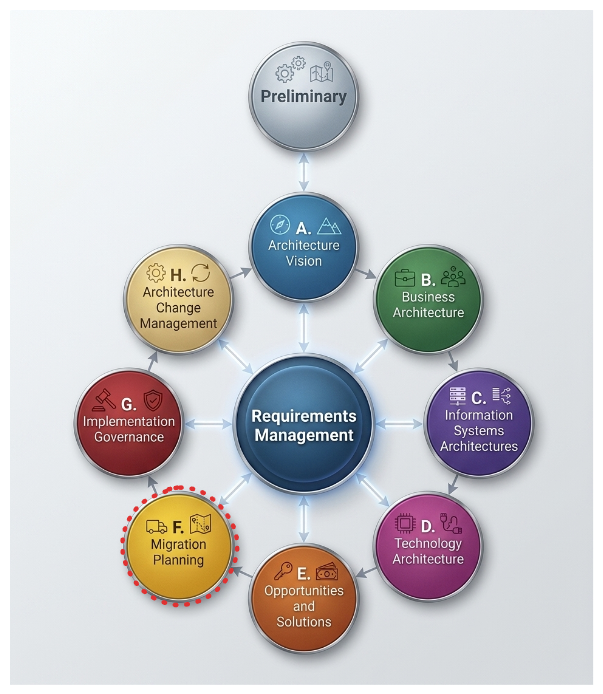
Phase F is driven by three core objectives:
Finalize the Architecture Roadmap and Implementation & Migration Plan: Convert the preliminary roadmap from Phase E into a detailed, actionable schedule.
Align with Enterprise Change Management: Ensure the migration plan integrates seamlessly with the organization’s existing portfolio, program, and project management processes.
Communicate Value & Cost to Stakeholders: Guarantee that key decision-makers fully understand the business value, financial implications, and risks associated with each work package and interim architectural state.
Before diving into the process, understand these foundational concepts:
| Concept | Definition |
|---|---|
| Architecture Roadmap | A timeline that sequences individual work packages to show the progression from Baseline to Target Architecture, highlighting business value at each stage. |
| Implementation & Migration Plan | A detailed schedule of projects, resources, dependencies, costs, and governance controls required to execute the roadmap. |
| Work Package | A logical grouping of changes or projects that deliver a specific portion of the Target Architecture. |
| Transition Architecture | An interim, architecturally significant state between Baseline and Target. It delivers measurable business value early and reduces implementation risk. |
| Cost/Benefit Analysis | Evaluation of financial investments versus expected business returns for each migration project. |
| Risk Assessment | Identification and mitigation planning for technical, operational, and organizational risks tied to migration activities. |
Phase F follows a structured approach to ensure migration planning is thorough and actionable:
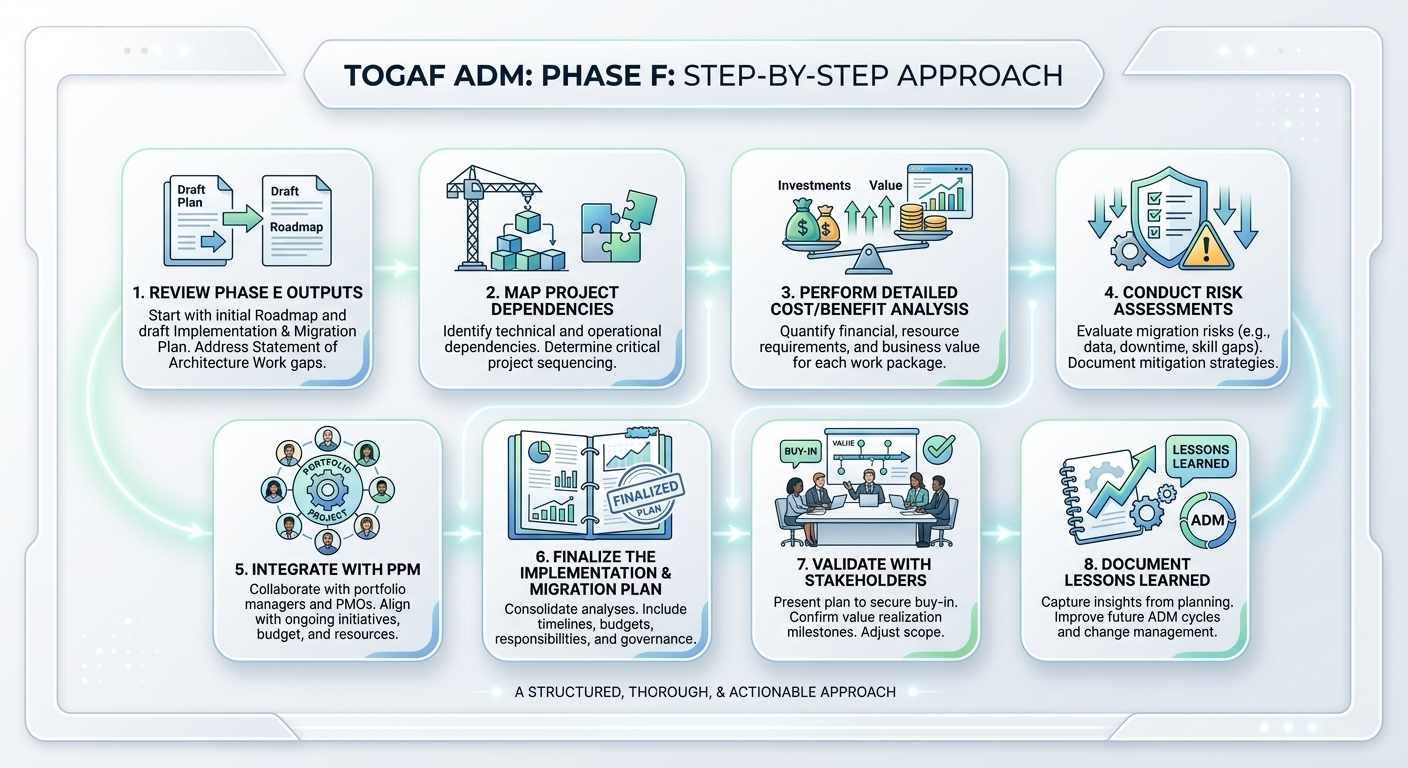
Review Phase E Outputs: Start with the incomplete Architecture Roadmap and draft Implementation & Migration Plan produced in Phase E. These address the initial Statement of Architecture Work but lack enterprise-wide integration.
Map Project Dependencies: Identify technical and operational dependencies between work packages. Determine which projects must be completed before others can begin.
Perform Detailed Cost/Benefit Analysis: Quantify the financial investment, resource requirements, and expected business value for each work package and Transition Architecture.
Conduct Risk Assessments: Evaluate migration risks (e.g., data loss, system downtime, skill gaps, vendor delays) and document mitigation strategies.
Integrate with Portfolio & Project Management: Collaborate with portfolio managers, PMOs, and business unit leaders to align the migration plan with ongoing change initiatives, budget cycles, and resource availability.
Finalize the Implementation & Migration Plan: Consolidate all analyses into a comprehensive, approved plan that includes timelines, budgets, responsibilities, and governance checkpoints.
Validate with Stakeholders: Present the finalized plan to executives and key stakeholders to secure buy-in, confirm value realization milestones, and adjust scope if necessary.
Document Lessons Learned: Capture insights from the planning process to improve future ADM cycles and organizational change management practices.
Phase F produces two primary outputs that carry the architecture into execution:
Finalized Architecture Roadmap: A stakeholder-approved timeline showing the sequence of work packages, Transition Architectures, and value delivery milestones.
Detailed Implementation & Migration Plan: A comprehensive document covering project schedules, resource allocation, cost/benefit summaries, risk mitigation strategies, dependency mappings, and alignment with enterprise change processes.
Scenario: A mid-sized retail company wants to migrate from fragmented legacy inventory systems to a unified, cloud-based Enterprise Resource Planning (ERP) platform.
Starting Point (From Phase E): The architecture team has already identified three major work packages: Data Migration, Core ERP Deployment, and Store-Level Integration.
Dependency Mapping: Data Migration must finish before Core ERP Deployment can begin. Store-Level Integration depends on both.
Cost/Benefit & Risk Analysis:
Data Migration: High risk (potential data corruption), moderate cost, low immediate business value.
Core ERP Deployment: High cost, high risk (system downtime), but delivers significant long-term efficiency gains.
Store Integration: Moderate cost, low risk, delivers quick wins (real-time stock visibility).
Creating Transition Architectures: Instead of waiting 18 months for full deployment, the team designs a Transition Architecture 1: Migrate headquarters data first, deploy ERP core, and integrate 5 pilot stores. This delivers early value and validates the approach.
Finalizing the Plan: The team sequences the work packages across 4 quarters, aligns with the company’s annual budget cycle, assigns a PMO lead, documents risk mitigation (e.g., parallel run for 30 days), and presents the roadmap to the CFO and COO for approval.
Outcome: Stakeholders see a clear, low-risk path to transformation with measurable milestones. The plan moves to Phase G for governed execution.
Phase F does not operate in isolation. Successful migration planning requires:
Portfolio Alignment: Ensuring architecture projects don’t conflict with other strategic initiatives.
Resource Coordination: Working with IT, business units, and vendors to secure skills, funding, and infrastructure.
Change Readiness: Factoring in organizational culture, training needs, and communication strategies to minimize resistance.
Governance Handoff: Preparing clear compliance checkpoints and success metrics for Phase G (Implementation Governance).
✅ Start with Value in Mind: Prioritize work packages that deliver quick, visible business benefits to maintain stakeholder momentum.
✅ Use Transition Architectures Strategically: Break large transformations into manageable, value-delivering increments rather than attempting a "big bang" deployment.
✅ Engage PMO Early: Involve portfolio and project managers during Phase F to ensure realistic scheduling, budgeting, and resource allocation.
✅ Quantify Risks & Benefits: Avoid vague projections. Use data-driven cost/benefit and risk matrices to justify sequencing decisions.
✅ Maintain Flexibility: Build contingency buffers for dependencies, vendor delays, or shifting business priorities.
✅ Document Thoroughly: Clear plans reduce ambiguity during implementation and provide a baseline for compliance reviews in Phase G.
| Phase | Role in Context |
|---|---|
| Phase E: Opportunities & Solutions | Identifies major implementation projects, groups them into work packages, and produces a preliminary roadmap and migration strategy. |
| Phase F: Migration Planning | Takes Phase E outputs, adds detailed cost/benefit, risk, dependency, and enterprise alignment analysis, and produces a finalized, executable plan. |
| Phase G: Implementation Governance | Takes the approved plan from Phase F and oversees actual project execution, ensuring compliance with the target architecture and managing Change Requests. |
Phase F: Migration Planning transforms architectural vision into operational reality. By rigorously analyzing costs, risks, dependencies, and business value, and by aligning the migration strategy with enterprise change management processes, Phase F ensures that the architecture is not just theoretically sound, but practically achievable. A well-executed Phase F delivers stakeholder confidence, minimizes transformation risk, and sets a clear, governed path for successful implementation in Phase G.

