
In the TOGAF Architecture Development Method (ADM), Phase G: Implementation Governance is where theoretical architecture meets real-world execution. After the architecture has been designed (Phases B–D), planned (Phases E–F), and approved, organizations begin building and deploying the solution.
Phase G does not involve writing code, configuring servers, or managing daily project tasks. Instead, it provides the architectural oversight necessary to ensure that implementation projects build exactly what was designed, adhere to enterprise standards, and deliver the expected business value. It runs in parallel with actual development and deployment activities.
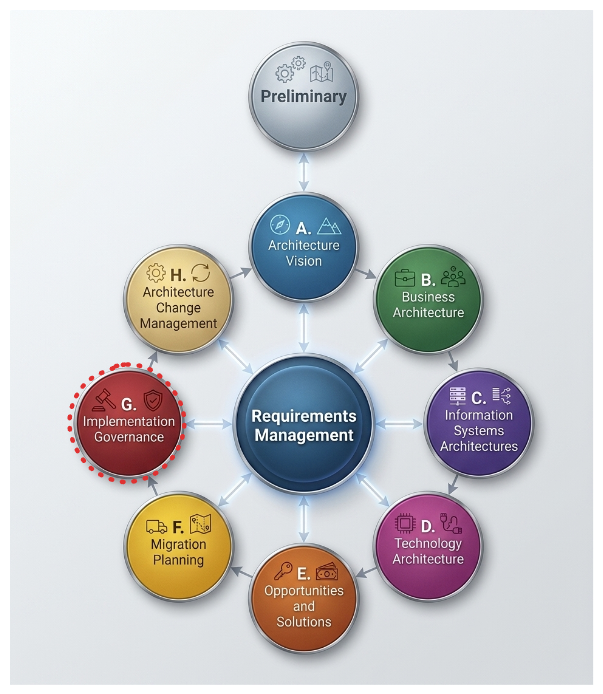
The primary goals of Phase G are:
Ensure Conformance: Verify that implementation projects align with the approved Target Architecture.
Perform Governance Functions: Execute formal architecture governance activities for the deployed solution and handle any implementation-driven architecture Change Requests.
Maintain Architectural Integrity: Prevent scope creep, unauthorized deviations, or fragmented implementations that could undermine the enterprise architecture.
Phase G revolves around four core activities:
| Activity | Description |
|---|---|
| Architectural Oversight | Monitoring implementation to ensure it stays aligned with architectural blueprints, standards, and business priorities. |
| Defining Architecture Constraints | Establishing clear boundaries and non-negotiable requirements (e.g., security standards, data formats, integration patterns) that implementation teams must follow. |
| Architecture Contract Management | Creating, issuing, and monitoring formal agreements between the architecture team/sponsors and implementation partners. |
| Conformance Monitoring | Continuously checking development work against the architecture to catch misalignments early. |
An Architecture Contract is a formal joint agreement between development partners (vendors, internal IT teams) and sponsors (business leaders, architecture board). It is typically produced and managed during Phase G.
Deliverables: Clear definition of what must be produced.
Quality Standards: Metrics and benchmarks the solution must meet.
Fitness-for-Purpose: Confirmation that the solution aligns with business objectives and architectural intent.
Provides a controlled environment for monitoring integrity, changes, and decision-making.
Ensures adherence to enterprise principles, standards, and requirements.
Identifies risks across development and operational aspects.
Establishes clear accountability, responsibility, and discipline.
Defines the governance organization’s authority and scope.
Compliance reviews are the primary mechanism used in Phase G to verify that projects match the architecture.
Catch architectural errors early, reducing costly rework later.
Ensure best practices are applied consistently.
Provide executive visibility into technical readiness.
Identify opportunities to share services or consolidate redundant systems.
Communicate architectural gaps to vendors and development teams.
Inform procurement criteria for future technology purchases.
Request Review: Initiated per governance policy by any authorized stakeholder.
Identify Organization & Principals: Assign an Architecture Review Coordinator.
Assign Lead Architect: Designate the Lead Enterprise Architect and supporting architects.
Determine Scope: Identify involved business units and map how the system fits into the corporate architecture.
Tailor Checklists: Customize review criteria to address specific business requirements.
Schedule Meeting: Coordinate timing with the review team and project leads.
Interview Principals: Gather background, technical details, and context using checklists.
Analyze Checklists: Compare against corporate standards, identify issues, and draft recommendations.
Prepare Report: Document findings, risks, and required actions.
Present Findings: Share results with the customer/project sponsor and Architecture Board.
Accept & Sign-Off: Formal approval by the Architecture Board and customer.
Archive Summary: Send the final assessment to the Architecture Review Coordinator for repository storage.
💡 Beginner Tip: Compliance reviews are not policing exercises. They are collaborative checkpoints designed to guide implementation teams, resolve conflicts, and protect the enterprise’s long-term architectural health.
Implementation rarely follows a perfect script. New facts emerge, technologies evolve, and business needs shift. Phase G provides the framework to handle these realities.
During deployment, teams may discover that the original architecture is impractical or insufficient. They can submit a Change Request to:
Request a formal dispensation (temporary exception).
Trigger a new ADM cycle if the change is significant.
Update the Architecture Definition Document with newly validated requirements.
Risk management is continuous in Phase G. The architecture team:
Maintains risk identification and mitigation worksheets.
Monitors whether mitigation actions are being executed.
Escalates unmitigated critical risks to the Architecture Board.
Determines if unresolved risks require a partial or full restart of the ADM cycle.
Simplification Change: Handled via standard change management (e.g., consolidating systems without altering architecture).
Incremental Change: May require partial re-architecting; handled case-by-case.
Re-architecting Change: Requires a new Request for Architecture Work and a fresh ADM cycle.
TOGAF recommends the following structured approach for Phase G:
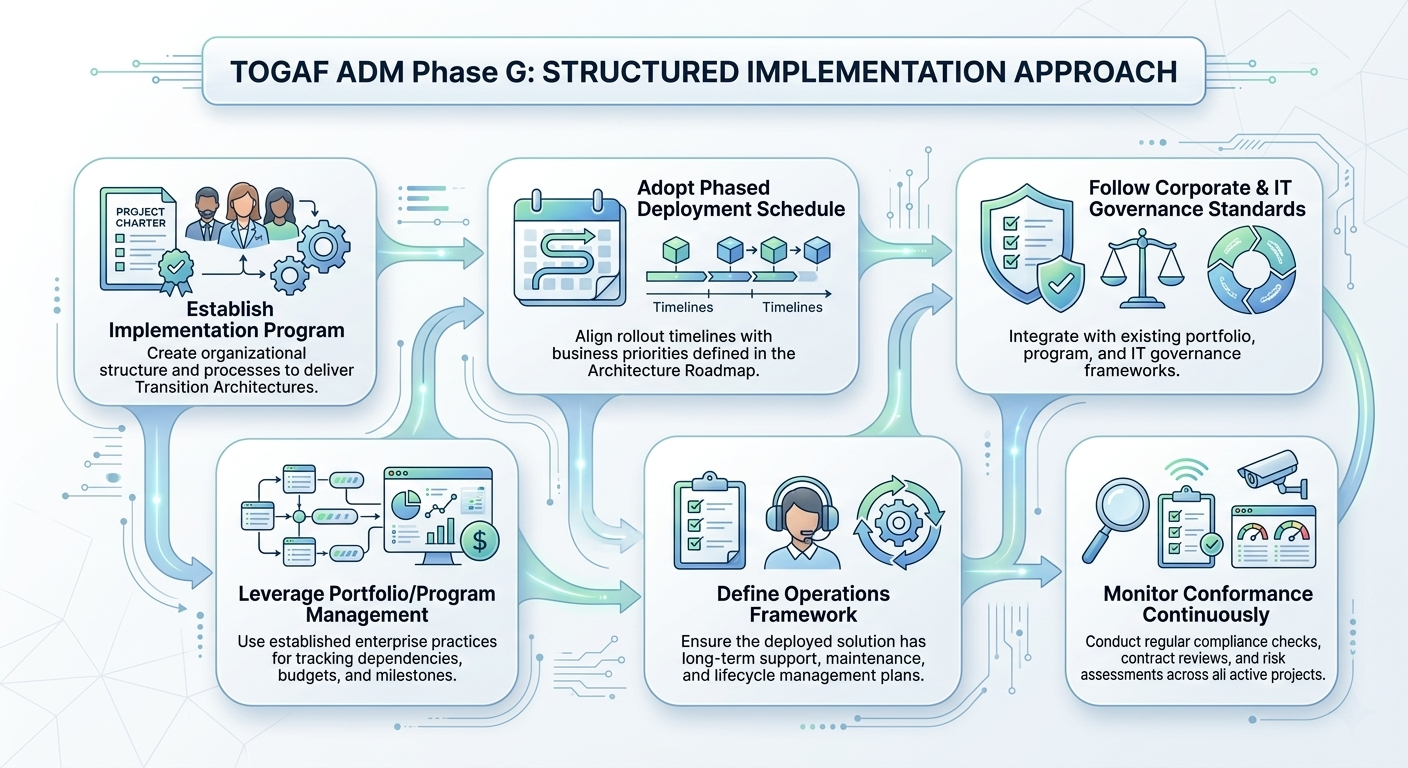
Establish an Implementation Program: Create the organizational structure and processes to deliver agreed Transition Architectures.
Adopt a Phased Deployment Schedule: Align rollout timelines with business priorities defined in the Architecture Roadmap.
Follow Corporate & IT Governance Standards: Integrate with existing portfolio, program, and IT governance frameworks.
Leverage Portfolio/Program Management: Use established enterprise practices for tracking dependencies, budgets, and milestones.
Define an Operations Framework: Ensure the deployed solution has long-term support, maintenance, and lifecycle management plans.
Monitor Conformance Continuously: Conduct regular compliance checks, contract reviews, and risk assessments across all active projects.
Scenario: A mid-sized retail company is implementing a new omnichannel Customer Relationship Management (CRM) system to unify online and in-store customer data.
Pre-Phase G: Architects designed a cloud-based CRM with strict data encryption, API standards, and integration with existing inventory systems. The Architecture Roadmap scheduled Phase 1 (core CRM) and Phase 2 (loyalty program).
Phase G Begins: The architecture team signs an Architecture Contract with the implementation vendor. It specifies deliverables, security standards, and compliance checkpoints.
Oversight in Action:
The vendor proposes using a non-approved database to speed up development. The architecture team initiates a Change Request. After review, it’s denied due to security and compliance risks. The vendor adjusts their approach.
A Compliance Review is conducted mid-development. Reviewers verify that data flows match the approved architecture, APIs follow enterprise standards, and user authentication aligns with corporate security policies.
Risks are tracked: A delay in third-party payment gateway integration is flagged. Mitigation actions are added to the Implementation and Migration Plan.
Outcome: The CRM launches on schedule, fully compliant with the Target Architecture. The operations framework ensures smooth post-launch support. Any future enhancements will go through Phase G governance again.
Start Governance Early: Engage implementation teams during Phase E/F to set expectations before coding begins.
Use Tailored Checklists: Avoid one-size-fits-all compliance reviews. Customize them to project scope and business context.
Foster Collaboration, Not Conflict: Position the architecture team as enablers, not gatekeepers. Provide guidance, not just approvals.
Document Everything: Store contracts, compliance reports, and change requests in the Architecture Repository for auditability and future reference.
Align with Enterprise Portfolio Management: Integrate Phase G activities with existing project tracking, budgeting, and resource planning tools.
Monitor Continuously: Don’t wait until the end of development to check compliance. Conduct iterative reviews aligned with agile or waterfall milestones.
Phase G: Implementation Governance is the architectural "quality assurance" stage of the TOGAF ADM. It ensures that the carefully designed Target Architecture is translated into reality without deviation, fragmentation, or unmanaged risk. Through Architecture Contracts, Compliance Reviews, Change Management, and Continuous Oversight, Phase G bridges the gap between architectural vision and operational reality. When executed effectively, it protects enterprise investments, accelerates time-to-value, and ensures that every implemented system contributes to a cohesive, scalable, and future-ready enterprise architecture.

