
In today's rapidly evolving digital landscape, enterprise architecture frameworks must adapt to support agile practices, continuous delivery, and modern technology ecosystems. The release of the TOGAF® Standard, 10th Edition represents a significant evolution in enterprise architecture methodology, designed to address these contemporary challenges through modularization, enhanced flexibility, and deeper integration with digital transformation initiatives. This case study explores how a mid-sized financial services organization successfully navigated the transition from TOGAF 9.2 to the 10th Edition, leveraging Visual Paradigm's specialized tooling to accelerate adoption, improve team collaboration, and deliver measurable business value. Through this real-world implementation journey, we examine the practical benefits of TOGAF 10's modular structure, the enhanced Architecture Development Method (ADM), and the critical role of intelligent software support in making enterprise architecture both accessible and actionable for modern organizations.
NexGen Financial Services, a regional bank with over 2,000 employees and a growing digital banking platform, faced increasing pressure to modernize its IT infrastructure while maintaining regulatory compliance and operational stability. The enterprise architecture team, consisting of eight practitioners, had been using TOGAF 9.2 for five years but encountered challenges with:
Lengthy architecture cycles that couldn't keep pace with agile development teams
Difficulty tailoring the framework to specific digital transformation initiatives
Inconsistent application of architecture governance across business units
Limited integration between architecture artifacts and development workflows
When The Open Group announced TOGAF 10, NexGen's leadership recognized an opportunity to reinvigorate their EA practice. They initiated a structured migration project with three primary objectives: reduce time-to-value for architecture deliverables by 40%, improve alignment between enterprise architecture and agile delivery teams, and establish a more adaptive governance model supporting continuous innovation.
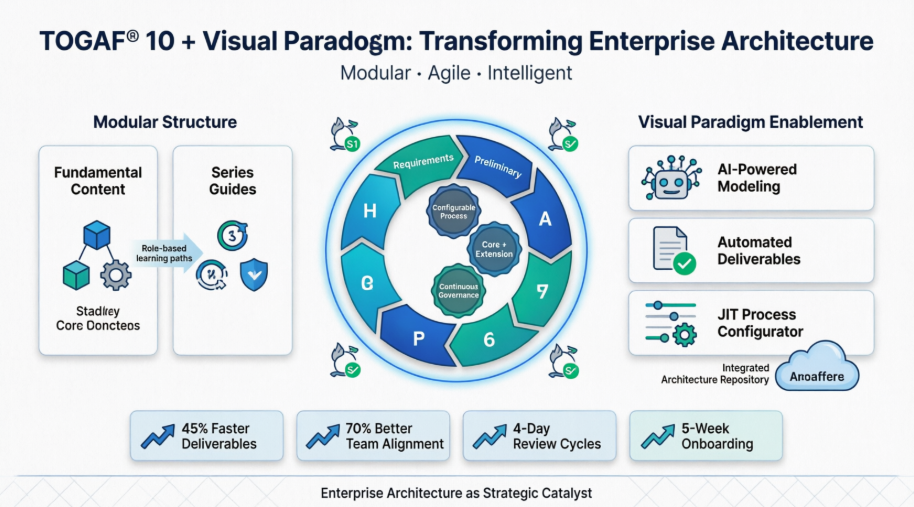
The first major shift for NexGen was adopting TOGAF 10's modular architecture. Rather than treating the standard as a monolithic document, the team organized their knowledge base around the two primary sections: Fundamental Content and the TOGAF Series Guides.
The Fundamental Content provided the stable foundation—core concepts, definitions, and universal principles that all architects needed to understand. This became the mandatory onboarding curriculum for new team members and the reference baseline for all architecture reviews.
More transformative was the strategic use of Series Guides. For their digital banking modernization initiative, the team prioritized the Digital Transformation Series Guide and the Agile Series Guide. These topic-specific resources provided immediately applicable patterns, checklists, and examples that resonated with their development teams. Instead of asking architects to interpret generic guidance, the Series Guides offered contextualized advice that could be directly applied to sprint planning, feature decomposition, and incremental value delivery.
The modular approach also simplified training. Rather than requiring all staff to master the entire framework, NexGen created role-based learning paths: business architects focused on the Business Architecture Series Guide, while solution architects leveraged the Cloud Computing Series Guide. This targeted upskilling reduced training time by 60% and improved knowledge retention.
NexGen's architecture team was initially concerned about changes to the iconic ADM cycle, particularly the removal of arrowheads from the diagram. However, they quickly discovered that this visual change reflected a profound philosophical shift: the ADM was no longer prescribed as a rigid sequence but presented as a configurable toolkit.
For their core banking platform migration, the team configured the ADM to support iterative delivery. They executed Phase B (Business Architecture) and Phase C (Information Systems Architecture) in parallel sprints, using lightweight capability models and value stream maps to guide development teams. The enhanced guidance on business architecture proved invaluable—detailed techniques for modeling business capabilities allowed NexGen to clearly articulate which capabilities would be modernized in each release, creating a shared language between business stakeholders and engineering teams.
The distinction between Core and Extension content further streamlined their workflow. The team established a "Core ADM" baseline containing essential steps required for all initiatives, then layered on Extension materials only when relevant. For a cloud migration project, they incorporated the Cloud Extension guidance on security patterns and operational resilience; for a customer experience initiative, they applied the Digital Extension's guidance on journey mapping and experience metrics. This selective application prevented framework overload and kept architecture activities focused on delivering value.
Modernized governance was perhaps the most impactful change. Instead of gate-based reviews at the end of each ADM phase, NexGen implemented continuous governance checkpoints integrated into their agile ceremonies. Architecture reviews became part of sprint retrospectives, and compliance validation was automated through policy-as-code patterns documented in the Series Guides. This shift reduced architecture approval cycles from weeks to days while improving adherence to standards.
While TOGAF 10 provided the methodological foundation, Visual Paradigm served as the practical enabler that made the framework actionable for NexGen's teams. The tool's alignment with TOGAF 10's modular structure was immediately apparent: the interface clearly separated Fundamental Content from Series Guides, allowing architects to quickly locate relevant guidance without wading through unrelated material.
The AI-enhanced ADM tool proved transformative for productivity. When documenting the target architecture for the digital banking platform, architects could describe business requirements in natural language, and the tool would suggest relevant ArchiMate® diagrams, identify potentially impacted business units, and even draft initial capability models. This didn't replace architectural thinking but accelerated the documentation process, freeing architects to focus on strategic analysis rather than diagram mechanics.
Visual Paradigm's actionable process maps turned the ADM from a conceptual framework into a guided workflow. Each phase presented specific "work items"—structured forms and modeling tasks that architects completed. As these items were filled out, the tool automatically generated official TOGAF deliverables like the Architecture Vision document or the Migration Roadmap. This automation ensured consistency across projects and dramatically reduced the administrative burden on the architecture team.
The Just-in-Time (JIT) process capability allowed NexGen to tailor the ADM to specific initiative needs. For a rapid proof-of-concept project, the team used JIT to streamline phases, focusing only on essential architecture decisions. For a complex regulatory compliance initiative, they expanded the governance activities. This configurability ensured that architecture effort was proportional to project risk and complexity, addressing a long-standing pain point with previous framework implementations.
All artifacts were automatically archived in Visual Paradigm's integrated Architecture Repository, creating a single source of truth for the entire EA practice. This repository served not just as a document store but as a living knowledge base, with relationships between artifacts automatically maintained. When a business capability was updated, the tool highlighted all associated application components and technology resources, enabling impact analysis that previously required manual tracing across multiple spreadsheets.
Six months after adopting TOGAF 10 with Visual Paradigm, NexGen Financial Services reported significant improvements across key metrics:
Time-to-value: Architecture deliverables were produced 45% faster, with the automated generation of official documents eliminating weeks of formatting and consolidation work.
Team alignment: Agile development teams reported a 70% improvement in understanding architecture decisions, attributed to the clearer, more contextual guidance from the Series Guides and the visual modeling capabilities.
Governance efficiency: Architecture review cycles decreased from an average of 18 days to 4 days, while compliance audit findings related to architecture documentation dropped by 80%.
Knowledge retention: New architect onboarding time reduced from 3 months to 5 weeks, supported by the modular learning paths and the tool's guided process navigation.
Key lessons from the implementation included:
Start with fundamentals, then specialize: Investing time in mastering the Fundamental Content before diving into Series Guides created a stronger foundation for contextual application.
Configure, don't customize: Using TOGAF 10's built-in configurability options (Core vs. Extension, JIT process) proved more sustainable than creating organization-specific framework modifications.
Tooling enables adoption: Visual Paradigm didn't just support TOGAF 10—it made the framework accessible to practitioners who might have been intimidated by its scope, turning methodology into daily practice.
Governance as enablement: Shifting from gate-based to continuous governance transformed architecture from a bottleneck into an enabler of speed and quality.
The journey of NexGen Financial Services illustrates that the true value of the TOGAF® Standard, 10th Edition lies not just in its updated content, but in its fundamental reimagining of how enterprise architecture can operate in modern organizations. By embracing modularity, flexibility, and contextual guidance, TOGAF 10 addresses long-standing criticisms of enterprise architecture frameworks while preserving the rigorous thinking that makes them valuable. When paired with intelligent tooling like Visual Paradigm, which translates framework concepts into actionable workflows, organizations can achieve the elusive balance between architectural discipline and delivery agility.
For enterprises considering a similar transition, the path forward is clear: view TOGAF 10 not as a documentation exercise but as an opportunity to reimagine how architecture creates value. Start with the Fundamental Content to establish shared understanding, then strategically apply Series Guides to address specific business challenges. Leverage tooling that makes the framework tangible and adaptable, and most importantly, configure the ADM to support your organization's unique rhythm of innovation. In doing so, enterprise architecture can fulfill its promise: not as a bureaucratic overhead, but as a strategic catalyst for sustainable digital transformation.
"From Framework to Practice: How Modular Enterprise Architecture Drives Digital Transformation with TOGAF 10 and Visual Paradigm"

