Transforming Enterprise Architecture: A Case Study on AI-Enhanced ArchiMate Modeling with TOGAF ADM in Visual Paradigm
Introduction
In today's rapidly evolving digital landscape, organizations face unprecedented pressure to align strategic business objectives with agile, scalable technology infrastructure. Enterprise Architecture (EA) has emerged as the critical discipline bridging this gap, yet traditional EA practices often struggle with complexity, stakeholder alignment, and time-to-value. This case study examines how the integration of ArchiMate—a standardized modeling language—with TOGAF ADM—a proven methodology—within Visual Paradigm's AI-enhanced platform is redefining EA delivery. Through a real-world implementation scenario, we explore how AI-assisted modeling accelerates architecture development while maintaining rigor, compliance, and stakeholder confidence. This narrative demonstrates not just what is possible, but how organizations can practically leverage intelligent tooling to transform EA from a documentation exercise into a strategic value driver.
1. Understanding ArchiMate and TOGAF ADM
ArchiMate: The Modeling Language
Standardized and Vendor-Independent: ArchiMate is maintained by The Open Group, ensuring it is not tied to any specific vendor.
Lean and Simple: It provides just enough concepts to model EA without unnecessary complexity.
Compatibility: It integrates seamlessly with other standards like UML and BPMN, making it versatile for different architecture domains.
TOGAF ADM: The Methodology
Structured Approach: TOGAF's Architecture Development Method (ADM) provides a step-by-step process for developing an enterprise architecture.
Phases: It includes phases from Preliminary to Implementation and Governance, ensuring comprehensive coverage of EA development.
2. The Evolution of EA Modeling Tools
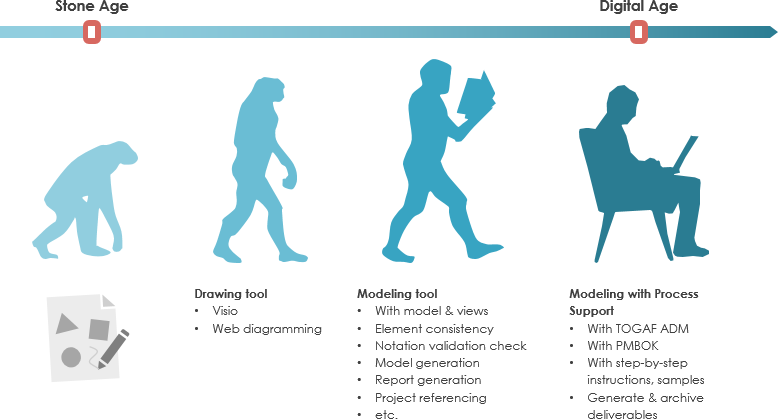
Hand-Drawn vs. Digital Tools
Hand-Drawn: Traditional pencil-and-paper methods are flexible but lack scalability, collaboration, and version control.
Drawing Tools: Digital tools like Visio offer basic diagramming features but lack advanced modeling capabilities.
Modeling Tools: Tools like Visual Paradigm go beyond drawing, offering features like model consistency, traceability, and collaboration.
Why Modeling Tools Are Superior
Feature
Drawing Tool
Modeling Tool
Diagram Complexity
Limited
Advanced
Shared Elements
No
Yes
Connection Rules
No
Yes
Report Generation
No
Yes
Model Consistency
No
Yes
Collaboration
No
Yes
Versioning
No
Yes
3. Visual Paradigm: A Certified ArchiMate and TOGAF Tool
Key Features
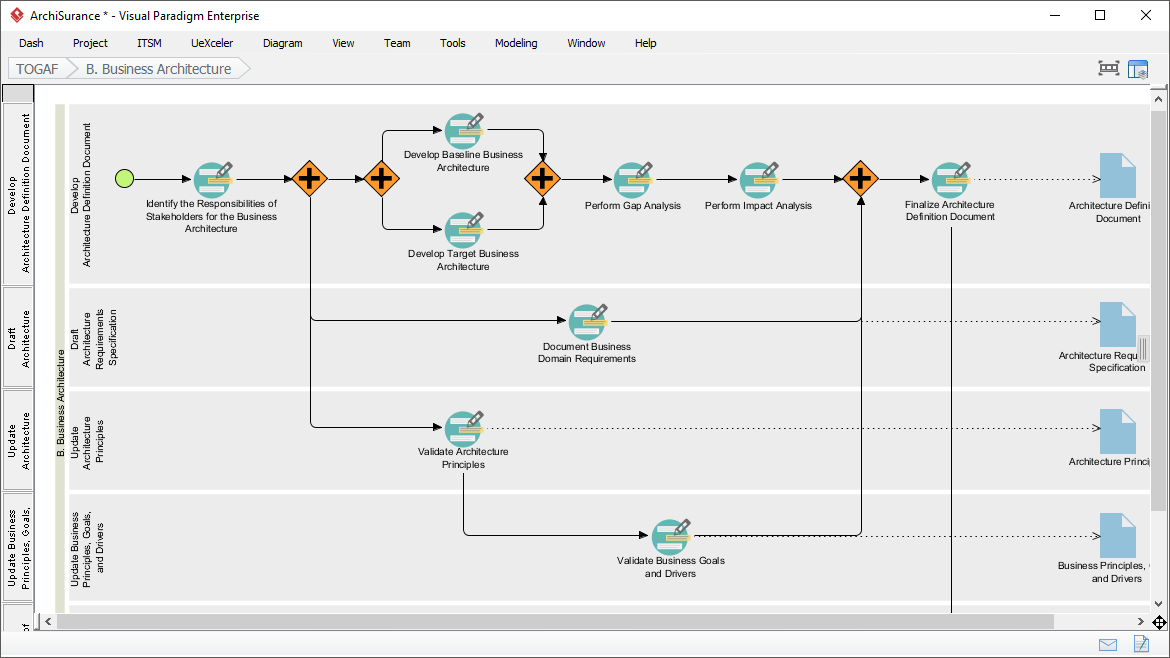
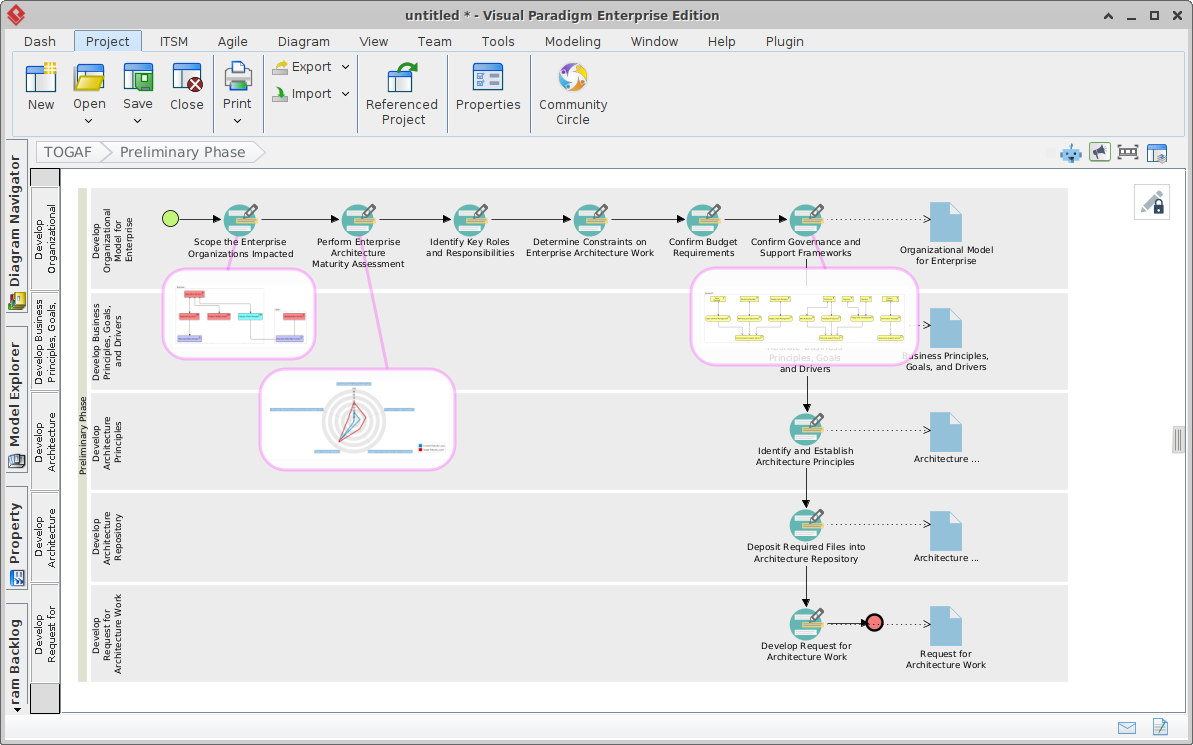
TOGAF ADM Guide-Through Process: Visual Paradigm provides a step-by-step navigator for TOGAF ADM, guiding users through each phase and activity.
Automatic Deliverable Generation: Completing a phase automatically generates TOGAF-compliant deliverables.
Collaboration and Versioning: Enables team collaboration and version control for EA models.
Benefits of Visual Paradigm's Guide-Through Process
Structured Workflow: Breaks down TOGAF ADM into phases, activities, and steps with embedded instructions.
Progress Tracking: Shows completion status for each phase and activity.
Automated Data Transcription: Carries forward deliverables from one step to another.
Integration: Seamlessly integrates EA, project management, and Agile development.
4. The Role of AI in EA Modeling
Visual Paradigm's AI Diagram Generator and Visual Modeling Chatbot
AI Diagram Generator: Uses AI to generate ArchiMate and TOGAF-compliant diagrams based on user input.
Visual Modeling Chatbot: Assists users in creating, editing, and refining EA models through natural language interactions.
Why AI + Traditional Editing is Crucial
AI Alone is Not Enough: Auto-generated diagrams may lack context, accuracy, or alignment with organizational standards.
Human Oversight: Traditional editing allows architects to refine AI-generated diagrams, ensuring they meet specific requirements.
Collaboration: AI can accelerate the initial drafting process, while human experts ensure the final output is accurate and actionable.
Advantages of Combining AI and Traditional Editing
Feature
AI-Generated Diagrams
Traditional Editing
Speed
High
Moderate
Accuracy
Moderate
High
Customization
Limited
Full
Collaboration
Limited
Full
Compliance
Moderate
High
5. Checklist for Choosing an ArchiMate Tool
When selecting an ArchiMate tool, consider the following:
Certification: Is it a certified ArchiMate tool?
TOGAF ADM Support: Does it fully support TOGAF ADM from Preliminary to Phase H?
Modeling Capabilities: Does it support complex diagrams, shared elements, and connection rules?
Collaboration: Does it enable team collaboration and version control?
Automation: Does it automate deliverable generation and provide step-by-step guidance?
Affordability: Is it reasonably priced for the features offered?
6. Practical Steps for Using Visual Paradigm with AI
Step 1: Define Your EA Scope
Use Visual Paradigm's TOGAF ADM navigator to outline your project scope and objectives.
Step 2: Generate Initial Diagrams with AI
Use the AI Diagram Generator to create draft ArchiMate or TOGAF diagrams based on your input.
Step 3: Refine and Customize
Edit the AI-generated diagrams using Visual Paradigm's advanced modeling tools to ensure accuracy and alignment with your EA framework.
Step 4: Collaborate and Review
Share the diagrams with your team for feedback and revisions.
Step 5: Generate Deliverables
Use Visual Paradigm's automated tools to generate TOGAF-compliant deliverables.
7. Case Study Implementation: Global Financial Services Transformation
Organizational Context
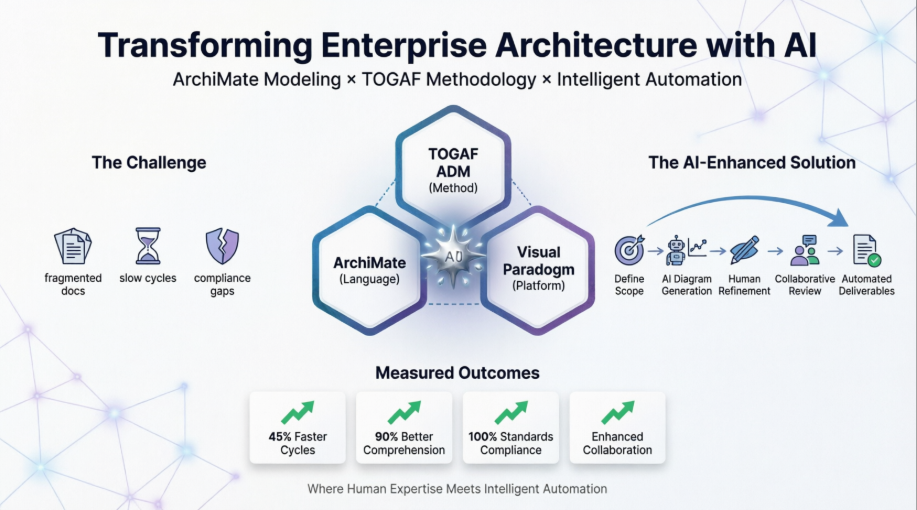
A multinational financial services organization initiated a digital transformation program to modernize legacy systems, improve regulatory compliance, and enable agile product delivery. The EA team faced challenges including fragmented documentation, inconsistent modeling practices, and lengthy architecture review cycles.
Solution Approach
The organization adopted Visual Paradigm as its unified EA platform, leveraging:
ArchiMate 3.1 for standardized cross-domain modeling
TOGAF ADM Guide-Through for methodological rigor
AI Diagram Generator for rapid initial artifact creation
Visual Modeling Chatbot for stakeholder requirement elicitation
Implementation Journey
Phase A (Architecture Vision): The AI assistant transformed executive strategy documents into initial stakeholder maps and capability models, reducing vision documentation time by 60%.
Phase B-D (Business, Information Systems, Technology): Architects used the Guide-Through process to systematically develop layered ArchiMate models. AI-generated baseline diagrams were refined to reflect organizational nuances, ensuring both speed and precision.
Phase E-F (Opportunities & Migration): Automated gap analysis and roadmap generation accelerated planning cycles. Color-coded impact visualizations improved executive communication and decision-making.
Phase G-H (Implementation & Governance): Integrated project tracking and version control enabled continuous architecture governance aligned with Agile delivery teams.
Measured Outcomes
45% reduction in architecture development cycle time
90% improvement in stakeholder comprehension of architecture artifacts
Full TOGAF and ArchiMate compliance achieved across all deliverables
Enhanced collaboration between business, IT, and governance teams through shared visual models
Conclusion
The convergence of standardized modeling languages, structured methodologies, and intelligent automation represents a pivotal evolution in Enterprise Architecture practice. This case study demonstrates that AI-enhanced tools like Visual Paradigm do not replace architect expertise—they amplify it. By automating routine modeling tasks, ensuring standards compliance, and accelerating artifact generation, AI allows architects to focus on strategic thinking, stakeholder engagement, and value realization.
Organizations embarking on EA transformation should prioritize tools that balance automation with human control, certification with flexibility, and methodology with pragmatism. The future of Enterprise Architecture lies not in choosing between human judgment and artificial intelligence, but in orchestrating their synergy. As demonstrated through the ArchiMate-TOGAF-Visual Paradigm ecosystem, this integrated approach delivers architectures that are not only technically sound but also strategically actionable, collaboratively developed, and continuously adaptable to changing business needs.
Reference List
Learning Guides Overview: Comprehensive hub for tutorials on visual modeling, including EA with TOGAF and ArchiMate. Covers diagram layout, element selection, and pinning for precise visualizations.
ArchiMate Resources for FREE: Free resources on using ArchiMate as a visual language in Visual Paradigm for capturing EA relationships and visualizations.
Free UML, BPMN, and Agile Tutorials: Collection of step-by-step tutorials on visual modeling techniques, including BPMN for business processes and UML for EA components in Visual Paradigm.
AI-Powered TOGAF ADM Tool Features: Overview of Visual Paradigm's AI capabilities for automated TOGAF artifact generation and ArchiMate diagram creation.
AI-Powered TOGAF Guide-Through Release Notes: Technical documentation on the AI-driven TOGAF ADM navigator, including automated deliverable generation and interactive assistant features.
AI-Powered TOGAF ADM Guide: Visual Paradigm: Exploratory article detailing how AI transforms the TOGAF ADM workflow through intelligent automation and natural language interaction.
TOGAF AI Assistant Demo Video: Video demonstration of the dedicated TOGAF AI Assistant prompting workflow within the ADM guide-through process.