
In today's interconnected digital landscape, engineering teams face a fundamental challenge: how to design, communicate, and implement complex systems that span software architecture, business workflows, and physical-digital integration. The choice of modeling language isn't merely a technical preference—it's a strategic decision that shapes team collaboration, development velocity, and long-term system maintainability.
This comprehensive guide explores three industry-standard modeling languages—Unified Modeling Language (UML), Business Process Model and Notation (BPMN), and Systems Modeling Language (SysML)—and demonstrates how they serve distinct yet complementary roles in modern engineering projects. Through practical analysis, real-world application scenarios, and tooling recommendations, we'll show how organizations can leverage these standards to bridge the gap between business strategy and technical execution.
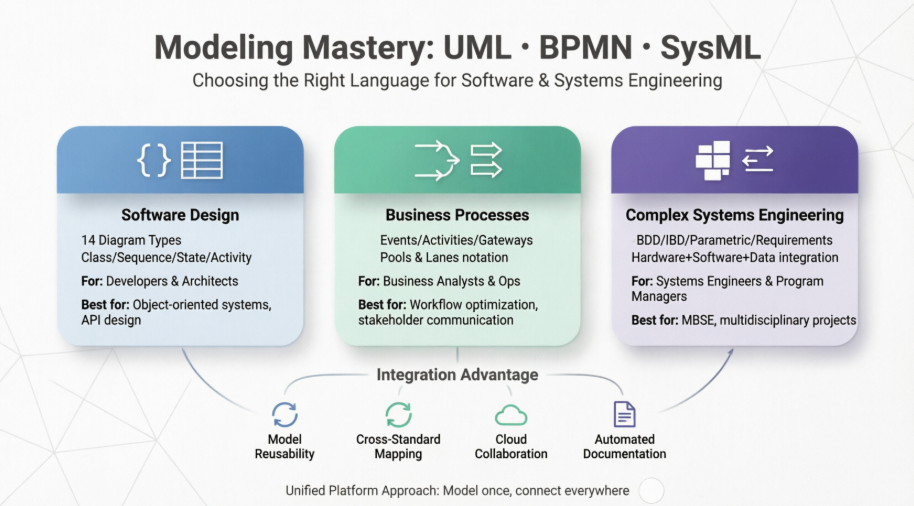
Whether you're a software architect designing microservices, a business analyst optimizing operational workflows, or a systems engineer managing hardware-software integration, understanding when and how to apply each modeling approach is essential for delivering successful, scalable solutions.
Unified Modeling Language (UML) is the industry-standard modeling language for software system design and development. It provides a comprehensive set of standardized diagrams to describe both the static structure and dynamic behavior of software systems.
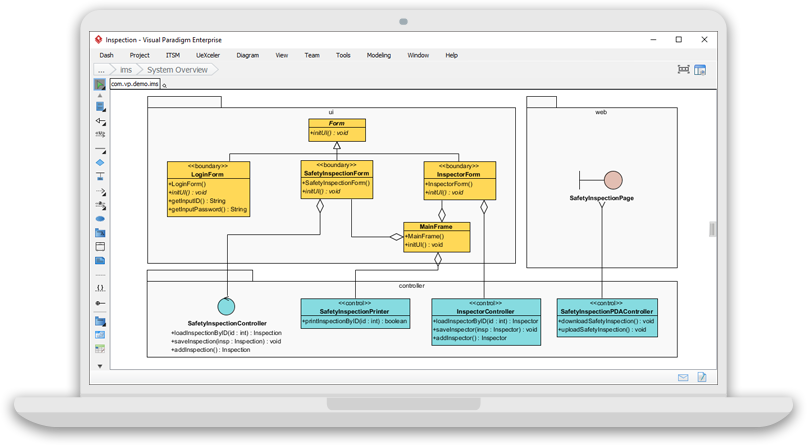
Core UML Diagram Types:
Class Diagram: Visualizes classes, interfaces, associations, and collaborations within a system—essential for object-oriented design
Sequence Diagram: Maps the chronological flow of messages between objects, clarifying interaction patterns and system behavior
State Diagram: Depicts how objects transition between states throughout their lifecycle, critical for modeling complex business rules
Activity Diagram: Represents workflows, business processes, or algorithmic logic using flowchart-style notation
UML's strength lies in its versatility. Whether you're documenting legacy systems, designing new microservices, or specifying API contracts, UML provides the visual vocabulary to make abstract concepts concrete and shareable across technical teams.
Business Process Model and Notation (BPMN) is a graphical notation specifically designed for modeling business processes. It offers an intuitive, standardized visual language that bridges the communication gap between business stakeholders and technical implementers.
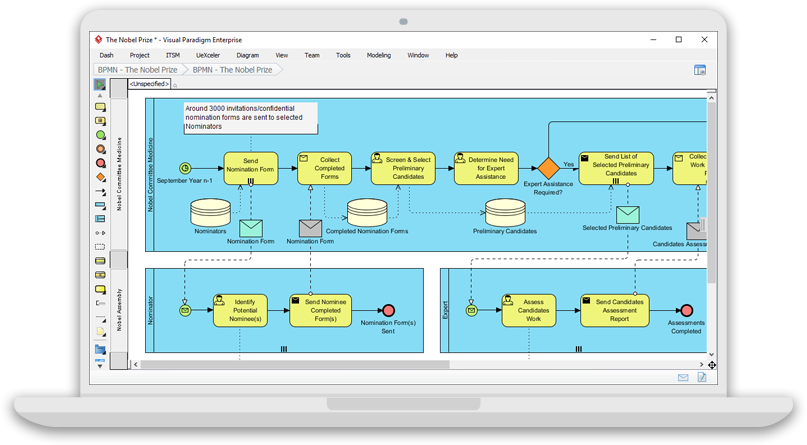
Core BPMN Elements:
Events: Represent triggers, milestones, or outcomes in a process (start, end, intermediate)
Activities: Define tasks, sub-processes, or work units that move the process forward
Gateways: Control decision points, parallel flows, and merging logic within workflows
Flow Objects: Connect elements to illustrate sequence, timing, and dependencies
BPMN excels at making complex operational workflows transparent and actionable. Its standardized notation ensures that process diagrams are universally understandable—enabling business analysts, operations teams, and developers to collaborate with shared context and reduced ambiguity.
SysML is a specialized modeling language for systems engineering, built as an extension of UML. It addresses the unique challenges of modeling complex, multidisciplinary systems that integrate hardware, software, data, and human processes.
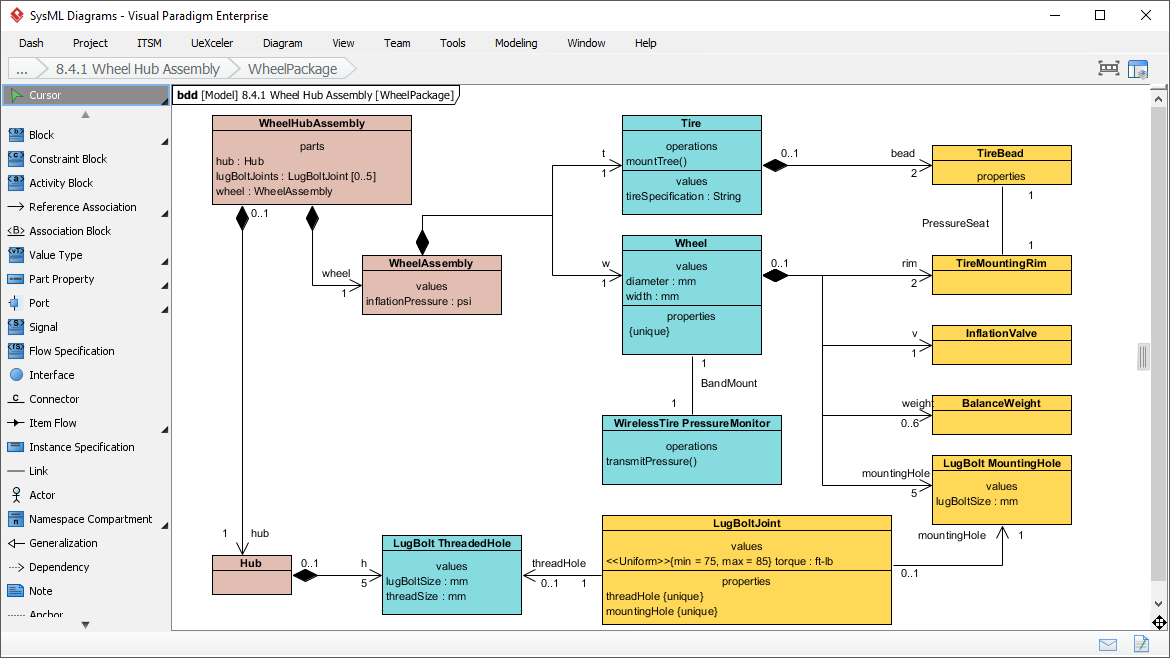
Core SysML Diagram Types:
Requirements Diagram: Captures system requirements, their relationships, and traceability to design elements
Block Definition Diagram (BDD): Defines the structural composition of systems using reusable blocks and relationships
Internal Block Diagram (IBD): Shows how system components connect and interact through ports and interfaces
Parametric Diagram: Models performance constraints, mathematical relationships, and engineering calculations
Behavior Diagrams: Describe system dynamics through activity, sequence, and state machine representations
SysML's power comes from its ability to unify diverse engineering disciplines under a single modeling framework. It enables systems engineers to specify, analyze, and validate complex architectures while maintaining traceability from high-level requirements down to component-level implementation.
| Feature | UML | BPMN | SysML |
|---|---|---|---|
| Primary Focus | Software architecture and behavior | Business process workflows | Multidisciplinary system engineering |
| Key Diagrams | Class, Sequence, State, Activity, Use Case | Events, Activities, Gateways, Pools/Lanes | Requirements, Block Definition, Parametric, Internal Block |
| Best For | Object-oriented design, API specification, software documentation | Process optimization, operational analysis, stakeholder communication | Complex system integration, requirements traceability, MBSE initiatives |
| Target Audience | Software developers, architects, QA engineers | Business analysts, operations managers, process owners | Systems engineers, hardware/software integration teams, program managers |
| Extensibility | Highly extensible via profiles and stereotypes | Focused on business semantics; limited technical extension | Built on UML foundation with systems-specific extensions |
| Integration Potential | Strong with IDEs, version control, code generation | Strong with BPM engines, workflow automation, ERP systems | Strong with requirements tools, simulation platforms, PLM systems |
When to Use Each:
→ Choose UML when designing software components, specifying interfaces, or documenting object interactions within an application.
→ Choose BPMN when mapping end-to-end business workflows, analyzing process bottlenecks, or communicating operational procedures to non-technical stakeholders.
→ Choose SysML when engineering complex systems that span hardware, software, and human elements—particularly in aerospace, automotive, medical devices, or industrial automation.
In modern engineering environments, teams rarely work in isolation. Projects increasingly demand collaboration across software development, business analysis, and systems engineering disciplines. Visual Paradigm addresses this need by providing a single, integrated platform that natively supports UML, BPMN, and SysML—enabling seamless traceability and collaboration across modeling domains.
Key Capabilities:
Complete UML 2.x Compliance: Full support for all 14 diagram types, ensuring standards-compliant modeling for any software design scenario
Intelligent Resource Catalog: Context-aware shape creation that suggests only syntactically valid connections, reducing modeling errors
Round-Trip Code Engineering: Bi-directional synchronization between models and source code—generate code from diagrams or reverse-engineer models from legacy codebases
AI-Assisted Diagram Generation: Leverage natural language prompts to automatically generate Class, Sequence, or Use Case diagrams, accelerating initial design phases
Ideal For: Software development teams seeking to formalize architecture, improve code quality through visual specification, and maintain living documentation that evolves with the codebase.
Key Capabilities:
Standards-Compliant BPMN 2.0: Full notation support including pools, lanes, events, gateways, and data objects for precise process representation
Hierarchical Process Decomposition: Embed sub-processes within high-level diagrams to manage complexity while maintaining drill-down navigation
As-Is / To-Be Comparison: Built-in matrices and versioning to visualize process improvements and track transformation progress
Procedure Documentation Integration: Attach step-by-step work instructions directly to BPMN tasks, generating auditable operational manuals
Ideal For: Business analysts, operations teams, and enterprise architects focused on process optimization, compliance documentation, and digital transformation initiatives.
Key Capabilities:
Comprehensive SysML v1/v2 Support: Full diagram suite including Block Definition, Internal Block, Parametric, and Requirements diagrams
SysML v2 Textual Modeling: Integrated Monaco-based editor for code-style system definitions that synchronize with visual diagrams
Requirements Traceability Matrices: Visual mapping of requirements to design elements with Excel import/export for audit readiness
Allocation Tables: Tabular views for verifying that structural, functional, and performance requirements are properly allocated across system components
Ideal For: Systems engineering teams managing multidisciplinary projects where hardware, software, data, and human factors must be coordinated under a single architectural vision.
| Capability | Business Impact |
|---|---|
| Model Element Reusability | Update a requirement, class, or process step once—and have changes propagate automatically across all diagrams where it appears, ensuring consistency and reducing maintenance overhead |
| Cross-Standard Traceability | Link a BPMN business process directly to UML use cases and SysML system blocks, creating end-to-end visibility from business goal to technical implementation |
| Cloud-Based Collaboration | Enable real-time co-authoring, version history, and visual diff tools so distributed teams can model together without merge conflicts or communication delays |
| Automated Documentation | Generate professional reports in PDF, Word, or Markdown directly from models—keeping documentation synchronized with design and eliminating manual update tasks |
| Toolchain Integration | Connect with Git, Jira, Eclipse, Visual Studio, and enterprise platforms to embed modeling into existing DevOps and ALM workflows |
These shared capabilities transform modeling from a siloed documentation activity into a strategic enabler of agility, quality, and alignment across the entire product lifecycle.
If you're evaluating a unified modeling platform for your organization, consider these foundational questions:
🔹 Team Composition: Which roles will use the tool? (Business Analysts, Software Engineers, Systems Architects, QA, Program Managers)
🔹 Deployment Preference: Do you need on-premise installation for security/compliance, or is cloud-based collaboration acceptable?
🔹 Development Workflow: Do you require IDE integration (Eclipse, Visual Studio, IntelliJ) for round-trip engineering?
🔹 Scale & Governance: How many concurrent users, projects, and models need to be managed? What approval or audit workflows are required?
Answering these questions helps narrow the field to the edition and licensing model that best matches your team's workflow, budget, and strategic objectives.
The convergence of software development, business process optimization, and systems engineering demands more than technical proficiency—it requires strategic clarity about how we represent, communicate, and evolve complex systems. UML, BPMN, and SysML are not competing standards but complementary lenses, each optimized for specific domains yet capable of powerful integration when supported by the right platform.
Organizations that thoughtfully adopt these modeling languages gain measurable advantages: reduced ambiguity in requirements, accelerated onboarding of new team members, improved stakeholder alignment, and more resilient architectures that adapt to changing business needs. The key insight is not to choose one language over another, but to apply each where it delivers maximum value—and to use integrated tooling to maintain traceability across boundaries.
Platforms like Visual Paradigm empower teams to transcend traditional silos by providing a unified environment where business analysts, software engineers, and systems architects collaborate using their preferred notation while maintaining end-to-end visibility. This integrated approach transforms modeling from a documentation exercise into a strategic asset—enabling organizations to design, validate, and evolve complex systems with greater confidence, efficiency, and alignment to business outcomes.
As engineering challenges continue to grow in scale and complexity, the ability to model effectively across domains will become an increasingly critical competency. Teams that invest in mastering UML, BPMN, and SysML—and the platforms that unify them—position themselves to deliver innovative, resilient, and business-aligned solutions in an ever-evolving technological landscape.

