
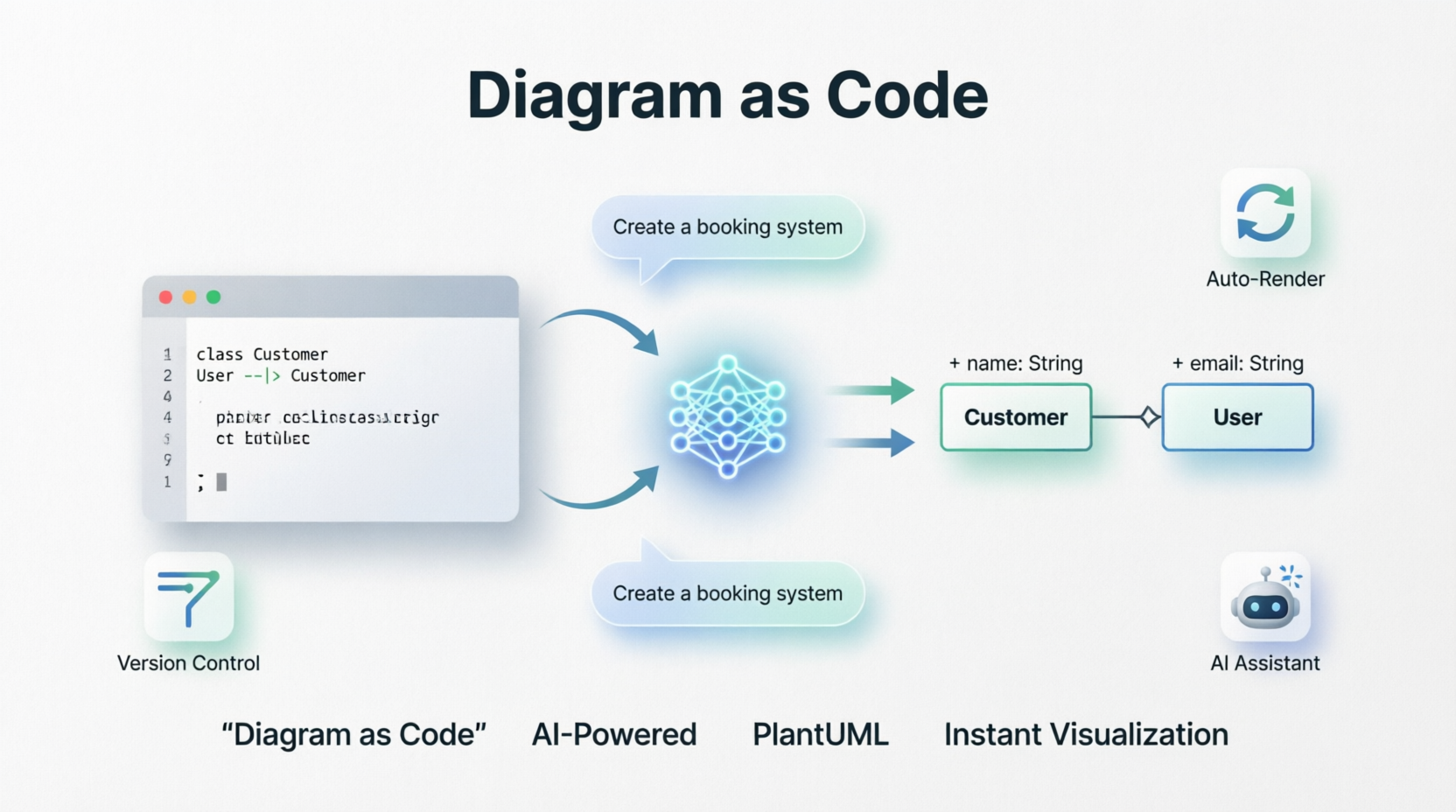
In the rapidly evolving landscape of software engineering, the gap between conceptual design and technical implementation has traditionally been bridged by static diagrams—images drawn manually, often becoming outdated the moment code changes. However, a paradigm shift is underway. Diagram as Code (DaC) is transforming software architecture from static, manually drawn images into dynamic, version-controlled text files. By leveraging lightweight, human-readable scripting languages like PlantUML, developers write code that automatically generates and updates visual layouts.
When combined with Generative AI and advanced tools like VPasCode by Visual Paradigm, DaC acts as an AI-friendly partner. It bridges the gap between conceptual prompt descriptions and formal engineering models, allowing teams to iterate faster, maintain consistency, and leverage the native text-processing capabilities of Large Language Models (LLMs). This case study explores the core concepts of UML Class Diagrams through a comprehensive Food Delivery System example, demonstrating how AI and DaC converge to modernize architectural design.
A comprehensive Class Diagram details the static blueprint of your application. It relies on three structural fundamentals:
+ (Public), - (Private), # (Protected), and ~ (Package-private).| Relationship Type | PlantUML Syntax | Meaning & Lifecycle |
|---|---|---|
| Inheritance / Generalization | `Subclass -- | > Superclass` |
| Realization / Implementation | `Class .. | > Interface` |
| Composition | Parent "*-- "1" Child |
Strong ownership; the Child cannot exist without the Parent. |
| Aggregation | Parent "o-- "1" Child |
Loose ownership; a "has-a" relationship where the Child exists independently. |
| Association | ClassA --> ClassB |
A structural link showing navigation path between two entities. |
| Dependency | ClassA ..> ClassB |
A temporary use relationship; ClassA is affected by changes to ClassB. |
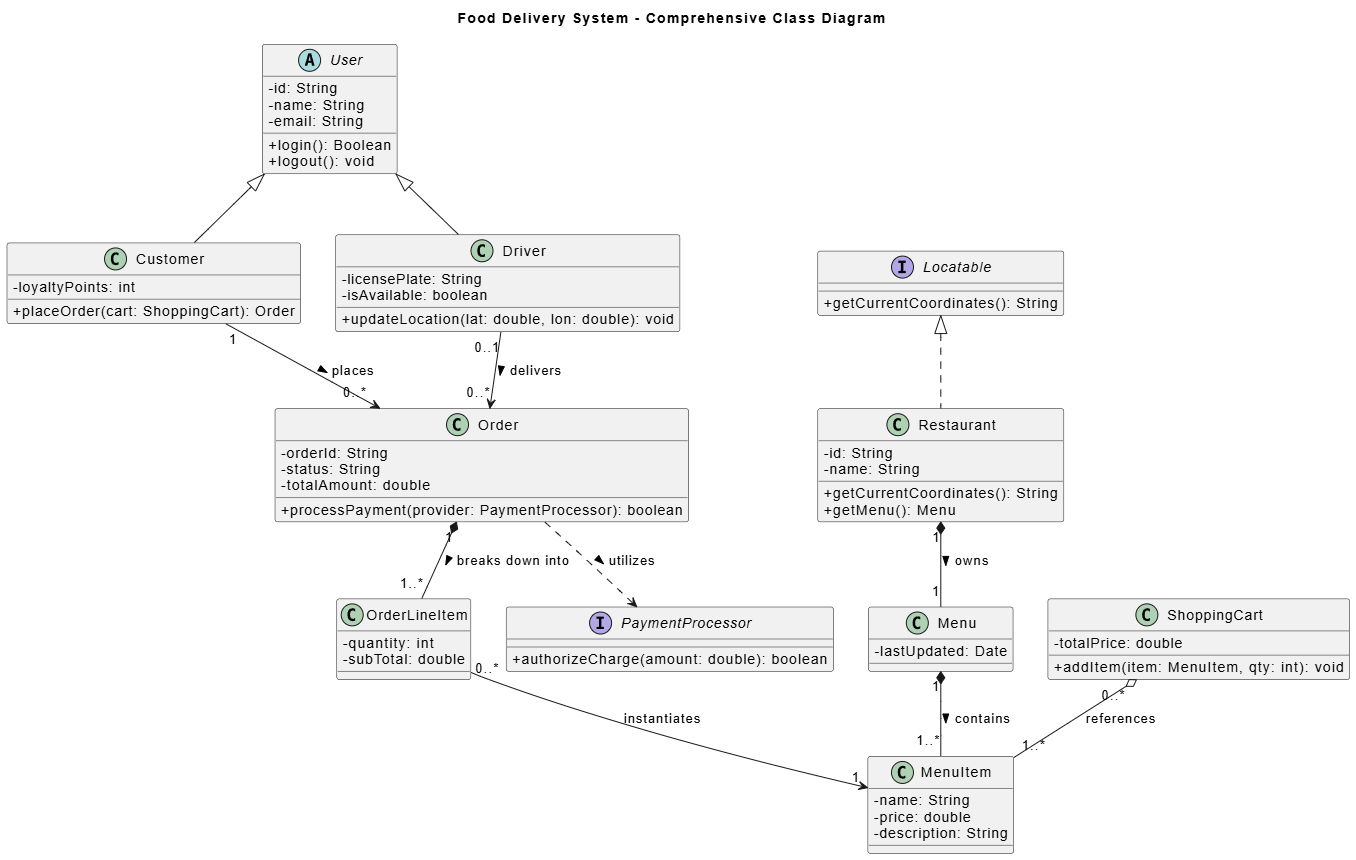
The comprehensive PlantUML example below models a standard food delivery ecosystem. It maps abstract data, inheritance structures, interfaces, and nested entity compositions.
@startuml
title Food Delivery System - Comprehensive Class Diagram

' Styling options for clean visual layout
skinparam classAttributeIconSize 0
skinparam monochrome false
skinparam shadowing false

' 1. Abstract Class & Inheritance
abstract class User {
    - id: String
    - name: String
    - email: String
    + login(): Boolean
    + logout(): void
}

class Customer extends User {
    - loyaltyPoints: int
    + placeOrder(cart: ShoppingCart): Order
}

class Driver extends User {
    - licensePlate: String
    - isAvailable: boolean
    + updateLocation(lat: double, lon: double): void
}

' 2. Interface and Realization
interface Locatable {
    + getCurrentCoordinates(): String
}

class Restaurant implements Locatable {
    - id: String
    - name: String
    + getCurrentCoordinates(): String
    + getMenu(): Menu
}

' 3. Composition (Strong Ownership - Lifecycle Tied Together)
class Menu {
    - lastUpdated: Date
}

class MenuItem {
    - name: String
    - price: double
    - description: String
}

Restaurant "1" *-- "1" Menu : owns >
Menu "1" *-- "1..*" MenuItem : contains >

' 4. Aggregation (Loose Ownership - Independent Lifecycle)
class ShoppingCart {
    - totalPrice: double
    + addItem(item: MenuItem, qty: int): void
}

ShoppingCart "0..*" o-- "1..*" MenuItem : references

' 5. Association & Multiplicity
class Order {
    - orderId: String
    - status: String
    - totalAmount: double
    + processPayment(provider: PaymentProcessor): boolean
}

Customer "1" --> "0..*" Order : places >
Driver "0..1" --> "0..*" Order : delivers >
Order "1" *-- "1..*" OrderLineItem : breaks down into >

class OrderLineItem {
    - quantity: int
    - subTotal: double
}

OrderLineItem "0..*" --> "1" MenuItem : instantiates

' 6. Dependency (Temporary Interaction)
interface PaymentProcessor {
    + authorizeCharge(amount: double): boolean
}

Order ..> PaymentProcessor : utilizes >

@enduml
(Note: The above code block represents the textual definition. In a DaC environment, this text is rendered into the visual diagram shown in the original source materials.)
Looking for a powerful, free diagram-as-code tool? Effortlessly render PlantUML, Mermaid, Graphviz, and 20+ programming languages in real time—powered by instant AI error fixing and automatic format detection.
AI cannot manipulate mouse coordinates on traditional drag-and-drop design canvases reliably. However, text strings are the native language of Large Language Models (LLMs). This compatibility drives several developer workflows:
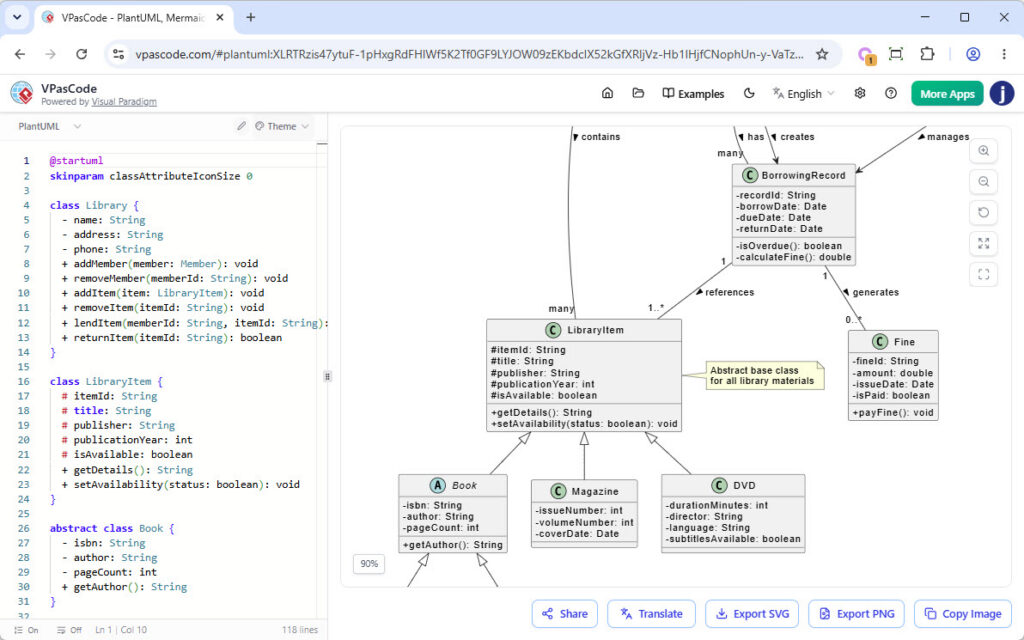
Visual Paradigm's VPasCode is a cloud-based platform designed specifically for this text-to-diagram workflow.
The integration of Diagram as Code with Generative AI represents a significant leap forward in software architecture design. By treating diagrams as version-controlled code, teams can ensure that their architectural documentation remains living, breathing artifacts that evolve alongside their applications. Tools like VPasCode lower the barrier to entry, allowing developers to focus on structural logic rather than visual formatting. As AI continues to mature, its ability to interpret natural language prompts and convert them into precise UML models will further accelerate the design process, making high-quality architectural visualization accessible to all members of the development team.

